
Bourbon & Beyond has gotten big. It has grown from a two-day, 50,000-person festival that began in 2017 at Louisville’s Champions Park to a massive four-day festival that takes over the grounds of the Kentucky Exposition Center, hosts approximately 145,000 attendees, and generates an estimated $13.8 million. You can no longer easily check out most bands, drop in for an informative bourbon tasting at the Fork & Flask stage, relax amongst the art installations, grab bourbon cocktails and swag from dozens of Kentucky bourbon producers, and have a few moments to just enjoy your festival crew. So now, you have to make choices, but the options are endless and all worthy.
The festival has five stages — two pairs of side-by-side large stages and a smaller bluegrass stage nestled inside of a bourbon bar with 14 bourbon producers, each offering their take on the perfect whiskey cocktail. The main stages, called “Oak” and “Barrel,” are laid out as mirror images of each other. There is a similar pair of stages at the other end of the festival grounds called “Revival” and “100 Proof”. Each pair has music going continuously, from open to close, except for a five-minute changeover between acts, which gives festers time to walk 15 yards to their right or left if they want to watch the next band at that pair of stages. It also gives the sound engineers and roadies time to strike and set up the next act on one stage while a band performs on that stage’s twin.
So what was special?
Thursday – Day One
Congress the Band made the most of their 30-minute set. This young, 5-piece band out of Charleston, South Carolina was having so much fun on-stage that it was palpable to all of us in the crowd. With a full, indie rock-driven guitar sound led by craggy-voiced William Bennett, they ran through a selection from their first album but ending with an excellent new song, “She Love Me For What”. We will be looking for them to tour near us.
Langhorne Slim played an early 30-minute set on one of the main stages, which was plagued by microphone and sound problems and started at least 10 minutes late. Nevertheless, he lived up to his reputation as an animated performer with a great blues-adjacent backing band. When the microphone cut out, he jumped down off the big stage into the crowd so people could hear him. At one point, a super fit random fan popped him up on his shoulders and walked him through the crowd that had huddled around him. The festival did give him five minutes of extra time, but after that 5 minutes, they cut his mic (and the feed to the band). Slim was unfazed, and he and the band all continued to play, acoustically, until the end of the song.
With only a 45-minute set, Linda Perry of 4 Non Blondes could have played her stellar 1991 album Bigger, Better, Faster, More! front-to-back, and one thought she might, as she started with the classic album’s first track, “Train”. But instead, Perry introduced the crowd to her new material, recorded but as yet unreleased. The crowd was fairly receptive though she did have to implore them to sing along to a new song “like it was “What’s Going On”. She finally closed with her anthem, and the crowd swayed and sang every word. The old stuff is brilliant; the new songs sound great; looking forward to their release and a long enough performance to see them combined live.
The War on Drugs features Adam Granduciel on guitar and lead vocals and a group of six versatile musicians who move around the four keyboards and numerous guitars on stage. This gives them a noticeably full sound, like a giant wave of thick music washing over the crowd. Granduciel thanked the crowd briefly, and graciously fit as much music into their 55-minute set as was possible.
Queens of the Stone Age can still bring it. Their hard-rock sound, which emerged from Seattle in the nineties, still holds up. They walked out to the ironic intro music, “Afternoon Delight”, but soon turned it into the hard-rocking grunge sound they are known for. They played some songs from their 2023 release, In Times New Roman…, like “Paper Machete”, but also mixed in some older crowd favorites, finishing with their 2002 hit, “A Song for the Dead”.
But there was more: the Stanley Simmons (Kiss offspring) band had a great set of solid rock and deserves a listen; Cheap Trick still brings it; Goose played a less jammy set than usual to shoehorn them into their 55-minute timeslot; Sierra Hull showed her mandolin prowess; and Foo Fighters headlined, and these reviewers continued to be underwhelmed by the band.
Friday – Day Two
Friday’s lineup tilted to pop rock and had these reviewers running ragged, doing the long walk between the two big stages endlessly to catch what we thought might be the best.
Nathan Bess was up first for those that came early. This singer-songwriter’s stripped-down show – deep-voiced Bess on guitar crooning songs about life in Appalachia accompanied only by a female stellar fiddle player – was solid, and he was one of the few who was not stressed by the short set and offered some thoughtful stage banter. He has a full-time job, two EPs and a few opening slots in arenas, but we are looking forward to hearing more from Bess.
Virginia’s Palmyra also played a fun set of upbeat folky/poppy rock on the smaller stage. They seemed to love being on stage and played their hit, “Arizona,” with their crowd singing along at the top of their lungs and cell phones recording all over the place.
Ben Chapman impressed these reviewers with a guitar-driven, atmospheric southern rock set that covered many bases – bluesy, slide, funky, spacey, hard – and sounded much more intense than his recordings. The Nashville-based band is reminiscent of both Dead Confederate and Andrew Duhon.
Amigo the Devil had the crowd in stitches with his banjo-forward form of folk rock and his clever lyrics and stage banter. He finished his set with the crowd singing along gleefully to “Hell and You” with a chorus meant for a sing-a-long – “Cause I’d rot in hell with you if you’d just ask me to. I love the shitty things we do together, live with me in this sin forever.”
The Flaming Lips are a festival favorite with their quirky songs and elaborate blow-up props, which included four 40-foot inflatable robots, an eight-foot star head mascot, dozens of giant blow-up balls that were thrown into the audience, and many more. The crowd had a blast, singing along and participating with the Flaming Lips’ brand of performance art.
Mumford & Sons played a spirited set, and their energy and range of hits justified their headline status. They are pushing their Prizefighter release and touring relentlessly. One gripe is that their performed songs sound exactly like their recorded work. They did try an intimate version of Paul Simon’s “The Boxer”, but it sounded very thin. But they had the crowd, and clearly their songs resonate.
There were other solid performances by country rockers Jason Scott & the High Heat; great harmonies by the Rainbow Girls; the old-time country sound of Shelby Means; and the flamboyant, emotive singing of St. Paul & the Broken Bones.
Saturday – Day Three
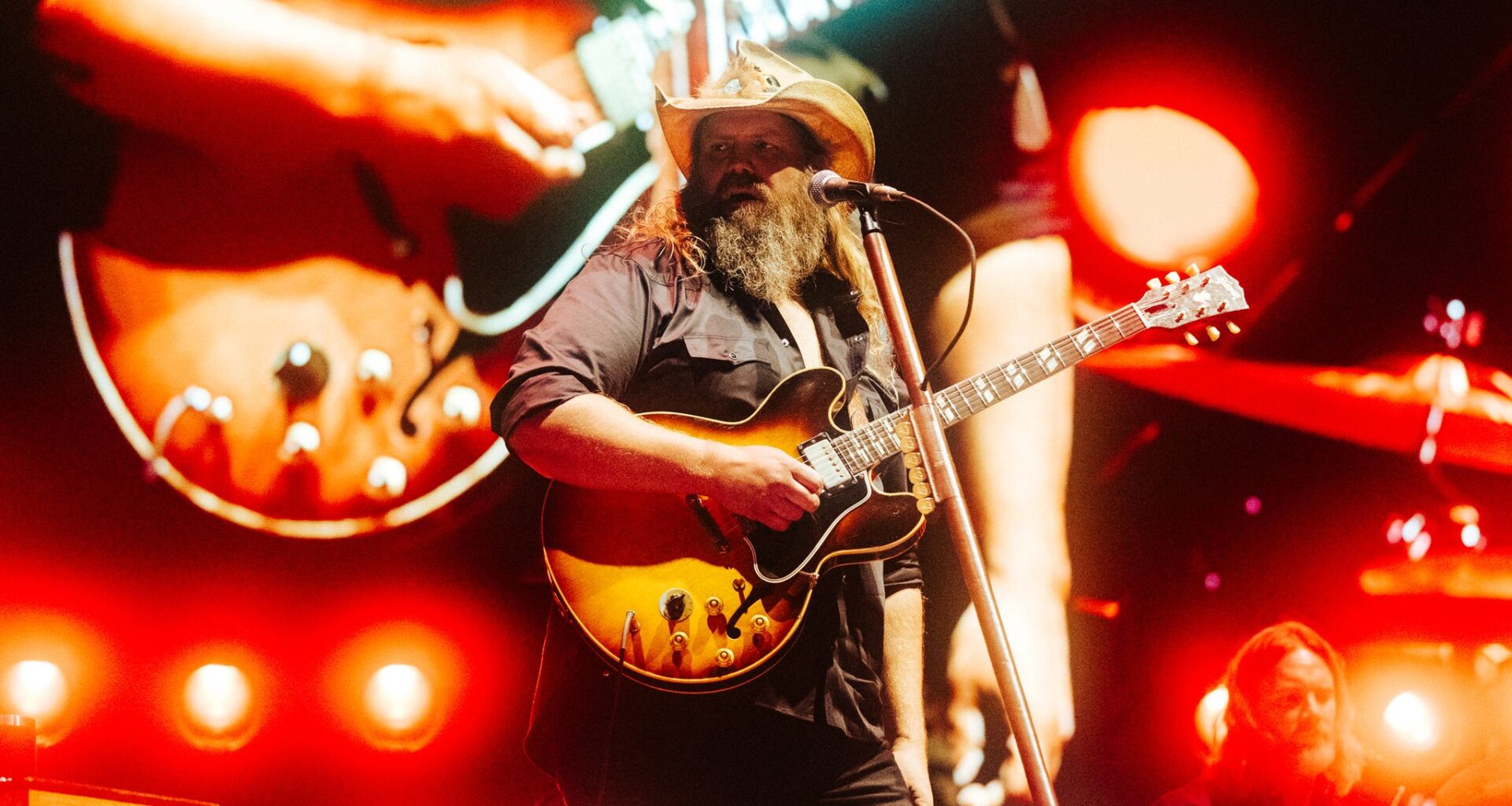
The third day was headlined by Chris Stapleton, and the day’s acts seemed a little tilted toward the countryside of the musical spectrum. Stapleton is not a showman, but he delivered a wonderful wall-to-wall set of lustrous, guitar-driven country rock and blues that he is famous for. He played 18 songs from all aspects of his career. He started the set with two scorching, rocking blues numbers: “Bad As I Used To Be” from the 2025 Soundtrack of the movie F1; and “Arkansas” from Starting Over, which he released in 2020. He also leaned on his earlier work with “Parachute”, “Traveler”, “Tennessee Whiskey”, “Nobody To Blame”, and “Fire Away,” all from Traveler, the first record he released in 2015.
He played plenty of newer songs too, with “White Horse” and “Think I’m in Love with You” really standing out. Although he played almost the entire set without stage banter, he did share a wonderful moment with the audience while introducing the band in an extemporaneous song, including phrases like “They call him the San Francisco treat, which is geographically inaccurate, as he is really from San Jose,” when introducing keyboardist Mike Webb. Another one that got a laugh from the crowd was his soulful introduction of bassist J.T. Cure, which included the phrase, “he hates beachballs almost as much as I hate beachballs,” as a beachball passed by his sight line in the crowd.
Cracker had some sound problems, but made the most of their criminally short 35-minute set on one of the smaller stages. The crowd was waiting for them, as they seemed to know every word to the first six songs they played; “Euro-Trash Girl” and “St. Cajetan” showcased the yearning and quirky nature of David Lowrey’s songwriting. They then launched into their two biggest hits, “Teen Angst (What the World Needs Now)” and “Low”. They still tour, and Lowrey still writes new music, and they are well worth seeing if they play near you.
Jason Isbell and the 400 Unit offered up an excellent ten-song set, a good mix of Isbell’s poetry and guitar-driven southern rock. The crowd knew every song and sang along, but Isbell could have played any other ten songs, and they would have known them; his catalog is that solid. His last two songs demonstrated his mastery of songwriting, his voice, and his instrument perfectly, as he closed “This Ain’t Me” with an extended guitar jam before starting “Cover Me Up” solo, with the whole band kicking in to close the set. Again, why only one hour? Oh, because we still have two more bands to come.
The Red Clay Strays delivered an excellent set, packing 15 songs into their 70-minute time slot. A five-piece band from Mobile, Alabama, led by Brandon Coleman, whose distinctive voice drives every song, they augmented their already full sound with an additional guitar and B-3 organ, plus three gals belting out soulful backing vocals. Drawing heavily from their newest release, with seven songs from Grateful, the crowd still knew every word. Particularly stellar were two songs that highlighted mental health, “Drowning” and “Devil in My Ear”. Coleman speaks little from the stage and has a very understated manner, letting his voice and the songs present themselves, but perhaps let it be known that he tires of their big hit, as he introduced “Wondering Why” with something like “ok, I guess we gotta play this now”. The band is tight and having a lot of fun on stage even though they are in the middle of what seems like an exhausting tour.
Jessie Murph delivered an extremely intriguing performance that had these reviewers and the entire crowd on the metaphorical edge of their seats. She came out dressed in what looked like a white babydoll nightgown and an oversized blue house coat and strutted awkwardly around the stage with a particularly mischievous look in her eye.
Things really got interesting when she announced before her third song, “This is the part where I paint a fan,” and she had her friend/roadie bring a volunteer from the crowd on stage, sat him in a chair, made him take his shirt off, and seductively and maliciously painted 60% of his face and 40% of his torso while singing “Dirty”. She thanked him and gave him a hug, which left blue paint all over her dress, in her jet-black hair, and even on her carefully made-up face. She spent the rest of the set walking and crawling around the stage, which kept the audience riveted as we worried that anything could happen next. Her set wasn’t all about theatrics; she had a beautiful, powerful voice that conveyed the feelings of betrayal, anger, and sensual joy that dominate her songs.
There were some other solid performances by country hip-hop artist Atlus; traditional country singer Kaitlin Butts; young Montana country-pop band Buffalo Traffic Jam; bluegrass-leaning Still Unknown; and outlaw country Rattlesnake Milk.
Sunday – Day Four
Just to add to the fun, B&B has an outfit theme each day. Sunday’s was “90s Grunge,” perhaps to add to the full complement of 90s bands that filled most of the schedule. (Note that Friday’s theme was “Animal Print,” and so many festers sported at least one animal on their clothing that these reviewers wondered if they had missed a revived fashion trend.) This crowd also swapped out the cowboy boots for sneaks, whether because it was day 4 of B&B or just because it was not the past 3 fest days of country-oriented rock.
There was a full complement of ’90s bands celebrating the 30th anniversary of the hit that put them on the map. – The Verve Pipe, Tonic, Paula Cole, Vertical Horizon, Lisa Loeb, Counting Crows, Hootie & The Blowfish – but it was great to also see the 90s bands that have continued to play and create new music like Joan Osborne, Edie Brickell (now leading World Famous Pets), Our Lady Peace, and of course, headliner Dave Matthews Band.
Jesse Welles provided the festival’s first overtly political set (at 5:40 pm on Day 4), a key element of his music. Starting with “Nerd Reich”, “Join ICE”, and “Masks Off”, he added Black Sabbath’s “War Pigs” and turned Tom Petty’s “Won’t Back Down” into a protest song. He lightened the mood, closing the show with his latest release, “Bugs”, a cute ditty about loving all creatures, including bugs. He doesn’t pull any punches and cleverly mixes his political take with biting lyrics and well-crafted music.
The Dave Matthews Band isn’t everyone’s cup of tea, and he is terrible at stage banter, but no one can deny that he puts everything he has into his performances. The same was true of this festival’s closing set. He rocked the festival crowd, many of whom had been on their feet for all four days and guarding their rail since they ran in the doors at eleven that morning, for just shy of two hours. He opened with “Don’t Drink the Water,” which he warped into Woody Guthrie’s “This Land Is Your Land.” As the moon rose over a perfect Louisville night, he continued to furiously strum his way through some of his most famous songs (“So Much to Say”, “Too Much”, “Satellite”, “Jimi Thing”, and “Ants Marching”). He also fit in a few covers, including Bob Dylan’s “All Along the Watchtower” Jimi-style mashed with Led Zeppelin’s “Stairway to Heaven”, and “Word Up” by Cameo. There are times during his performance that the song felt too full — all the instruments furiously playing at once can feel too crowded, but for the most part, the band sounded great.
The biggest ovation of the festival may have been given to country jamgrass phenom Daniel Donato’s Cosmic Country, which played for 45 minutes on the Bluegrass Situation stage in the Bourbon Bar. He worked the audience up to a lather with his brand of high-energy, country-infused funk. There was more dancing in that tent during that set than these reviewers saw at the entire festival. The last two songs were especially upbeat versions of Willie Nelson’s “Whiskey River” and Donato’s “Dance in the Desert,” which had everyone in the tent dancing, high-fiving their neighbors, and celebrating a joyous set of music. When they finished, the band got an elongated and well-deserved standing ovation.
Our Lady Peace is a Canadian rock band that had their biggest hits, “Superman’s Dead” in 1997 and “Starseed” in 1994. They are fronted by and get their signature sound from their lead singer, Raine Maida, who has one of the growliest voices this side of Mark Lanegan. They managed to fit seven songs into their 40-minute set, which featured many fans singing every word of every song and a few others waving Canadian flags. Although they have about a dozen albums to their name, it was the first time these reviewers had encountered them, and as one of their fans put it, they may be, “the best Canadian rock band in history”.
Tonic fit the bill of the 90’s nostalgia act to a tee. They managed to fit six songs into their allotted 30 minutes, and none of them were released after 2002. That said, the band was well-rehearsed, sounded good, and added wrinkles to the recorded versions of their songs. Before Emerson Hart (lead vocals and guitar) launched into the song that put them on the map, he told the audience the story about how he wrote it as a know-it-all 21-year-old: “I fell hard for a woman, and things moved really fast. I called my mom to tell her that we were getting married, and she told me that was a terrible idea. I responded, “If you could only see the way she loves me, maybe you’d understand. The song wrote itself and changed my life. My mom was right, though; the relationship was a complete disaster, so listen to your mother.” Then they launched into a great version of “If You Could Only See,” with the crowd singing and recording every word.
Aside from Jesse Wells, there were very few political statements at this festival. It’s not clear if this was a reaction to Macklemore’s well-publicized political statements on Ed Sheeran’s tour or just the bands’ choice, but these reviewers noted few overt statements beyond a classic protest song here or there or a tweaked lyric (like DMB not only inserting “This land is your land” into his opening song but singing The Gulf of Mexico in place of the Gulf Stream Waters).
There were two more stars of this festival: One was the weather. Just a week prior to Bourbon & Beyond at the Louder than Life festival, temperatures soared into the 90s, but over the four days of the festival, highs just touched 80 degrees, and evenings dropped into the pleasantly cool mid-60s with beautiful breezes. The other unsung hero of the festival was the friendliness displayed by almost every crew member and patron.