
Still, they may find themselves swayed by the allure of the school’s culture. In 2025, Srinivasan officially launched the Balaji Fund, which operates as a “rolling fund” to which accredited investors can contribute by subscription, which offers more flexibility than a typical venture fund. Angel investments are put towards “on-thesis deals.”11 This means Srinivasan sources pitches en masse from aspirational founders and distributes the funds at his discretion. On one level, the school acts as a hub for generating infinite pitch decks delivered straight to Srinivasan in-house (in-hotel). Each week, he holds office hours in ten-minute slots, where members can pitch him on whatever scheme has transpired in their state of intensive incubation. Someone wants to vibe code an app that tells you where the closest public toilets are anywhere in the world.
These meetings happen in portable work pods next to the concierge in the hotel lobby. Meanwhile, occasional friends of the Sultan of Johor filter in and out of the front doors next to a grand piano that repeatedly autoplays Ludwig van Beethoven’s Für Elise. This is maddening. But, you will be told by the team of friendly Filipino call-center girls who work a night shift in the lobby, the piano eventually is shut off. Sent as a group by their biotech startup, the girls work unfathomable hours to rendezvous with clients mostly based in the US. They mention that their work currently consists, in large part, of training an AI chatbot to automate customer service tasks. The majority of the team has already been cut. For now, the remainder are enjoying the all-expenses paid work trip, which works so long as they do not actually leave the hotel. Forest City is, after all, a splurge for someone with even a halfway decent wage measured against the Philippines’ GDP. Plus, the buffet attendant doesn’t raise an eyebrow when they smuggle platters of pastries and delicately sliced fruits back to their hotel mini-fridge for a Blueprint-alternative meal during the night shift.
If you have ever identified as chronically online, mealtime conversations at the school will humble you. You will learn the delicate turns of phrase that one must employ to signal belonging at NS, as if appealing to a high school clique. He’s cracked. She’s locked in. New forms of language replace the rules of regular conversation inside of the walls of the hotel. In fact, aside from the first-day ice breaker, where someone from the school’s team will instruct you to line up across the café based on how much you align with a set of statements (college is a scam, Bitcoin will outlast the Federal Reserve, a universal basic income would make people stop working, etc.), substantive discussion of events in the external world hardly ever shows up.
At one level, this makes sense. Network State presupposes that “opting-in” organically produces ideological alignment so that you can skip the first principles chat and get to the mind-meld stuff. But even at its most lucid moments, the table talk just barely coheres into general ambivalence around institutions and elite control, bending towards right-wingish memes that boil down material politics until they are as soggy and generic as the Blueprint meal rotation.
But usually the conversation is more debased. You will learn that there is a parallel reality running alongside the ordinary one, that human cognitive symbiosis with ChatGPT is so complete that it seamlessly replaces the need for the internal reasoning dialogue. You can actually just talk to it through your phone, without the text box interface. How many grams of protein in one serving of chicken thigh? Ask GPT. Do I need to have an exit flight already booked to clear the Tuas checkpoint customs? Ask GPT. Did I dislocate my shoulder in the NS Cup volleyball championship match? Definitely just ask GPT. The theorist Walter Ong famously argued that the age of electronic information processing was instituting a “secondary orality,” in which oral communication is dialectically transformed in its relation with text. Whereas primary orality promotes a sense of immediacy because the reflective distance afforded by text is not yet available, secondary orality “promotes spontaneity because through analytic reflection we have decided that spontaneity is a good thing.”12 Another verb for spontaneous decision-making is vibe, as in the sensibility of a good venture capital bet. If it remains rather inscrutable what most of the people at the school spend their time building, this is perhaps because you aren’t properly attuned yet.
To be clear, I never see anyone ship anything, but crypto reaches an all-time high. I meet an Italian ex-philosopher who quit academia for trading. He wrote a dissertation on G.W.F. Hegel but now he is developing a Marxist theory of Srinivasan where the members of the school are the new proletariat of a global elite. He tells me Srinivasan is an alchemist practicing in a state of nigredo, where the rotten elements of society must be decomposed and made to die before the new higher-order stage can be born. With the proper mixture of magic and discipline, the guru will transmute dark talent into gold.
Network School members turn to Srinivasan to be enlightened. Gurus were, after all, religious mentors—literally the “dispellers of darkness” in Sanskrit—before they were secular prophets who promised to deliver us from the existential anxiety of being chronically online. Gurus, alongside influencers, fitness coaches, and consultants, are a new category of expert who offer, in scholar William Davies’s terms, “toolkits and advice on how to navigate and act upon a constantly changing and unpredictable environment.”13
Still, despite global unpredictability, everything at the Network School seems unchanging, as cyclical as clockwork. The digital nomad’s day in the life strings together hourly tasks into a pattern of protracted precariousness, forming a contingent disposition that threatens to cave at any moment. I am, admittedly, unable to key into the flow. The Bryan Johnson meal plan gives me chronic IBS. I request a room on a higher floor in the hotel, to escape both the pressing mold issue and my assigned roommate, who has taken to filming “get ready with me: my morning routine living in a solarpunk utopia” videos in the bathroom for hours each day. The “earn” section of the NS portal, where I am supposed to be able to complete tasks like “create a high-quality 59-second video explaining Peter Thiel’s Zero to One” for crypto prizes, never actually works for me.
TBD City
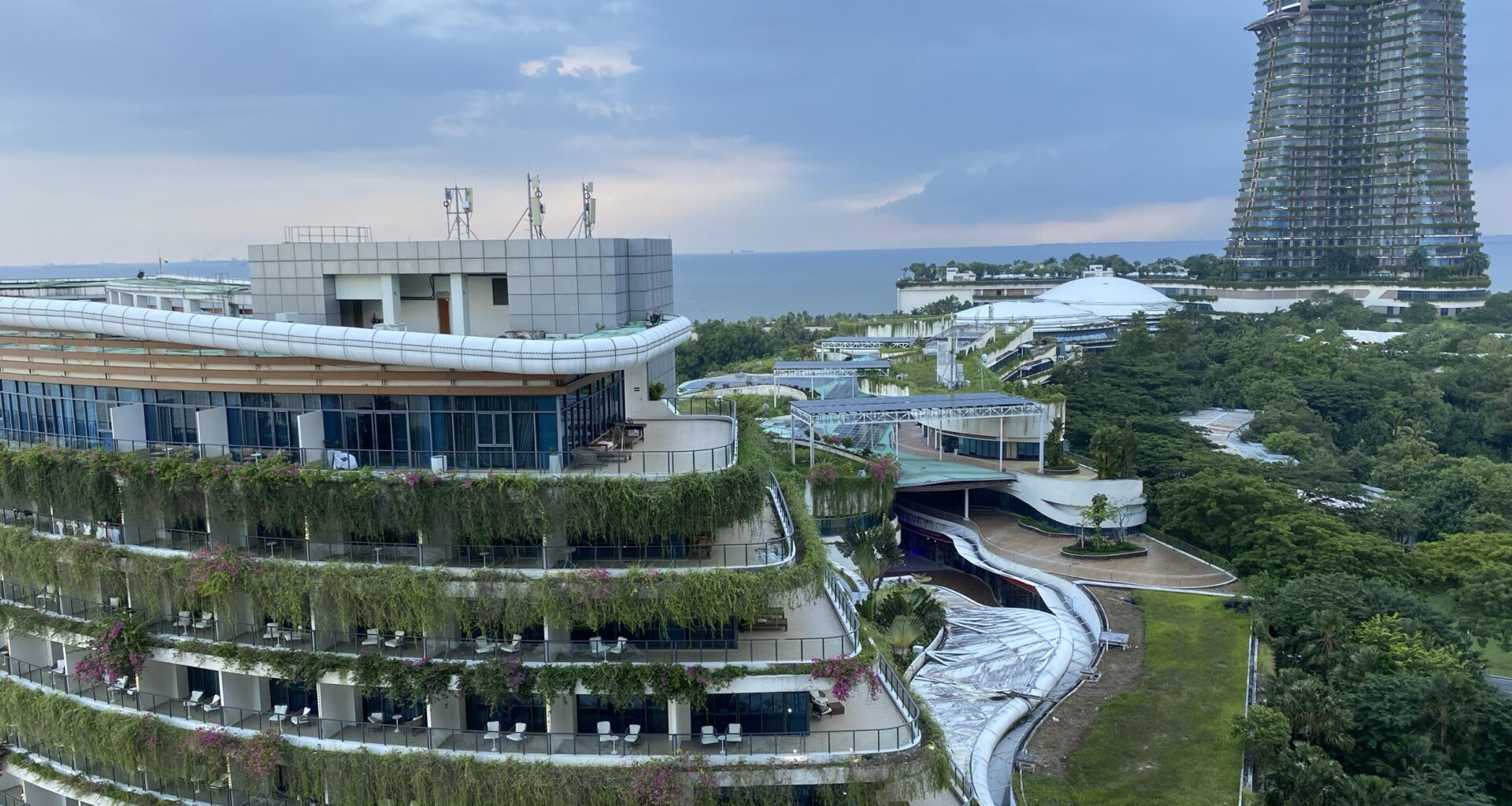
At one point, it seemed plausible to me that Network School took inspiration from Forest City, a development project itself well practiced in the art of the corporate pivot. The city has been an emblematic shapeshifter, defying all conventional meanings of the term “ghost city.” This typically evokes images of an abandoned settlement: fossils of roads, buildings, or other infrastructure that testify to once-fertile economic hubs left behind as capital moved on to alternative paths of less resistance. But such images don’t capture what has happened in Forest City since construction began in 2015 as part of an investment agreement under BRI financed by Country Garden Holding Co. Ltd. The projected 700,000 residents never arrived, nor did the speculated returns. Many of the vacant lots bear wooden signs indicating the city’s perpetually anticipatory stance: “TO BE DEVELOPED.”
The city was roundly hated from the start. Local activist groups contested its destructive biodiversity impacts as sand was mined from surrounding islands in the Malay Peninsula and dumped in local fishing grounds without environmental assessments. Several planned islands were never even built, and others formed massive sinkholes as a result of cost-cutting construction and poor irrigation design, caving in portions of the roadway and forming tiny lagoons that now teem with monitor lizards. A small “Eco Museum” next to the hotel displays infographics touting the innovative design that enables Forest City to recycle domestic sewage and wastewater. Meanwhile in the hotel, large coolers are constantly refilled with cheap disposable plastic water bottles for thirsty digital nomads to crush between badminton and beach volleyball, and thousands of plastic plants snake up the pillars of the lower decks of the open-air mall to provide visitors with cool shade and ambiance. The mall’s duty-free liquor shops sit stocked to the brim with merchandise and display handwritten signs: “Sorry, only selling tea and perfume.” Exploited by smugglers and frowned upon by the Sultan, the alcohol tax exemption was revoked as quickly as it was declared.
Meanwhile, the double threat of the Chinese real-estate market bubble and COVID restrictions in 2020 meant that the little foreign investment that showed up all but dried up. The nationalist administration of Mahathir bin Mohamad saw a state-backed push to “Malaysianize” the city, but this did little to ameliorate its steep living costs, leaving most of its workers to commute in from the surrounding Johor region to pick up the copious trash that washes up on the beach. Occupied high-rises remain few and far between, judging from the occasional lights that dot the matrix of black windows in Forest City’s nighttime skyline. Some move here to send their children to the elite international school, one of the city’s handful of functional assets. There are also commuters who work office jobs in higher-paying Singapore before returning to their families in Johor or Kuala Lumpur over the weekends. In the hotel, digital nomads’ rooms are turned over each day by Bangladeshi workers whose salaries are high for the region but not enough to meet the low-end cost of an apartment unit, about 510,000 MYR, or $125,000.
There is a truly horrid term in the crypto world that comes to mind: “HODL.” It means “hold on for dear life.” HODL says ignore short market fluctuations and keep your eyes on the long game. Despite its rampant failures and contradictions, Malaysia HODLs Forest City by adapting policies of privatization and deregulation and linking them to narratives of national economic and political power. Just prior to giving Srinivasan the boot, the country launched a national Special Financial Zone strategy that plans to reinvent Forest City as a mixed-use hub for financial services and family offices for transnational elites, while the adjoined Johor region is to become a home for AI hyperscalers due to its cheap land, labor, and water supply. One scholar of Malaysia’s political economy describes its polity as “neoliberal authoritarianism” to encapsulate how government officials have used political control to push for corporate growth and global trade while suppressing political dissent and democratic development since the 1970s.14 Economic growth, after all, depends on the careful maintenance of political stability, and this applies equally to communist and democratic political dissent, as to foreign investors who overstep constraints set by their host. The governing coalition’s legitimacy with its Malay-Muslim majority, for example, means that its solidarity with Palestine is not marginal, and the Network School’s parasitic dependence on the broader polity is not something that can be obfuscated no matter how much it brands itself “a solarpunk utopia on an island near Singapore.”
One day during my time in Forest City, I left to visit a doctor, due to the Bryan Johnson-induced IBS, and accidentally boarded a shuttle headed towards LEGOLAND in Johor. I was picked up next to a secluded megamall by an amused Grab driver, a friendly woman who told me about crossing the border daily for twenty years for twelve-hour shifts at Changi Airport in Singapore. Lost in recollecting Changi’s hyper-surveillant work atmosphere, she missed Forest City’s private entry gate and looped back through the swampy grassland, now repurposed as a popular luxury golf course. Forest City, she tells me, looks like a city, but it is rural. By this, she means that it seems culturally backwards, outside of the forces of historical progress despite its futuristic claims.
After the California ideology
Much like the cities Srinivasan is attracted to, the school seeks to deploy images of social improvement to absolve its inherent contradictions. What is striking is how the school involves its members in the continuous reproduction of their own Potemkin villages. At the 2025 annual Network State conference, one speaker referred to “pop-up villages,” and explained how a successful partnership resulted in Kazakhstan’s first “Solana Economic Zone,” which has since expanded to plans to support Alatau City, a planned eight-billion-dollar “smart megacity” with a dedicated zone where crypto can be used for everyday transactions.15 In June 2026, the Kazakhstan Stock Exchange launched its first Solana ETF, giving investors and institutions regulated access directly through normal brokerage accounts without direct token custody.16 Shortly after, Srinivasan opened the new Network School campus inside the Astana Hub, which offers special tax exemptions and streamlined visas for registered resident companies and entrepreneurs. “In the long term,” Astana Hub reported, “the [Network School] project could become a platform for testing new models of international technology communities that combine the digital economy with physical infrastructure.”17 Not zero-sum, but win/win. In this vision, the Network School accrues the human capital, providing the government a regulatory “sandbox” for testing out assets such as a Solana ETF on the ground, well before Western countries could even get a chance.
Antonio Gramsci once observed that every social form has its homo oeconomicus. As its name suggests, the Network School is a pedagogical machine for incubating subjects for whom life is a workplace and work is a lifestyle. The unique product, at the end of the day, lies in the digital nomad’s willingness to turn the work inward, to realize the quest for economic self-sufficiency as an endless self-optimization journey. After all, Srinivasan writes, “as the founder of a startup society, you aren’t a technology entrepreneur telling investors why this new innovation is better, faster, and cheaper. You are a moral entrepreneur telling potential future citizens about a better way of life.”18
As the balmy summer drew on, I stood on thirteenth floor of the Marina Hotel and sang karaoke with digital nomads from over forty countries. The recurring hit, inexplicably, was “Californication” by the Red Hot Chili Peppers, a lyrical exploration of the dark side of the California ideology. “It’s the edge of the world and all of Western civilization.” The song alludes to some kind of ending, but Californication also looks towards what comes after the end of California as a place of pure possibility. I left Forest City without a clear image of what the Network School aims to offer. I didn’t witness the birth of a tech unicorn during my stay. But while the Network School may only occasionally produce founders, it always produces subjects.