
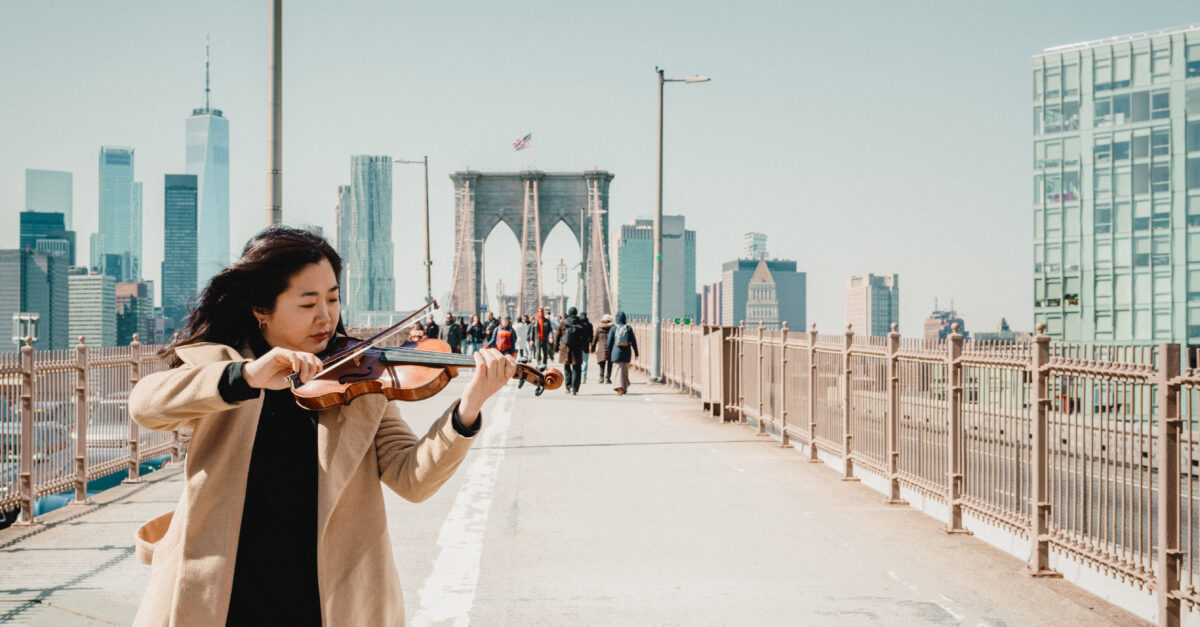
The Chamber Music Society of Lincoln Center’s opening night concert takes place on October 13. The program will feature American composers in a range of genres from ragtime to music for ballet and film: William Bolcom, an American icon as prolific as Mozart; Amy Beach, who broke the gender barrier with works of genius; Bernard Herrmann, a New York City wunderkind who took Hollywood by storm; and Aaron Copland, whose music personified the American spirit.
Below, violinist Kristin Lee reflects on what exactly is “American music.” Lee released her critically acclaimed debut solo album, American Sketches, in November 2024.
You’ve recently recorded a number of American works for your album American Sketches, and because of the 250th anniversary of the US this year, you’ve been playing a lot of American music. What binds together the American works that you’ve played?
Kristin Lee: I would say it’s impossible to reduce American music into any one kind of sound. Whether we’re talking about minimalism or the Appalachian-style folk sound or jazz or ragtime, these kinds of music come from very different areas, and that’s ultimately what makes American music what it is. If you had to tie it all together, I think of the words exploration and discovery. American music really stands for a celebration of different sounds and the history of those sounds.
How did you come to love American music?
My personal journey with American music began over a decade ago, when I was asked to do a program of American repertoire. I’ve always been a big fan of minimalist composers like Steve Reich, John Adams, and Terry Riley, but I didn’t really know what else represented American music. I did a lot of research and was completely mesmerized by the vast number of composers that we never really hear about today. And when you do a deeper dive into these composers, so many of their stories are tied to parts of American history.
You’ll be opening CMS’s new season with Three Rags for String Quartet by William Bolcom. What is so special about Bolcom’s approach to ragtime, which was a genre that was pioneered by Scott Joplin and other Black composers of the late 19th and early 20th centuries?
Ragtime is essential to the American sound. If you go back to its roots, it comes out of spirituals and is very much intertwined with American history. In terms of harmonic structure, it has a lot of similarities to blues and to jazz, which came out of ragtime. However, it has a very distinct, syncopated characteristic to its rhythm that allows it to be dance-like, whether it’s in a fast or slow tempo.
William Bolcom is a wonderful American composer who helped to revive ragtime in the middle of the 20th century. He has written a lot of pieces that are purely ragtime style, but he has also written pieces that blend ragtime style with something that’s a little bit more modern or even atonal sounding. One of his most celebrated pieces is the slow rag “Graceful Ghost,” which is included in the Three Rags for String Quartet. In it, he mostly writes something in the traditional style of ragtime that you find in a piece like Scott Joplin’s The Entertainer. It’s like a vignette of a traditional rag, translated into what Bolcom believes rags should be.
You’ll also be playing a concert suite of music written by Bernard Herrmann for the Alfred Hitchcock movie Psycho. I imagine many listeners are familiar with the terrifying, screeching music that accompanies the murder scene in the shower. What is it like experiencing this music in the absence of the film?
I think everyone listening to Psycho Suite is probably going to be waiting for the famous moment from the shower scene. Everyone’s going to wowed by that, because those screechy sounds that we’re able to create with our string instruments are pretty neat, I have to say. But it’s fascinating to realize how all of Herrmann’s writing is so in line with the movie. Right off the bat, when the suite starts, it has this very anxious quality.
When you’re watching a film, you may neglect the music that you’re hearing, but the music is still influencing the experience. This is a very exciting opportunity to flip that around.When I first played this piece, I didn’t recognize the tunes themselves, but then the film started coming back into my mind, even if they were tunes that I didn’t think I remembered.
This program also features a landmark piano quintet by Amy Beach. Can you tell me more about her role in early American music?
Amy Beach was the very first female composer to have a symphony premiered by the Boston Symphony Orchestra. When you are introduced to her music, you can sense her ambition to bring great art and great compositions to the world, whether the world was accepting it or not. This piano quintet is so big in scale, and I feel like she put so much heart and soul and effort into what she wrote. Her music in general is a great combination of things. It sounds a little bit like Gabriel Fauré, because she’s good at creating extremely long phrases that feel like they never end, but she also uses German Romantic harmonies. I’ve only discovered Amy Beach fairly recently, and I’m really glad that in the times that we’re living in right now, and also through the celebration of America’s 250th, her music and her name are becoming better known.
CMS’s opening night ends with Aaron Copland’s Appalachian Spring, probably one of the most familiar pieces of American music for concert audiences. What is it about this piece that makes it sound so American?
Aaron Copland represents America by creating an incredible musical landscape. It has a scenic element, where just the music itself helps you visualize the beauty of the land. You also have a little hoedown and you hear a lot of these very joyful qualities—a kind of American excitement that feels very adventurous. Then, of course, it ends with one of the greatest representations of an American folk tune, “Simple Gifts.” It’s a real journey. This is probably one of the pieces I play the most in any kind of chamber ensemble setting. It’s incredible, it’s kind of like how a violinist feels always delving into solo Bach—every single time I play it, I’m so moved, becauseI feel the celebration of America in away that’s reflective, but also forward-thinking. It’s a very special work.”
Visit ChamberMusicSociety.org.