
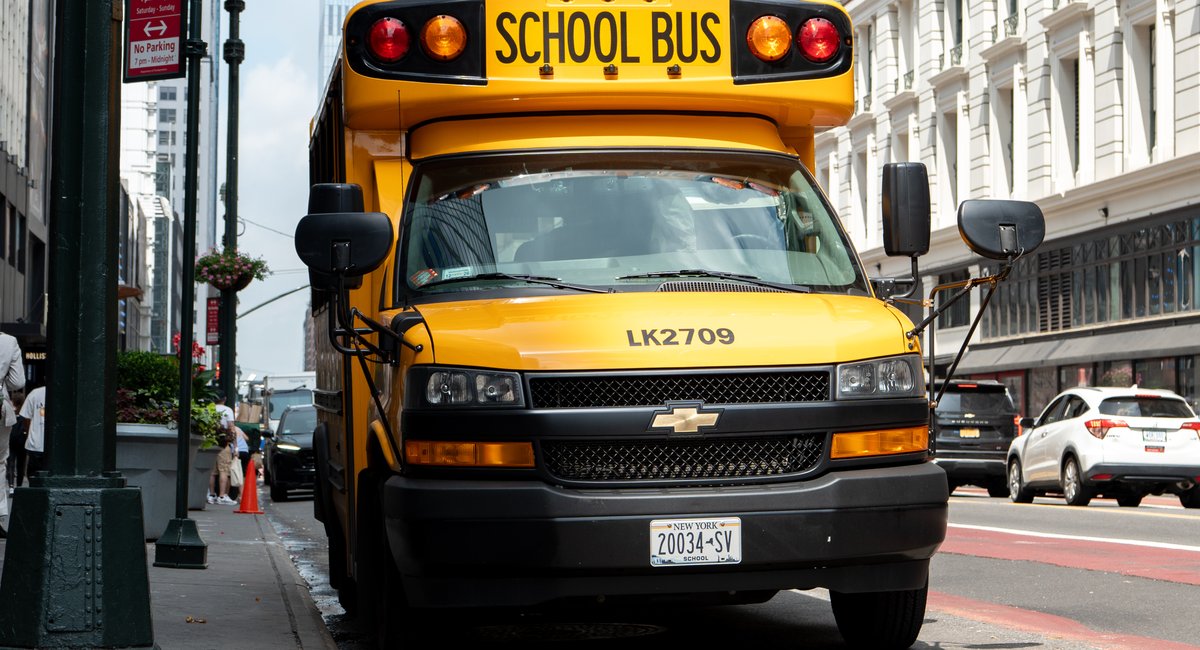
The new school year has kicked off in New York City with a familiar ritual: students with disabilities waiting for a yellow school bus that never shows.
Politicians, advocates for improved bus service, and parents said the annual back-to-school rite is particularly bad this year. According to advocates, 2,000 students did not have a bus assigned to them at the start of the school year – an unusually high number.
Randi Levine, policy director at Advocates for Children of New York, estimated that hundreds of students still lack consistent bus service.
The ongoing dysfunction follows a stand-off with school bus companies over a contract dispute last year that ended with a three-year contract extension and a pledge from companies to do better.
“We are doing everything we can to ensure that every single student is able to get to school,” Mayor Zohran Mamdani said at a press conference on the first day of school. “And we are also working at addressing this long-term issue.”
But the mom of a 9-year-old boy said she’s still waiting for the bus. The mom asked to be identified only by her first name, Jen, because she fears the bus company will retaliate and make it even harder for her son, who is nonverbal and autistic, to get to school.
Her son relies on a school bus to attend a specialized program through the public school system’s District 75 for students with complex disabilities.
But over the past several weeks, he has only made it to school twice. On other days, the bus hasn’t shown up, or – one day – it came and left after waiting a single minute while Jen rushed to get her son downstairs.
Jen said she can’t take her son on the subway because it’s too loud and crowded for a child with sensory issues, and Ubers are too expensive. So her son has been staying home.
“He misses his therapy. He misses schooling. His routine is completely thrown off. It’s terrible,” she said.
The Mamdani administration said the vast majority of the roughly 155,000 kids who need buses have them. But officials said that the number of students with disabilities who need busing spiked while the city, and other school districts across the country, continue to face a shortage of drivers.
Officials said they have been working urgently to reduce that number by acquiring more buses and hiring drivers. For students who still don’t have busing, the education department has offered OMNY cards and prepaid rideshare.
Dominique Ellison, a spokesperson for the education department, said that since the start of September, the city has hired more than 90 additional drivers and purchased 30 buses and vans.
“We are working around the clock on immediate fixes, including prepaid rideshare, and working toward long-term solutions, so families are not facing these same challenges year after year,” she said.
Public Advocate Jumaane Williams lamented that school bus problems were playing out yet again.
“ The definition of insanity is doing the same thing over and over and expecting a [different] result,” Williams said. “ We’re having the same result we have every single year. We’re getting inundated with hundreds of calls… that kids aren’t being picked up. They’re not being picked up on time. Kids who need the most services are having some of the most challenges.”
“Next year I want to talk about something else,” he added.
Many families and advocates said a solution will require replacing 45-year-old bus contracts with new ones that guarantee better service. Rebidding contracts, they said, depends on passing legislation in Albany that guarantees job protections for drivers in order to avoid a strike. Advocates and families are calling on lawmakers to pass bills enshrining those labor protections so contracts can finally be rebid.
“ Educational justice does not begin when the school bell rings. It begins with whether every child has a fair and reliable way to get there,” said Johanna Garcia, chief of staff to state Sen. Robert Jackson, who has sponsored one of the bills.
Last year, a coalition of families and advocates convinced the Panel for Educational Policy, the board that oversees education contracts, to negotiate a shorter renewal for bus contracts so the city and state could pass the driver protection bills and begin negotiations with bus companies.
“The number of students who began this school year without a bus is a crisis that should serve as a call to action to city and state leaders,” said Levine, of Advocates for Children of New York.
She said the situation highlights specific flaws in the city’s decades-old contracts with bus companies, including policies that let companies choose their routes.
“The students most likely to be without a bus at the end of the vendor pick are those with the most intensive needs, placed in schools farthest from where they live, the very students whose families tend to have the most difficulty getting them to school,” she said.