
This column originally appeared in The Politics Brief, our weekly newsletter on the people, power and policies that shape New Yorkers’ lives.
Sign up to get the full version where you can ask questions, share news tips and weigh in on the conversation. Hits inboxes on Wednesdays.
New York Gov. Kathy Hochul has a 9-point lead over her Republican opponent Bruce Blakeman, the Nassau County executive.
Or maybe she’s up by 19 points. Or is it actually 4 points?
Hochul only needs to win her race by a single vote to secure another four-year term, and the public polls are unanimous: She’s in the lead. But those same polls can’t seem to agree whether she’s on track for a landslide win, a single-digit squeaker or something in between.
“ There’s nothing in the state constitution that says the governor has more or less power depending on their margin of victory,” said Evan Stavisky, a veteran Democratic campaign strategist. “So ultimately, it’s much ado about nothing.”
That may be true from the governor’s perspective. But Hochul’s potential margin of victory — if she wins — could have major implications for Democratic congressional candidates who are counting on her to turn out voters and help regain control of the House.
Just ask Robert Zimmerman. He was the Democratic congressional candidate who lost to Republican George Santos — remember him? — in New York’s 3rd Congressional District in 2022.
Hochul did Zimmerman and other Democratic congressional candidates no favors at the top of the ticket back then when she won statewide by 5 ½ points over Republican Lee Zeldin, a narrow margin in a deep blue state. That was far less than the prior two election cycles, when Gov. Andrew Cuomo won by 23 and 13 points.
Hochul particularly struggled on Long Island, losing the 3rd District — which includes a sliver of Queens — by roughly 12 points. Zimmerman, by comparison, lost by 5 ½ points, outpacing the governor in the district.
It all led former House Speaker Nancy Pelosi to single out Hochul’s performance as she cast blame for Republicans retaking the House that year. “The governor didn’t realize soon enough where the trouble was,” Pelosi said at the time, naming crime as the top issue for voters.
Zimmerman has plenty of sympathy for downballot candidates feeling nervous about Hochul’s margin.
“Look, I get the feeling,” he said in an interview.
But Zimmerman said there are key differences between 2026 and 2022.
For one, Republican Donald Trump is in the White House, which is a “great turnout motivator for Democrats,” he said. And Hochul has invested significant resources in building up the state Democratic Party, an effort that largely didn’t exist four years ago, and having a unified message centered on affordability.
“ I think that out of the heartbreaking Republican landslide we faced in New York in so many parts of the state [in 2022], that coordinated campaign has really been a real … lesson learned and a real big improvement,” said Zimmerman, a public relations executive and Democratic National Committee member.
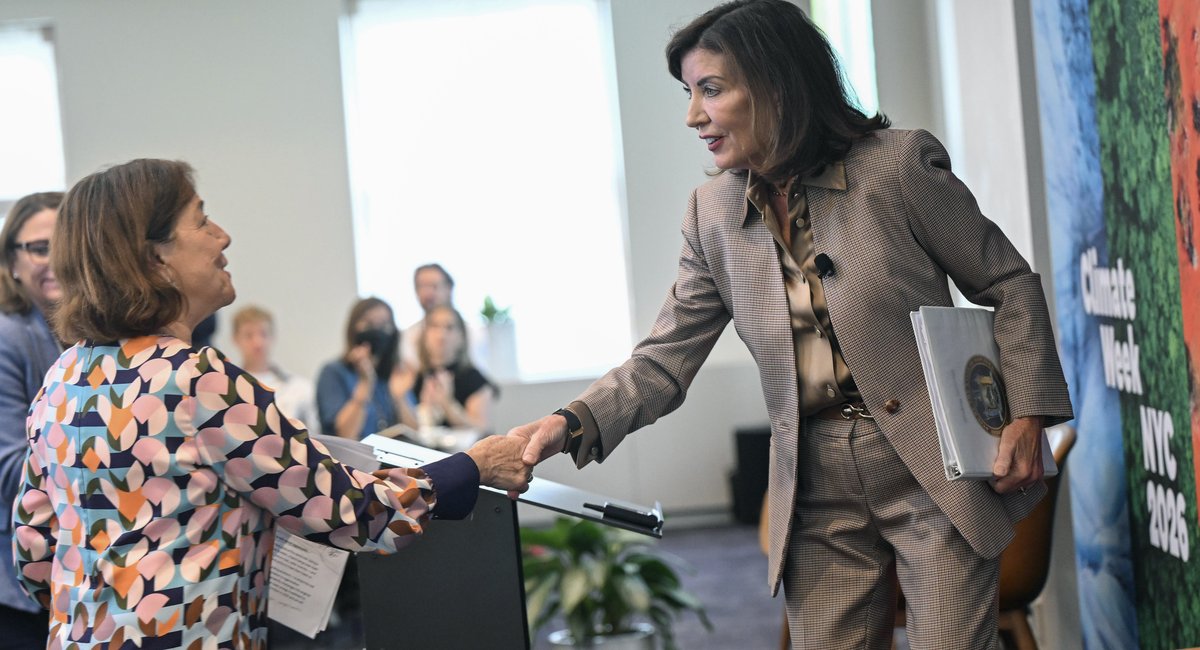
In an interview on WNYC’s “Who’s Running This Place?” last week, Hochul said she understands the gravity of the situation. “I don’t take anything for granted,” she said.
“ Our job is to make sure that we’re successful — and I’m the leader of the ticket, I understand that — but successful enough that [Democrat] Hakeem Jeffries will be the next speaker of the House of Representatives, because that’s how we start building the firewall to stop all this insanity that has been unleashed on this country,” she said.
Republicans, meanwhile, are choosing to believe the polls that show Blakeman within single digits of Hochul.
Siena University had Hochul winning 50%-41% in a poll released last week that anticipates lower turnout in deeply Democratic New York City. Quinnipiac University had Hochul winning 58%-39% in its own poll released a few hours later, anticipating higher turnout in New York City. (In non-independent polls, Blakeman’s own campaign pollster, John McLaughlin, had Hochul winning 50%-46% earlier this month.)
“All polls continue to show Kathy Hochul’s downward spiral and me closing the gap as New Yorkers learn more about my plan to cut income taxes by historic margins and slash electric bills in half,” Blakeman said in a statement.
Even if Hochul does win by a considerable margin at the top of the ticket, one key lawmaker has proven it doesn’t necessarily have to spell doom for Republicans.
Rep. Mike Lawler — a Hudson Valley Republican whose race is considered a toss-up by the nonpartisan Cook Political Report — was one of only three Republicans nationwide to win districts that Democratic presidential candidate Kamala Harris won over Trump in 2024. Lawler, who represents New York’s 17th District, is facing a challenge from Democrat Cait Conley.
“Obviously the stronger that the top of the ticket performs, the better it is for candidates down the ticket,” Stavisky said. “But you certainly see candidates on both sides of the aisle in the Hudson Valley, for example, who outperform the top of their ticket.”
Jimmy Vielkind contributed reporting.
We want to hear from you
Do you think New York Democrats have a more coherent message this cycle compared to four years ago?
We’ll share responses in next week’s newsletter. (Sign up!)