
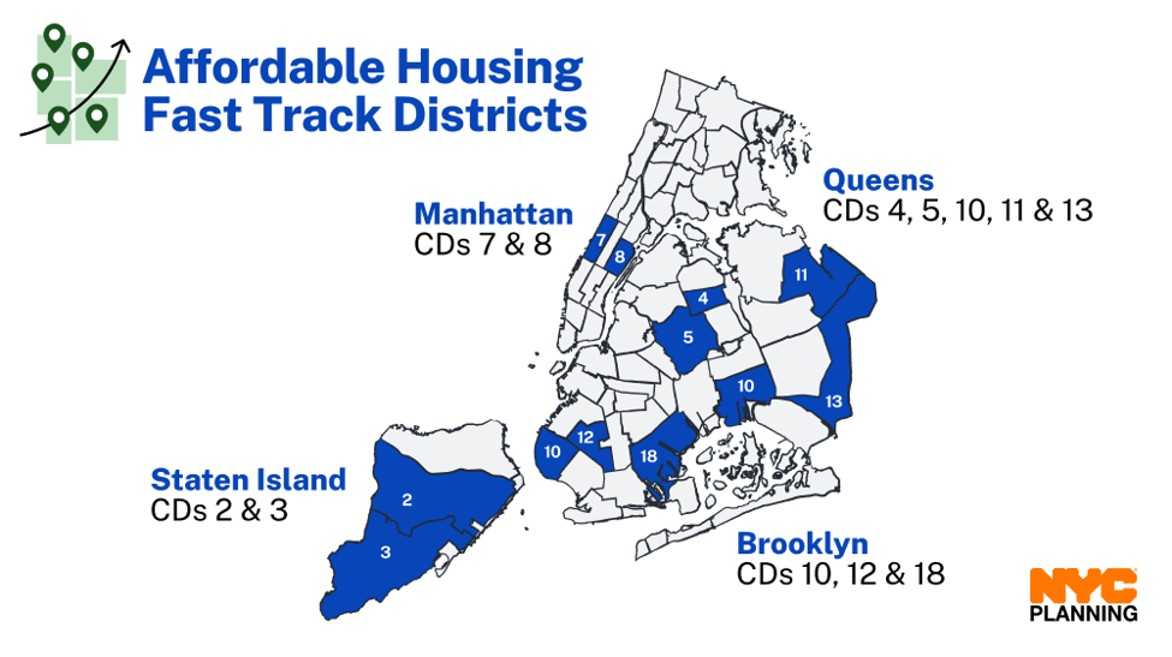
A new fast-track process for affordable housing will take effect in 12 community districts next year, after the Mamdani administration on Thursday identified the neighborhoods where the voter-approved changes will apply.
The list runs from Bay Ridge and Dyker Heights to the Upper East and West Sides of Manhattan, parts of eastern and southern Queens, and much of Staten Island. No Bronx community district appears on the list.
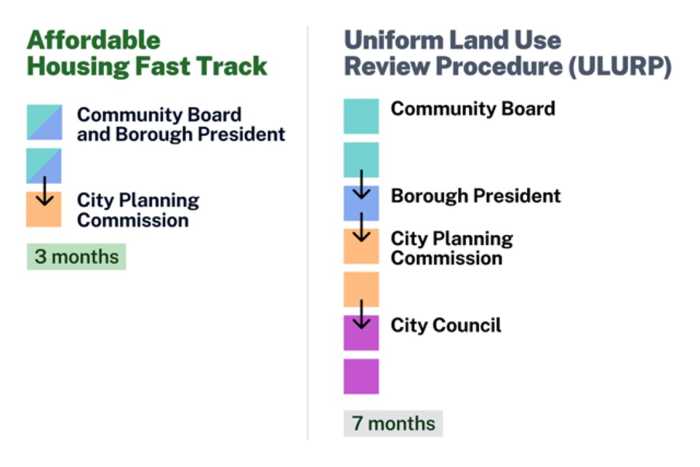
Starting Jan. 1, qualifying affordable housing proposals in those districts that require a land-use change can move through a 90-day review process instead of traditional ULURP.
The change does not rezone any of the neighborhoods or automatically clear projects for construction. But it does alter who gets the final say when an eligible proposal comes forward.
Community boards and borough presidents will still weigh in during a concurrent 60-day review. The City Planning Commission then makes the final decision. Those projects do not go on to the City Council, and there is no mayoral veto.
New Yorkers approved the Affordable Housing Fast Track in a citywide referendum last November, with 58.5% voting in favor and 41.5% opposed. Staten Island went sharply the other way: 68% of voters there rejected the measure, while 32% supported it. Two of the borough’s three community districts are now on the fast-track list.
City Planning later adopted a methodology that measures affordable housing production against the size of each community district’s existing housing stock. The 12 districts announced Thursday ranked lowest under that calculation.
The agency’s director, Sideya Sherman, said the aim is not only to move projects faster, but to spread affordable housing more evenly across the city.
“If we want to be a city that helps undo the patterns of segregation, that makes sure that New Yorkers have choice about where they live, we can’t concentrate affordable housing in just a handful of neighborhoods,” Sherman told reporters.
The districts are Brooklyn Community Districts 10, 12 and 18; Manhattan Community Districts 7 and 8; Queens Community Districts 4, 5, 10, 11 and 13; and Staten Island Community Districts 2 and 3. They include Bay Ridge, Dyker Heights, Borough Park, Kensington, Canarsie, Flatlands, Corona, Elmhurst, Ridgewood, Maspeth, Middle Village, South Ozone Park, Howard Beach, Bayside, Douglaston and several other neighborhoods.
 NYC Planning
Sherman emphasized that the designation does not amount to a blanket rezoning.
“It does not mandate housing. It does not automatically rezone,” she said. “Certainly, [it] does not take away public input from our land use processes.”
Environmental review and landmark protections will also remain in place, but how much housing the change will actually produce is still an open question.
“We don’t have a projection or unit count,” Sherman said.
City Hall is also looking at where it could take a more active role. Sherman said DCP is assessing possible city-led land-use actions in the 12 districts, including rezonings in areas where existing zoning limits development, sites near transit and city-owned property that could be used for affordable housing.
“Certainly we have a focus on these 12 districts, and so we are prioritizing our time and our resources in those communities,” Sherman said.
Mayor Zohran Mamdani cast the change as part of a broader push to get more neighborhoods to contribute to the city’s affordable housing supply.
“New York’s housing crisis is not going to be solved by asking the same neighborhoods to do all the building,” Mamdani said in a statement. “Every New Yorker deserves a home they can afford, and every neighborhood must be part of delivering it.”
The list will be recalculated every five years based on updated affordable housing production, with the next list due in October 2031. Sherman said projects will have to move beyond approval and be permitted to count toward that calculation.