
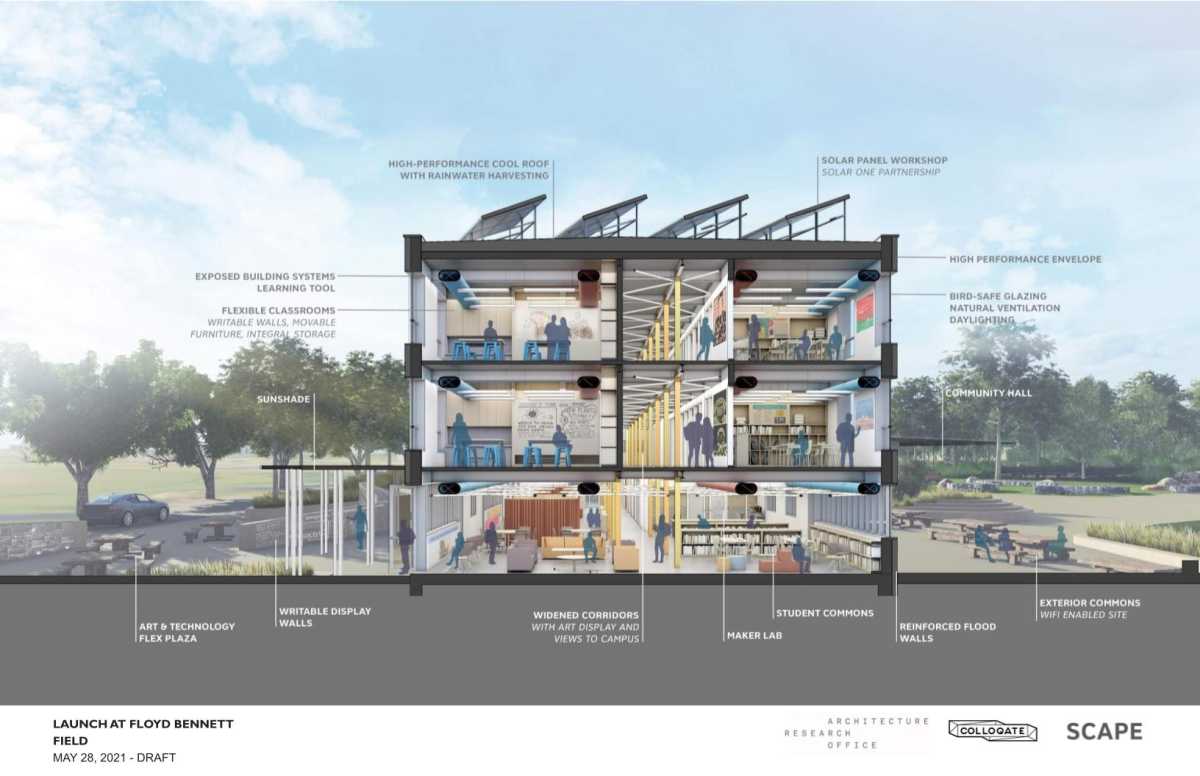
For years, Runway Green has been pitching an ambitious vision for Floyd Bennett Field: turn part of the sprawling former airfield into an outdoor classroom where New York City students can learn about sustainability, explore green careers and get hands-on experience outside the traditional classroom.
Now, the vision is starting to become something Brooklynites can actually see taking shape.
With a 60-year lease for the new site now secured, Runway Green expects to break ground in 2027 on the first piece of its planned campus — a three-acre farm being developed in collaboration with the Campaign Against Hunger.
For Geoff Roehm, Runway Green’s founder and CEO, the lease is more than a legal milestone; one that gives the project a permanent home.
“Having site control, of course, is a prerequisite to be able to begin construction,” Roehm told Brooklyn Paper. He added that the organization is “really excited” to begin breaking ground.
But the farm is only the beginning.
Brooklyn Paper spoke with Roehm about what Runway Green’s campus could actually look like, what students could do there and why the organization believes Floyd Bennett Field could become a testing ground for a new kind of education in New York.
From a plot of land to an education system
The first phase will begin in 2027, but Runway Green’s larger goal is to create an interconnected campus rather than a standalone school or facility.
“We need to know that we have a permanent home base to be able to create this really special thing for kids that we’re all working on,” Roehm said.
Runway Green is working with a collection of public and private partners, including education, environmental and youth organizations. The idea, he said, is for those organizations to operate alongside one another and give students different ways to learn.
“One of the most exciting things about this project is it’s not just one organization,” he said. “But a broad set of both public and private stakeholders coming together to say, ‘How can we create something that’s more powerful working together for kids?’”
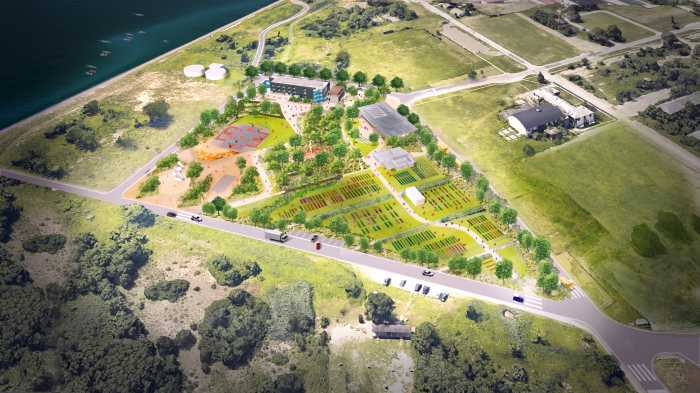 A new $60 million education campus is planned for Floyd Bennett Field, where Runway Green has secured a 60-year lease for seven acres of the historic airfield.Rendering courtesy of ARO, SCAPE, Colloqate
Roehm describes that network as an “ecosystem,” with the future Floyd Bennett Field campus at its center.
The construction itself will happen in phases. Runway Green already has $9.3 million in dedicated public funding to get the project started, Roehm said, while fundraising continues for the larger campus.
The unusual nature of the site — federal land located within New York City — means the project involves multiple layers of government and partners, he said.
“This is a piece of federal land that is in New York City,” Roehm said. “And a wonderful component of this is that there are lots of folks in New York City and lots of folks in the federal government who are excited about supporting this.”
What would a student actually do there?
That may be the most interesting part of Runway Green’s vision.
Roehm doesn’t envision students simply taking a field trip to walk around the future campus. Instead, he described a range of experiences that could grow from a single day of exploration into semester-long programs and college credit.
A student could start with a one-day visit, exploring different organizations and learning about careers connected to sustainability and the green economy.
“We’ll have these wonderful different partner organizations on the campus all doing sort of authentic and powerful work, much of it related to issues of sustainability and green economy and job development,” Roehm said.
Partner organizations include CUNY, Billion Oyster Project, Solar One and Outward Bound. The goal is partly exposure: giving students a chance to encounter careers they may not have considered before.
“What are these different kinds of jobs that might be out there that I’ve never heard of?” Roehm said, describing the questions students could explore.
Students could also spend multiple days at the site, including overnight camping and team-building activities through New York City Outward Bound Schools.
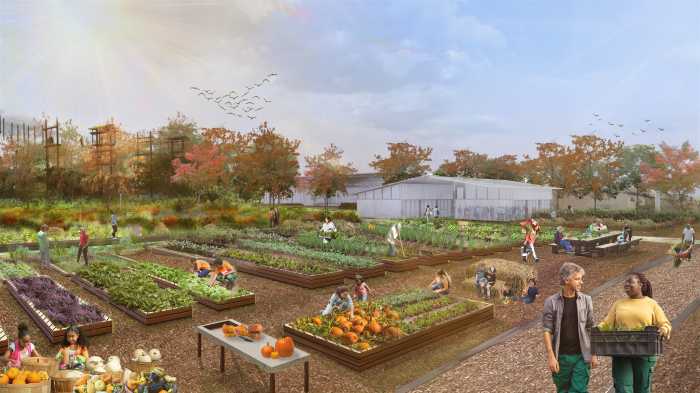 The first phase is expected to break ground in 2027 with a three-acre urban farm.Rendering courtesy of ARO, SCAPE, Colloqate
And then there’s the most intensive option: semester-long programming.
Students would remain enrolled at their home high schools while spending part of their week at Floyd Bennett Field, similar to the way other specialized education centers operate. They could ultimately earn a credential connected to a career in the green economy.
The programming is designed to give students a progression of experiences — from simply discovering new possibilities to getting deeply involved in a potential career pathway.
“All of those different access points are possible and really on a spectrum of I can come to explore up to I can end with a full credential and sort of a deepening understanding,” Roehm said.
A classroom where students could earn college credit
Runway Green’s plans also extend beyond high school programming.
The organization is working with CUNY Kingsborough Community College to develop dual-credit courses that would allow students to earn both high school and college credit.
A three-course pilot is scheduled to launch this winter, Roehm said.
“We’ve developed an initial three-course arc with CUNY that we’re going to launch this winter as a pilot program, where kids will be able to earn both high school and college credit,” he said.
The courses will combine classroom learning with hands-on work alongside Runway Green’s partner organizations.
But Roehm sees the pilot as testing something as part of a much bigger picture.
New York is moving toward its “Portrait of a Graduate” framework, which focuses on six competencies students will need to demonstrate as the state’s education system changes.
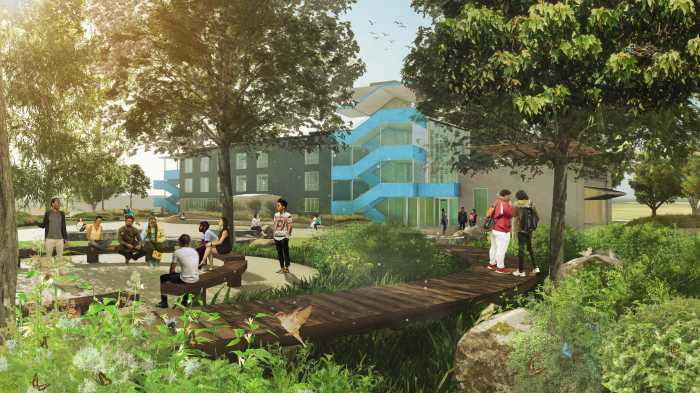 The site will offer outdoor classrooms and a maritime garden.Rendering courtesy of ARO, SCAPE, Colloqate
Runway Green wants its pilot to demonstrate what that could look like in practice.
“We’re actually going to make it what we think will be the first comprehensive model of assessing students on Portrait of a Graduate measures,” Roehm said.
Students will participate in hands-on projects, explore careers and earn college and high school credit while also demonstrating growth in the state’s six competencies.
For Runway Green, that could eventually make Floyd Bennett Field more than a campus for student programming. Roehm envisions it as a place where educators can experiment with what competency-based learning could look like across New York.
Why Floyd Bennett Field?
Part of what makes the project unusual is where Runway Green chose to build it.
Floyd Bennett Field carries layers of history, from the Lenape people and Barren Island to its days as New York City’s first municipal airport and its role during World War II.
Roehm said that history won’t simply sit in the background of the campus. He wants the site itself to become part of what students study.
“Every space has a long history, and we need to understand that history and use it as learning experiences,” he said.
Students have already spent time at Floyd Bennett Field through early pilot programs, even before construction has begun.
 Floyd Bennett Field is a large part of Brooklyn’s historical landscape. The site once served as an airfield.Photo courtesy of Cradle of Aviation/nyheritage.org
The site’s history can become a jumping-off point for lessons that combine social sciences with physical sciences, Roehm said — allowing students to learn about the place they’re standing in while also examining broader questions about how communities, environments and cities change.
“It was an airfield. It served a huge role, obviously, in World War II, the long-distance flights that took off from Floyd Bennett Field,” Roehm said.
“But even prior to that, the ways in which Barren Island supported New York City, you know, as it was a rapidly expanding sort of like global city, right? And the different iterations that Floyd Bennett Field went through over the course of that time, all sort of like interesting, powerful place-based learning experiences that can drive student learning.”
Why a 60-year lease?
The length of the new lease may be easy to overlook, but Roehm sees it as one of the most important parts of the project.
A 60-year agreement gives Runway Green the permanence it needs to build a long-term educational institution rather than a temporary program.
“To think about six decades of protected park land in the middle of New York City that is dedicated to New York City students,” Roehm said. “This isn’t about building high-rises.”
For Roehm, the value is in dedicating a piece of the city to students for generations.
“That’s not how the market is typically gonna work,” he said. “But in this case, because this is such a unique piece of land, it can work that way.”
The location also gives students something that can be difficult to find in New York City: access to nature and outdoor space alongside career-focused learning.
What Runway Green hopes Brooklyn sees next
A year from now, Roehm expects the project to look substantially different.
He hopes Runway Green will have broken ground, expanded programming with CUNY and New York City Public Schools, brought additional partners into the project and made significant progress toward funding the larger campus.
But he also has a broader goal.
Roehm believes the project could become particularly relevant as artificial intelligence begins changing how people work — and how schools prepare students for that work.
“We are at an inflection point as a society as we enter an age of AI that is going to change the way that we work and learn, across all industries and across sort of like all institutions, including in education,” he said.
He sees Floyd Bennett Field as a place where New York could experiment with what comes next.
“It’s a blank slate that we can come together on, and I think a year from now, having more people that are bought in to sort of that future vision and utilizing Floyd Bennett Field to be a driver of that would be exciting progress for us,” Roehm said.
And while the campus is being designed around a much larger vision, Roehm said Brooklyn families are central to the project’s origins.
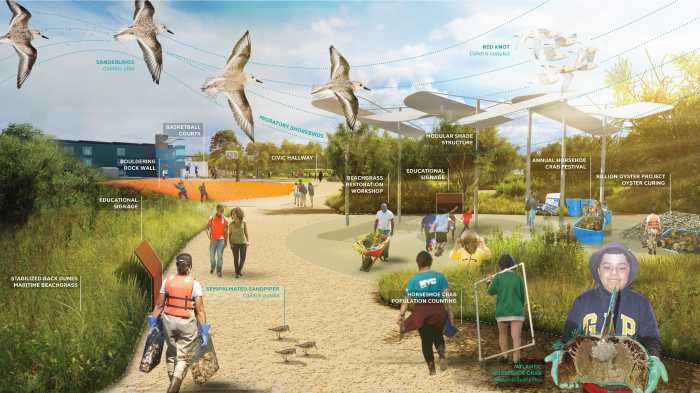 Runway Green is working with CUNY to develop dual-credit programming for students.Rendering courtesy of ARO, SCAPE, Colloqate
The concept, he said, came out of a community design process involving Brooklyn children and parents.
For those families, he wants Runway Green to ultimately offer something difficult to replicate inside a traditional classroom: the opportunity to work on real problems in a real place.
“I want Brooklyn parents to know that if they want their kids to be able to engage in real problem-solving, solving authentic problems that exist in our communities and in our society, being able to connect with nature, and an incredible part of our city, that is underutilized, that Runway Green is a great place for their kids to be able to come and learn,” Roehm said.
And that community involvement isn’t necessarily supposed to end once the campus is built.
“I think that history and that hopefully legacy of the project means that it will continue to evolve, to evolve with input and ownership from Brooklyn kids and parents,” he said.