
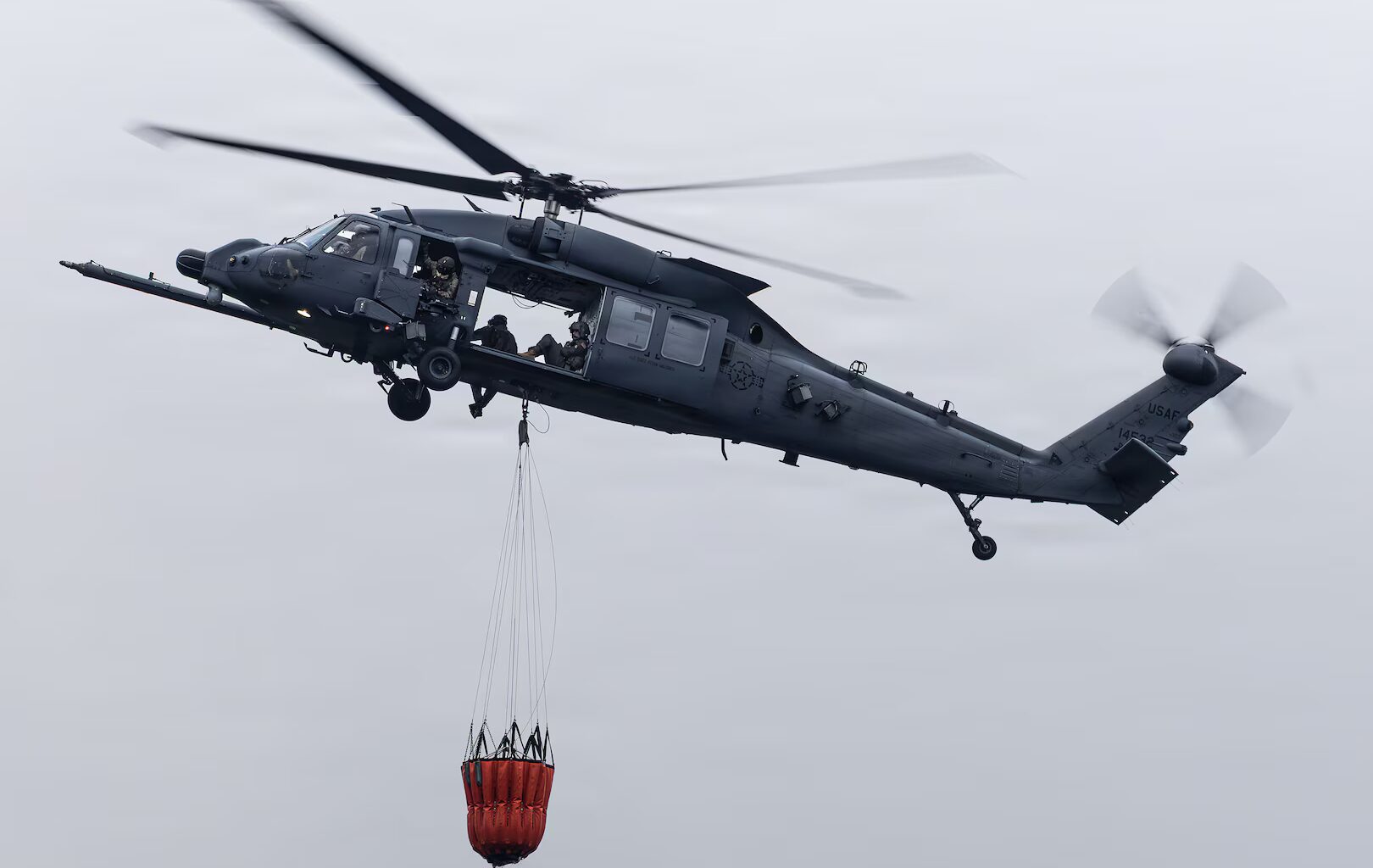
FRANCIS S. GABRESKI AIR NATIONAL GUARD BASE, WESTHAMPTON BEACH, N.Y. – New York National Guardsmen joined state personnel Sept. 16-17 in strengthening wildfire response capabilities and helicopter bucket operations in training that combined interagency discussions with hands-on aerial firefighting operations.
About 30 participants from the New York Air National Guard’s 106th Rescue Wing’s 101st Rescue Squadron; New York Army National Guard 3rd Battalion, 142nd Aviation Regiment; New York State Police; and New York State Department of Environmental Conservation took part in the training at Long Island MacArthur Airport in Islip, New York, and Stewart Air National Guard Base in Newburgh, New York.
The first day of training focused on helicopter bucket academics and integrating military and state agencies during wildfire response operations, said Master Sgt. Barry Wood, a special missions aviator with the 106th.
Large, collapsible water buckets hang beneath helicopters, letting aircrews collect and deliver large volumes of water to wildfire locations that may be difficult for ground responders to access, Wood said.
“We talked about integration, how we can get on the same frequencies during a disaster response and synergizing our efforts,” Wood said. “We also had a New York state forest ranger there explaining the process of how New York state responds to wildfire disasters.”
The following day, the training moved to Stewart Air National Guard Base, where the 106th deployed two HH-60W Jolly Green II rescue helicopters and the 142nd provided three UH-60M Black Hawk helicopters for hands-on helicopter bucket training, Wood said.
Before beginning flight operations, participants met with the New York State Police for an additional briefing on interagency coordination and the capabilities each organization could provide during a wildfire response.
Chief Warrant Officer 5 Robert Hansen, a standardization pilot with the New York Army National Guard 42nd Combat Aviation Brigade, emphasized the importance of that coordination.
“It’s great working with our National Guard partners to help synchronize our response efforts for New York state,” Hansen said.
Following the briefing, the 106th crews conducted about 14 helicopter bucket drops with the HH-60Ws. The training allowed three 106th pilots to earn their initial helicopter bucket certifications and an additional eight aircrew members to maintain their currency, Wood said.
Helicopter buckets were used during the Pine Barrens Fire in Westhampton Beach in March 2025 when the 106th and 142nd conducted aerial firefighting operations as part of the response to the 600-acre fire. The 106th conducted 28 helicopter bucket drops, delivering about 14,100 gallons of water, while the 142nd conducted 43 drops. Together, both units dropped more than 42,000 gallons of water on the blaze.
“These training events are essential to ensuring our Airmen and state partners can operate as a unified team during an emergency,” said Lt. Col. James Liston, 101st Rescue Squadron commander. “By training together before a crisis occurs, we improve our collective readiness to protect the people and communities of New York.”
The 106th Rescue Wing based at Francis S. Gabreski Air National Guard Base in Westhampton Beach, New York, operates and maintains the HC-130J Combat King II search and rescue aircraft and the HH-60W Jolly Green II rescue helicopter. The 106th Rescue Wing is home to a special warfare squadron of pararescuemen and combat rescue officers. The squadron specializes in rescue and recovery and deploys for domestic and overseas operations.