
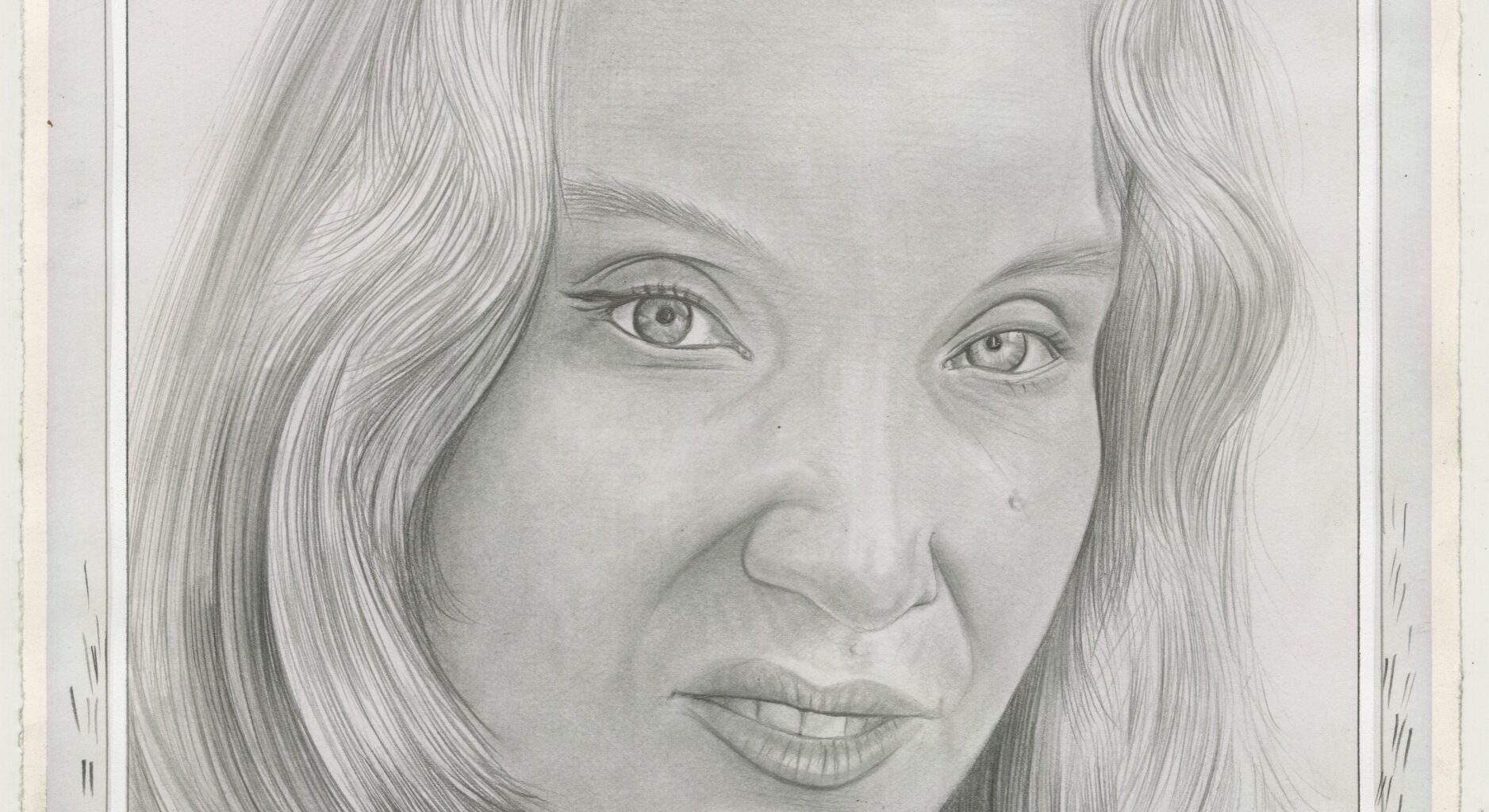
Rail: As you just said earlier, they are products of lines, as much as representations of the young female adolescent performing different gestures in multiplication. Does the reference to Paul Gauguin’s painting Where Do We Come From? What Are We? Where Are We Going? (1897–98) share a similar idea?
Ackermann: Yes, in the way that Gauguin’s painting could be looked at as a storyboard. From right to left, time passes through life, from the infant to the elder woman. It reads like Hebrew or Japanese. I wonder if Tahitians read like Japanese? It’s cool Gauguin painted the story from right to left in the opposite direction of his own culture. Could it be to hold our attention and to slow down the time of viewing? Or did he simply just want to become a Semitic, aboriginal rebel against his Parisian contemporaries?
Rail: I think so too. Yet we think of the idea of seriality itself as a form of narration. Andy Warhol’s Shadows (1978–79), for instance: without the 102 screenprints of the same images painted in different colors, hung as an abutted installation, it wouldn’t have this rather hypnotic, filmic, and narrative sequence. My question is: how would you describe your use of repetition in this new body of paintings, as a group of fourteen, in relation to your fascination with speed and the aesthetic of disappearance, both being Paul Virilio’s lifelong meditation? In other words, I can see how the images get made visible in the buried part, or simply disappear then reemerge in different contexts. Once again, we spoke of this eternal return in de Kooning’s paintings of the woman. Still, his deployment of speed is consistent in one or two gestures. We also see this in the work of Jackson Pollock and Robert Ryman, or in paintings by, say, Joe Bradley, Ann Craven, and Josh Smith, to name a few. But in your case, Rita, it’s an anarchy of multiple gestures, moving slowly to a very fast pace.
Ackermann: Back in Budapest I had a professor named Péter György, who taught courses on Virilio. His theories about speed and the notion of time and their relation to history and violence resonated with me. In fact, when I came to New York, the only book I brought with me was Virilio’s The Aesthetics of Disappearance in Hungarian. What fascinated me about Virilio is really that he was able to link together the fear and violence of stillness and the speed of technology and perpetual war—even in his earlier book, Bunker Archeology, which contains his photographs of the deteriorating German bunkers from WWII as monuments of the desire and fear of disappearance. I believe Virilio wrote the way he did because he was a multitasker doing a million things at once. He was a trained architect who started a magazine and built a chapel together with the famous French architect Claude Parent. He made the stained-glass windows in the chapel, then set out to photograph bunkers on the French coasts. He would refuse to be pinned down as a philosopher; he preferred the title “thinker.” To investigate the space between objects, he picked up drawings of still lifes inspired by Giorgio Morandi’s paintings. His pencil line drawings focused on the negative spaces between objects and the way they would define the positive space.
Rail: The same can be said of how the phenomenology of space treats the lived void and the physical object as an inseparable unity. We should mention that he had audited lectures given by Maurice Merleau-Ponty at the Sorbonne.
Ackermann: Ahh—anyway, Virilio introduced me to this way of thinking of running multiple tracks simultaneously, and you’re investing in every single track with the same speed and energy and devotion and passion all at once. That’s very present in The Aesthetics of Disappearance. In other words, all these thoughts are running on parallel tracks. While you’re reading it feels like an information grenade went off in your head. How will Howard Hughes’s iconoclastic behavior come to make sense with bunker archeology, and how did the German fairytales relate to the first photo images? He’s running so many different currents and ties them all together. It’s such shocking mastery at the end. Maybe he inspired me to do things simultaneously.
Rail: Virilio famously once said, “When you invent the ship, you also invent the shipwreck. When you invent the plane, you also invent the plane crash.”
Ackermann: There’s no other way than the double. Reading Virilio’s other books, Open Sky and The Original Accident made me realize that it is inevitable not to crash in the acceleration that our comfort culture imposes on us. So might as well run a practice on multiple tracks. Never declare one thing as your “signature brand,” because that is going to turn on you and empty you out. So, I keep changing tracks and play the same song in different styles until it is unrecognizable, like Bob Dylan does. I admire artists who have the freedom to do so, like Richard Prince.
Rail: The gestures are letters from the Hebrew alphabets, which are then painted with charcoal board green in broad gestures over silk-screened images, taken from your drawing after Jean-François Millet painting, which is then painted in different colors with different cropping, and so on. In addition to the mark making, what can you share with us about your impulse to erase painted and drawn images with various sizes of sponge?
Ackermann: Damn, it already sounds too complicated to explain the paintings of the alphabet. Maybe it’s best not to elaborate on this simple method, but just to say I’m combining different elements of my previous series. The concept behind chalkboard paintings is based on disappearance, layers, and layers of erasures. Meticulously drawn pictures being erased in a couple of hasty seconds. What made the whole thing interesting was how time stood still on the picture—not to take it back to the film idea, but there was an entire animation film underneath that frozen, stretched image in its finished state.
Rail: Unlike Joseph Beuys’s chalkboard drawings, which he used as a tool to articulate his ideas about freedom, education, and democracy, and often appeared as diagrams during his lectures or performances.
Ackermann: Yes, it was not about the subject. It was something to do with the recordings of the movements and how things disappear; what remains is the becoming of the picture.
Rail: I noticed the accumulation of repeated layers in the wiping process on the surface of each painting leads to different results in the alchemy of imagery. I was taken by the lower left portion of the painting In the Valley of the Missing Link (2026), in which some kind of chemical oxidation that occurred in the washing and wiping process altered the screenprinted Millet image below. Would you feel the gesture that makes things disappear is the same gesture that makes us look at things that emerge?
Ackermann: Yes, that sounds about right.
Rail: At times it looks like the glimpses of images that appear and disappear from a car’s window wipers, both from the sliding streams of water outside from the pouring rain and the condensation on the inside of the windshield. It’s an amazing perception of filmic interplay between negative and positive space, as you mentioned. The difference here is there are fourteen of them in a random order, identical in their vertical format, evoking time and timelessness simultaneously.
Ackerman: We could say that their “becoming” is visible. Their history is transparent. The concept of obscuring readability by transparent layerings of ballpoint pen drawings happened first in my ballpoint pen painting series.
Rail: Like World War III Around My Skull (1996–97), for example.
Ackerman: Yes. Some of Virilio’s photos of bunkers showed up in those paintings to represent the art of disappearance. I wanted to see how images that were drawn up on the top of each other could lose their original figures and morph into something new. Each layer transformed itself and the picture below by adding to it and destroying it at once. You see, the idea of constructing a picture by making the images vanish on the surface has been a lasting interest for me to this day, even with this new group of chalkboard paintings. Over time the same ideas reoccur, and you find new ways to execute them.
Rail: In some ways, by controlling, or rather orchestrating different tempos, different speeds, different physical touches—I mean, different ways to apply paint or pastels on the surface lying flat on the floor, or hung on the wall—there appears these frictions between the huge and stable structures of the letters, the aggressive wiping gesture, the clusters of expressive marks, and the delicate, thin, fragile white chalk outlines of the young adolescent girls. Is there a big Rita and small Rita working together here?
Ackermann: The goal is, like when two magnets oppose each other, to make that positive side of the magnet into a negative. Then they just click and all come together. That’s the moment when you know painting knows more than we do, and you should trust that the intellect and the hand are both just instruments for the action to make it happen.
Rail: It’s a many Ritas ritual, I think. What are your thoughts on cave paintings?
Ackermann: Cave paintings are ultramodern art in my opinion, bypassing Popism, Minimalism, and Conceptualism. The merit was the successful hunt and no extra bullshit of artist’s ego or self-therapy, etc. All those factors eventually take art out of the picture. Cave paintings are good reminders to always ask the question before making an image: Why make it?
Rail: I think necessity is deeply related to our desire for freedom. This brings me to my next question: in Meyer Schapiro’s classic 1969 essay, ”On Some Problems in the Semiotics of Visual Art: Field and Vehicle in Image-Signs,” he refers to “fields” as an unbounded, unprepared, irregular surface, like the natural surface of the cave wall, depending on whatever segment of the wall the cave painter chose to paint. I don’t think it’s random, since many of us have seen the great Werner Herzog film Cave of Forgotten Dreams. The idea of painting in a portable format was a later invention in human development.
Ackermann: No frame, no background, no foreground. Everything is suspended, but exactly where it needs to be.
Rail: I wonder if the painter was motivated by pleasure or anxiety? Anyway, the “vehicle” implies the use of material and binder—be it animal fat, bone marrow, urine, saliva, or whatever pigment they can extract from plants and vegetables. Whereas “image-sign” relates to both “field” and “vehicle” insofar as they function as a structural carrier.
Ackermann: Those cave paintings functioned as instrumental for survival. We don’t exactly know how, but they outlined substances into modernism.
Rail: Do you feel the elemental, primal urge to make marks, to make images which may or may not correlate to graffiti art at all?
Ackermann: Not at all. Tagging or street calligraphy can be cool, but I prefer to keep the infantile act of invincibility and destructive tendencies on canvas rather than risk life on the streets. Collage can also be a deconstructive act of cutting or tearing things up in order to create chaos, then you bring them to a coherent order. You remember we talked about Raymond Queneau, who wrote the book Exercises in Style. It was made into a play in Budapest that I was obsessed with when I was a kid. It acts out a rather insignificant happening off a mundane afternoon in sixty different styles. Still today, I’m doing that same act in seventy-seven different styles, approaching one thing from different angles in light of discovering something new. Painting isn’t really my life; painting is a study of style.
Rail: Let’s return a bit to The Aesthetics of Disappearance. Virilio was talking about how our society’s addiction to speed and technology can alter our consciousness and perception, and that with the acceleration of speed becoming so powerful, it would obliterate all the subtleties among our communication. These fourteen ”Chemical Alphabet” paintings were made with a mixed media that embraces both technical images (produced by screenprinting in different scales, different colors, different cropping and orientations), and made images (products of painting and drawing with acrylic paint, soft pastels, white chalk, and your new invented tool, the sponges of different sizes and textures). Can you share with us the impulse that lies behind them?
Ackermann: It is curiosity rather than impulse that led me to experiment with combining elements of previous works to get to something new that holds my interest. I had to find a compositional core to provide the structure within each picture. The block-style letters of the Hebrew alphabet become the anchors of each canvas to sustain the green field for the chalkboard method, through which blows the destruction of a “tornado of pastels and chalks.” There is always stillness before the storm. Studying the AlephBet through these paintings, I came to understand that a letter doesn’t symbolize a fixed meaning. It can hold two opposing forces, and in the same moment when you try to define its meaning, it contradicts itself.
Rail: When did the images of Millet’s painting first appear, and does its specific use in this series function any differently than it did in the past?
Ackermann: I don’t have a good enough explanation why and when the drawings that I made after Millet’s paintings became enlarged screenprints. His figures radiate humility in a way you want to make them your own. My favorite is the shepherd girl character whom he painted with the flocks of sheep. They strike me as modern, puritan, Minimalist paintings, with their restrained palette depicting peasants holding themselves with dignity, working on the fields with their heads down.
Rail: Without the trappings of social realism’s melodrama.
Ackermann: Exactly. By obscuring the human faces and always painting them in shadow, we’re directed to look towards their bodies in action in the environments of rural nature. Simple humans, not gods.
Rail: Which was why he was admired by Vincent van Gogh.
Ackermann: And Honoré Daumier.
Rail: The Sower (1888), Noon: Rest from Work (1890) are among many paintings that van Gogh had painted in the manner of or in translation after Millet.
Ackermann: Yes, van Gogh adopted them into his own best works! How amazingly generous is that?