
Given the extremity of our moment there is an understandable desire to look to history as a possible source of orientation: hegemonic succession, fascism, the nuclear arms race, Cold War 2.0, middle-income trap, Japan 1990s etc are all commonly invoked.
In each case the motive is understandable and the discussion is often fruitful, but more often than not the effect is comforting and to that degree also misleading.
Fascism was a political force that was defeated.
If we are in an interregnum then there is a new order to come.
The nuclear arms race was managed and the “West won the Cold War”.
If there are middle-income traps, then China’s growth must ultimately end and the “natural order” of world hierarchy will reassert itself.
To my mind each of these analogies follows a similar pattern. You start with uncertainty, reach for history and arrive at a narrative which, even if it is not fully spelled out, actually has a reassuring conclusion. The fact that the conclusion remains tacit contributes significantly to the consoling effect.
To put it the other way around, if any of this chosen repertoire of stories had truly nightmarish conclusions would we really be invoking them so light-handedly?
To avoid that vertiginous turn involves subtle shifts of focus. We speak of the threat of a new fascism not so much of the Holocaust or World War II. We speak of the Manhattan project, less of Hiroshima, Nagasaki (they barely appear in Nolan’s Oppenheimer) or even worse possibilities.
You might reply: what’s wrong with a consoling story as a rallying cry? What’s wrong with summoning allies to a battle that we might actually win? Fair enough. But there is also an evident risk: we not only underestimate the danger, but above all we underestimate the novelty, the historical novelty of the situation we are in.
What we underestimate is that we may not be in a re-run. This may not be the latest installment of a familiar franchise. We may be in a radically new script or, at the very least, in a new mash-up the likes of which we have simply never seen before.
You think you are in Alien v. Predator and then Hannibal Lecter walks in.
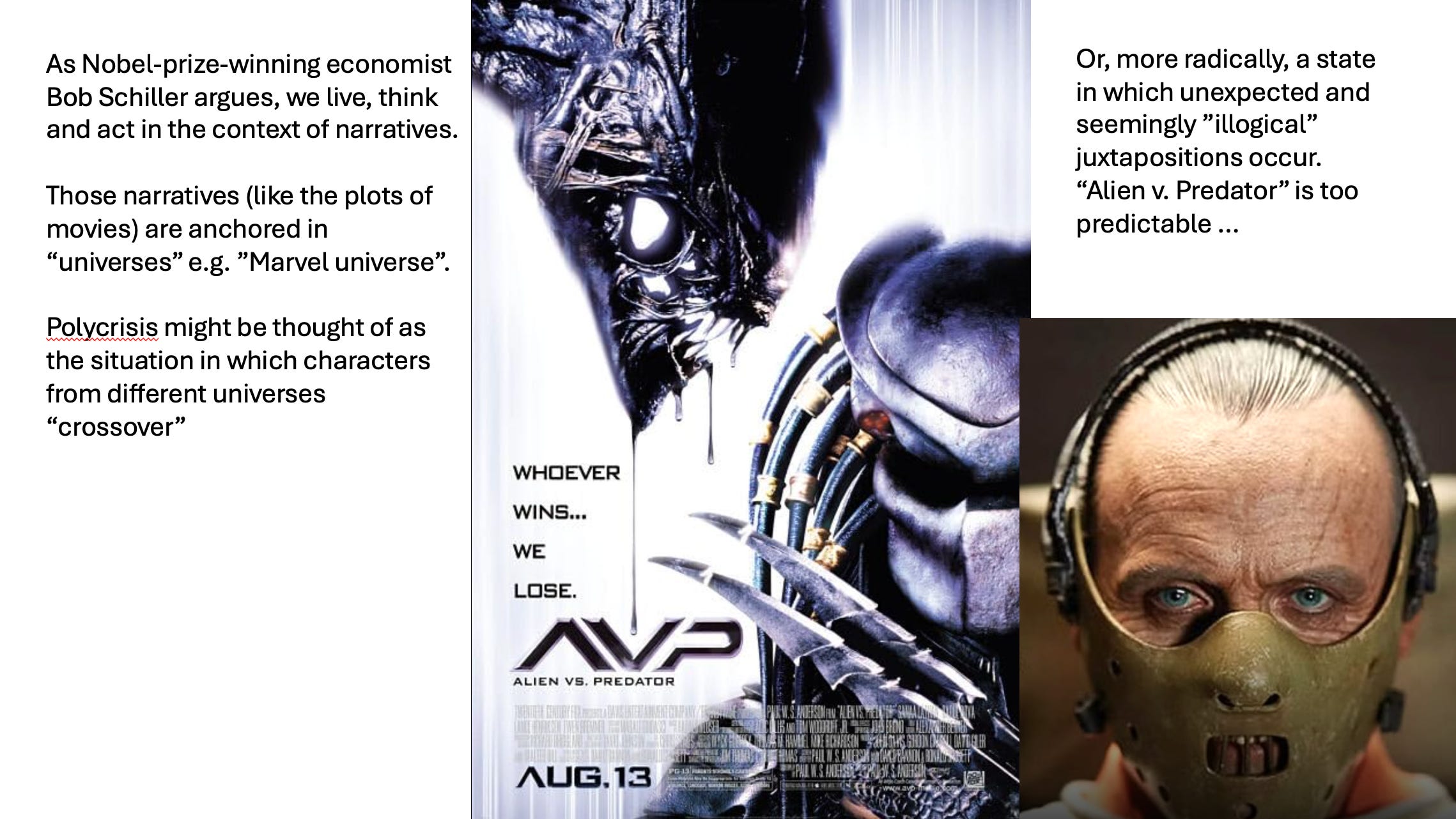
What film are we in now?
My latest argument along these lines was in the FT on Friday, where I argued that the current AI race is NOT, as widely suggested, a re-run of the Manhattan Project.
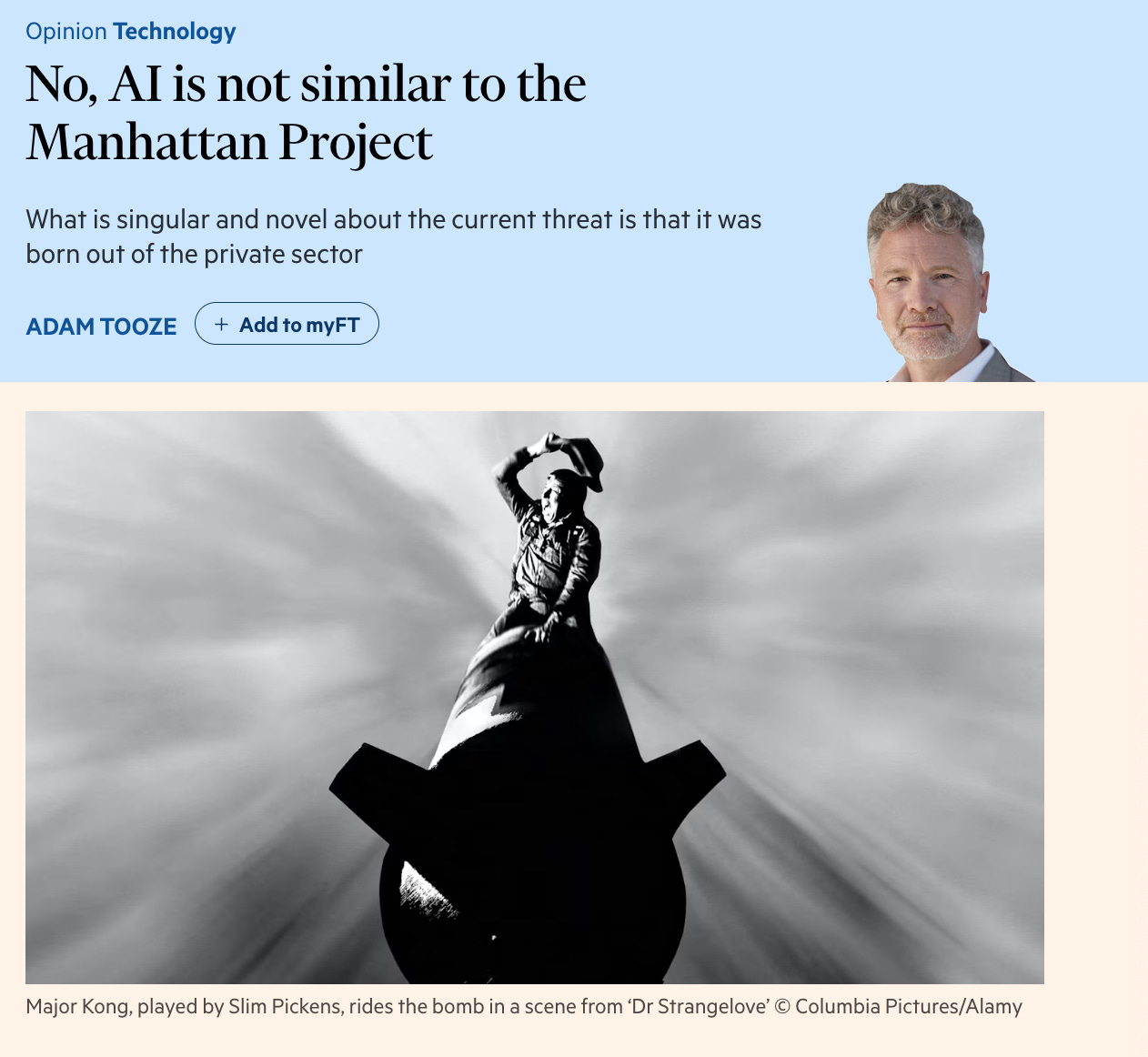
Why not? Because of the political economy …
What separates us both from the Manhattan Project and from Dr Strangelove is political economy. … The world we are in is not that of ascetic bombmakers wrestling with their souls. It is both darker and more mundane. Today’s world-threatening technologies are fuelled by trillionaire greed, junk bonds and jerry-rigged financial engineering.
As a colleague recently pointed out on twitter, if they had made the decision to wind down the Manhattan project, it would not have caused a massive stock market crash.

Esteban Actis@actis_esteban
Si en 1942 se frenaba el Proyecto Manhattan (el desarrollo nuclear),la economia estadounidense no se inmutaba. En 2026 si se frena el boom de la IA, se derrumba la economía de EEUU.
Dos gráficos para entender porqué los incentivos son nulos para poner poner el pie en el freno. …


2:20 PM · Oct 2, 2026 · 1.96K Views
20 Reposts · 58 Likes
Think of my FT piece as the latest installment in a long-running series that starts with polycrisis and neoliberal order breakdown syndrome continues with
Violence and Hyper-agency.
Mar-a-Lago Stockholm syndrome.
The malign coincidence of MAGA and AI.
Trumpite futurism or taking seriously Musk’s space business.
What film are we in now?
In filmic terms (as far as AI is concerned), think Dr Strangelove mashed up with Gordon “Greed-is-Good” Gekko and a dash of The Big Short. If this is the way the world ends, it will be not with a bang or a whimper, but in a whirl of tech jargon, Californian lifestyles and financial engineering.
I love putting out Chartbook. I am particularly pleased that it goes out for free to thousands of subscribers around the world. But, writing this newsletter takes a lot of work. If you are enjoying it and would like to support the project, sign up for one of the subscription options here. It is the equivalent of a fancy cup of coffee per month!