
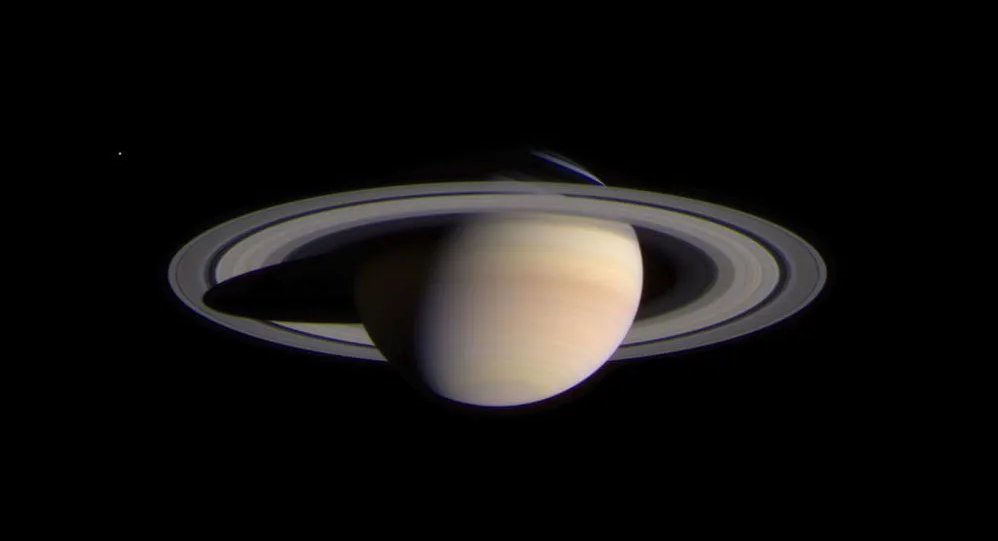
Saturn is big, bright and at its closest position to the Earth.
The ringed planet will be in opposition on Oct. 4, which means it will pass between the Sun and the Earth for a spectacular nighttime sight that will linger through the month.
October also has a double-billing of meteor showers and the appearance of more autumn constellations.
“Fall is a great time of year for stargazing because the weather is good,” said Jackie Faherty, an astrophysicist at the American Museum of Natural History. “Saturn is definitely the star of the month.”
Saturn will be bright enough to be seen over New York City’s light pollution and a full moon.
The best time to spot Saturn with the naked eye will be just after sunset. Look to the southeast, and the sixth planet from the sun will be a shiny, yellowish-orange dot.
“ Saturn will be great into the winter,” said Bart Fried, a member of the American Astronomical Society. “Saturn is just lovely, and now the rings are coming back. They’re tilted about seven and a half degrees.”
The first meteor shower of the month is the Draconids, which runs from Oct. 6-10, and peaks on the night of Oct. 8 with a shooting star about every five minutes. The viewing conditions are favorable because there is a crescent moon, which means the sky will be darker.
”The Draconids are best an hour or two after sunset, so you don’t have to wake up early or stay up late,” Fried said. “Go outside, have a cup of coffee, and watch for some meteors.”
Almost two weeks later, a faster and brighter meteor shower, the Orionids, peaks on Oct. 21. The shooting stars are the result of debris from Halley’s Comet. The Orionids have about twice as many meteors as the Draconids, though the viewing conditions won’t be as good because the moon is around 75% illuminated. Fried said it will still be possible to see them.
“ The Orionids have fast, bright meteors that leave long trails that are really worth it if you see one. It’s pretty cool,” Fried said. “The best plan of action is to wait until it sets in the hours before dawn.”
More of the fall constellations will also come into view as the fall continues. Perseus is visible in the northeastern sky, right near the W-shaped formation of stars called Cassiopeia. The Perseus constellation has a famous blinking demon star, Algol. It’s actually three stars that noticeably dim and brighten on a clockwork-like schedule of about every three days.
Next to Perseus in the southeastern sky is the sea monster, Cetus, the fourth-largest constellation.
For a profound stargazing experience, the Amateur Astronomers Association is hosting its 30th annual Autumn Starfest on Oct. 24 on Pat’s Lawn at Inwood Hill Park. Attendees can expect about 20 high-powered telescopes pointing to the rings of Saturn, star clusters and the Andromeda Galaxy. The event is free and open to the public of all ages. The rain date is the next evening.
“ People cannot believe that you can see the rings and see Saturn with a relatively small telescopes,” Fried said. “ Everybody remembers their first view of Saturn. It’s unbelievable.”