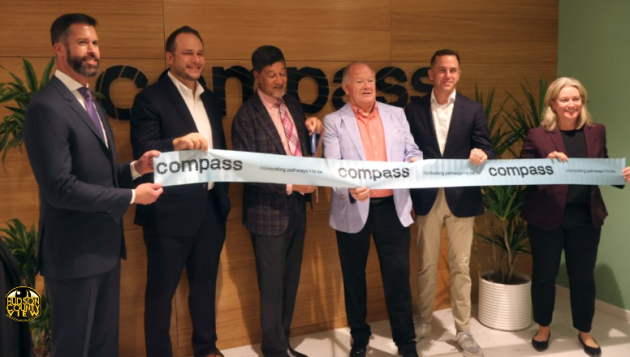
The UK-based Compass Pathways, a synthetic psilocybin company, opened their first U.S. office in Jersey City this afternoon, cutting the ribbon with elected officials.
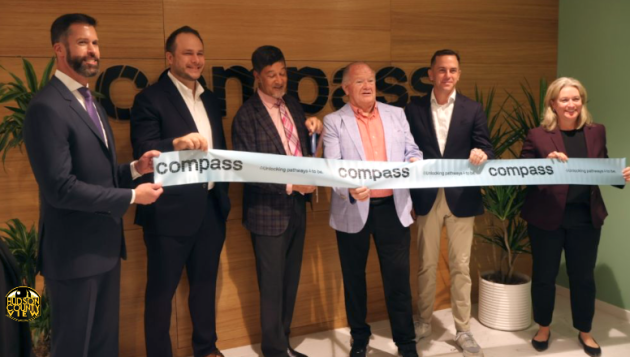
By Daniel Ulloa/Hudson County View
U.S. Rep. Rob Menendez (D-8), Mayor James Solomon, and Hudson County Executive Craig Guy all attended the event along with Compass Pathways CEO Kabir Nath.

Notably, their synthetic psilocybin drug COMP360 has been designated a Breakthrough Therapy by the U.S. Food and Drug Administration (FDA). Therefore, Nath was confident of FDA approval, with clinic treatments beginning in early 2027.
“This space will be home for our Compass U.S. colleagues, working alongside the vibrant life sciences healthcare community in New Jersey. Mental healthcare is personal for me, as I’m sure it is for many of you. It’s touched my life in ways that have shaped my career, and it’s why I believe so strongly in our mission as a company,” he explained.
“Too many are struggling to get better despite the treatments that are available. That can mean years of trying different approaches without finding the relief that they need.”
He further stated that they have developed a synthetic psilocybin drug, COMP 360, based on “vigorous science and clinical development.”
“So how come it’s Jersey City?” Nath asked to laughter. “ … We join the vibrant, innovative life sciences community that’s long been established here. I’ve seen that for myself. I’ve spent many years here living, working, and paying a lot of tax,” he joked.
During his remarks, the congressman noted that New Jersey has been acknowledged as “the medicine cabinet of our country” due to their thriving pharmaceutical industry.
“There are so many across our communities, but specifically our veterans, who I know are hoping to unlock these treatments to get the help that they deserve. I’m excited the government and FDA are being good partners, giving you breakthrough designation,” he added.
“There will be more work for us to partner on. I look forward to being an advocate for you.”
Solomon of course also expressed excitement about choosing Jersey City as their base of operations, not just in New Jersey, but the entire country.
“Kabir said, ‘Why Jersey City?’ I wanted to respond it’s self-evident!” Solomon exclaimed to laughter. “We’re obviously in a region … with such an investment in life sciences. That’s something as an administration, we are committed to grow,” he declared.
Guy jokingly welcomed them to the neighborhood, Suite 340 at 30 Montgomery St. downtown, noting that his first job out of high school was located right next door.
“In my former life as a lieutenant with the Jersey City Police Department, right down the block, 9/11 … This building itself was a melting pot of first responders trying to help the people,” he recalled.
“Those people today still suffer from their mental illness. There’s a PTSD component.So many members of the local police Department suffered from PTSD.”
Nath said their synthetic psilocybin treatment would be individually administered in clinics as part of a six-hour experience. Patients would be observed by a psychiatrist who would be there as a precautionary.
He further stated that the treatment would have to be administered one to three times a year to maintain the effects.
“Eventually, if it becomes widespread, you can imagine group sessions just like happenings in the underground,” Nath noted.
He noted that with underground psilocybin, often referred to as “magic mushrooms” or just “shrooms,” there is plenty of risk involved: “You don’t know what you’re getting.”
Additionally, Nath said the criminalization of small quantities of natural psilocybin for personal use “makes no sense to me.”
“The recreational side will continue to exist and co-exist in parallel,” he added.
Nath said they have a medical FDA-approved model different from the legal shrooms model in Oregon.
“By going through the medical model, it will be up to us to negotiate with insurers and with Medicare and Medicaid to make sure it’s covered,” he explained, also indicating they’re eager to work with them to make it affordable.
Nath recognized that right-wing billionaire Peter Thiel was an early investor, though also pointed out that his firm now owns less than 1 percent of the company.
“The psychedelic community … has a lot of interesting supporters. I was in DC last week … Mental illness is one thing you can still talk to both sides of the aisle about,” he stated.
Nath explained Hackensack Meridian Health hospital might be where their synthetic psilocybin drug could be administered locally since they’ve been working together.
State Senate President Nick Scutari (D-22) championed the New Jersey psilocybin bill that facilitated that. During the process, the bill was amended to remove decriminalization and regulations that would empower local businesses.
The grassroots advocates who initially supported the initial bill were generally not happy with the changes.
The legalization of psychedelics is part of a trend where President Donald Trump‘s (R) administration see the benefits, as well as the profits, that could be made from making synthetic pills.