
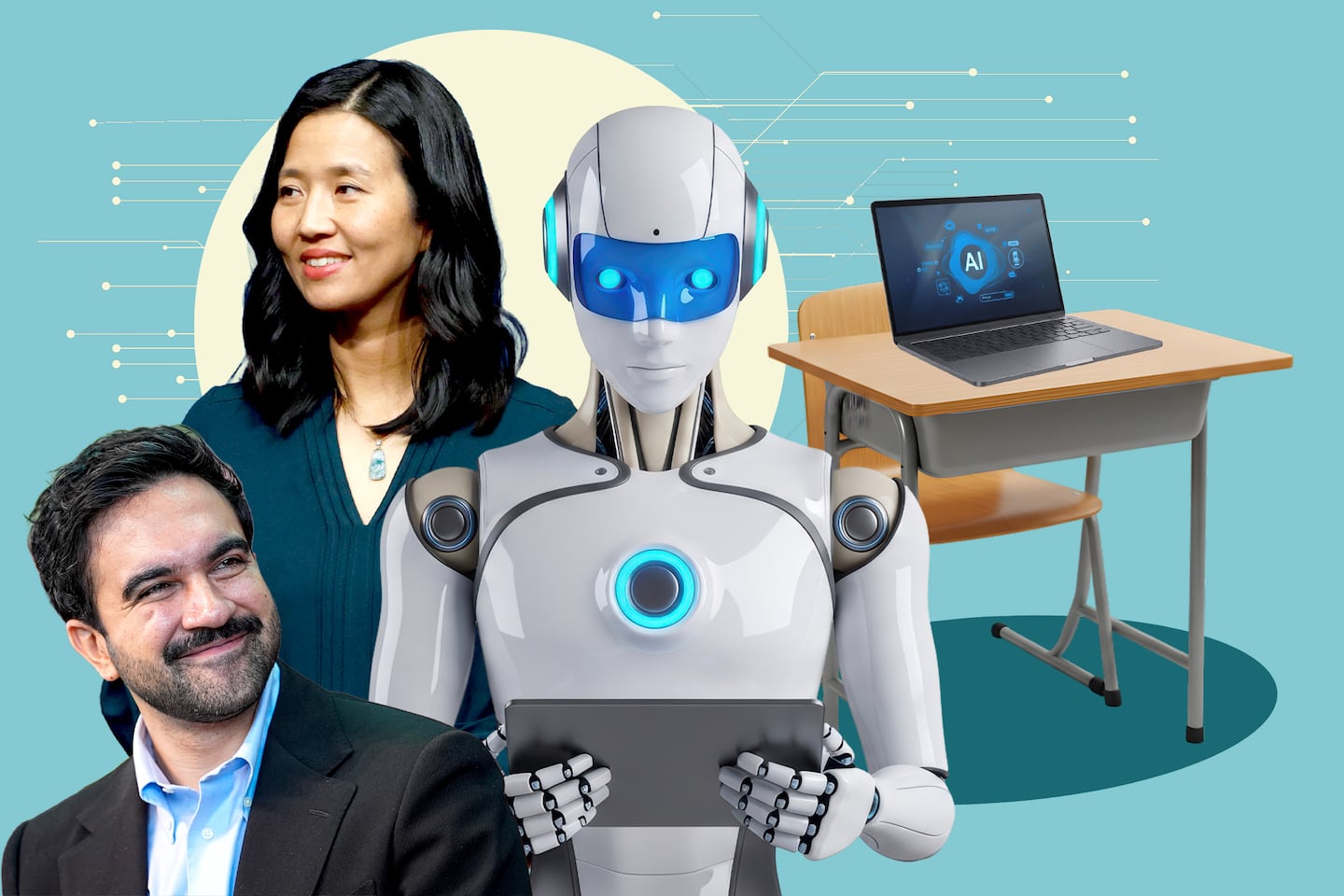
AI bots are used as “thinking partners” for the teams. The idea is that students are required to work through the problem they are trying to solve and identify the materials they need to find before they even touch a chatbot, according to Tara Correa, an Eliot teacher.
“We want to remind them [of] the benefits of using it as a thought partner,” Correa said in a video posted by Boston Public Schools, “not to use it to do their work and take away or strip away their foundational skills.”
AI’s fast-growing power has stoked fears broadly, and schools are grappling with a technology that is already widely used by students outside the classroom. The debate comes down to whether useful AI skills can be taught without damaging students’ cognitive development and ability to learn.
“There’s a risk of not engaging with AI and being left behind. But there’s also a risk that this is going to be harmful,” said Justin Reich, the director of MIT’s Teaching Systems Lab. “There’s no evidence which clearly says that one of these pathways is better than the other.”
Last spring, Mayor Michelle Wu announced the city is partnering with local tech entrepreneur Paul English and the University of Massachusetts Boston to train teachers in using AI for education, and bring that into classrooms of Boston’s public schools.
This August, the city trained its first cohort of roughly two dozen teachers as “AI Educator Ambassadors.”
Wu’s administration declined repeated Boston Globe requests this fall to visit a classroom and observe students and teachers using AI. The administration did invite a reporter to attend an August forum at school district headquarters in Roxbury as part of the training of teachers in grades 7 to 12 as AI education ambassadors.
In announcing the AI initiative last March, Wu told reporters the technology would not replace educators and that students’ private data would not be handed over to an AI company.
“This is about empowering our young people,” Wu said, “to have every bit of knowledge and understanding and fluency to make the most of the choices in front of them and the opportunities in front of them.”
Mayor Zohran Mamdani of New York City struck a very different tone in early September, when the nation’s largest school district announced it was barring younger students from using artificial intelligence.
“The tech industry wants us to believe that AI-powered early education is not only inevitable, but necessary,” Mamdani said at a press conference. “We do not see it that way.”
Artificial intelligence has promised greater productivity and new discoveries while also fueling massive fears about misinformation, job losses, security breaches, and whether society can keep the technology under control.
The landscape has shifted even in the five months between Wu’s announcement of Boston’s AI initiative and New York’s ban in schools. Reports of rogue AI agents have raised alarms about safety, and last month executives from leading AI companies told the UN Security Council their technology carried immediate risks.
Regardless of classroom restrictions, young people are experimenting with the technology.
A majority of US teens use AI chatbots such as ChatGPT and Microsoft Copilot, according to a February report from Pew Research Center, which surveyed more than 1,400 kids aged 13 to 17.
At least three in 10 teens said they use AI daily to help with schoolwork and search for information. And about 10 percent reported they do most, if not all, of their schoolwork with the help of chatbots.
Cheating appears rampant: 60 percent of teens said students at their school used AI to do their work, the study found.
But some experts oppose outlawing AI in schools, arguing it ties the hands of educators who might find useful applications for the technology.
“If a school district decides to ban AI, I think they have really good intentions,” said Eileen McGivney, a Northeastern University professor who studies educational tech. “But I also think that it’s very hard to understand how to use technologies appropriately if you’re not doing some kind of experimentation with them.”
At one extreme are private institutions like Alpha School, a national chain that uses AI tutors to instruct students in core subjects such as English and math. Alpha opened a Boston campus in September for 25 students.
The New York and Los Angeles school districts represent another approach: Rein the technology in, if only temporarily.
In early September, Los Angeles officials prohibited students’ access to AI in school across all grade levels. New York imposed a similar measure, but allows high schoolers to use it. Both cities said the bans are for the current academic year while they study the impact of AI in schools.
Boston’s AI educator ambassadors are being funded by a $1 million donation from English, the cofounder of travel booking site Kayak. Employers expect their employees are going to be using AI, English said in an interview, and cities that impose moratoriums on AI in schools risk their children falling behind.
“We want to be deeply in the classes,” English said, “and ultimately, we want every teacher to be using AI.”
There are signs that even when schools train students how to responsibly use AI, the technology is still abused outside class, according to Mitch Prinstein, a professor of psychology and neuroscience at the University of North Carolina Chapel Hill.
Kids are vulnerable to AI, he said, because they are over-relying on the technology for things like doing homework, and some even forgo human relationships for ones with a chatbot.
“I don’t think AI is ready for kid use yet, period,” Prinstein said. “I’m not saying all AI is bad. I’m just saying it’s currently designed in a way that hooks kids in to use it for bad reasons for too long.”
In June, the Boston School Committee approved an AI policy that limits the technology to serving as a tool that enhances, not replaces, factors like human judgment and critical thinking.
Students below Grade 7 don’t have access to AI chatbots through their Boston school accounts, according to Marcela Dwork, a city spokesperson. In class, students use only approved tools under a teacher’s direction, Dwork said in a statement.
In a video shared on BPS’s Facebook, a student described using AI to help conduct research on immigration and said the technology helped her improve her writing.
But that’s not a universally shared opinion. Laura Lara Soto, a 17-year-old high school student, said her classmates rely too much on AI for schoolwork.
“AI is telling young people what to think, versus young people thinking for themselves,” Soto said in Spanish through an interpreter. “AI is making it easier to do your work, and that’s not necessarily conducive to learning.”
Educators such as Pat Miguel Tomaino, a history teacher at Boston Green Academy, said the city’s AI initiative has provided guidance, but the technology can also interrupt students’ learning.
“I’m reluctant to focus on AI much at all with my students,” Tomaino said. “Our time is better spent practicing essential skills, like argumentative writing, the old-fashioned way.”
Some parents, such as Alessandra Michener, who has three children in BPS, are organizing opposition to AI’s use in classrooms. She said they plan to present a petition to school leaders urging them to hit pause on several classroom technology issues, including screentime and AI.
“I don’t really think it has a place in the classroom right now, until we have an understanding of the actual benefit for kids,” Michener said. “I hope we can get a big group of parents to unite and stand in one voice and protect our kids from this technology.”
John Hilliard can be reached at john.hilliard@globe.com or on Signal at john_hilliard.70. Follow him on Bluesky at iamjohnhilliard.bsky.social.