
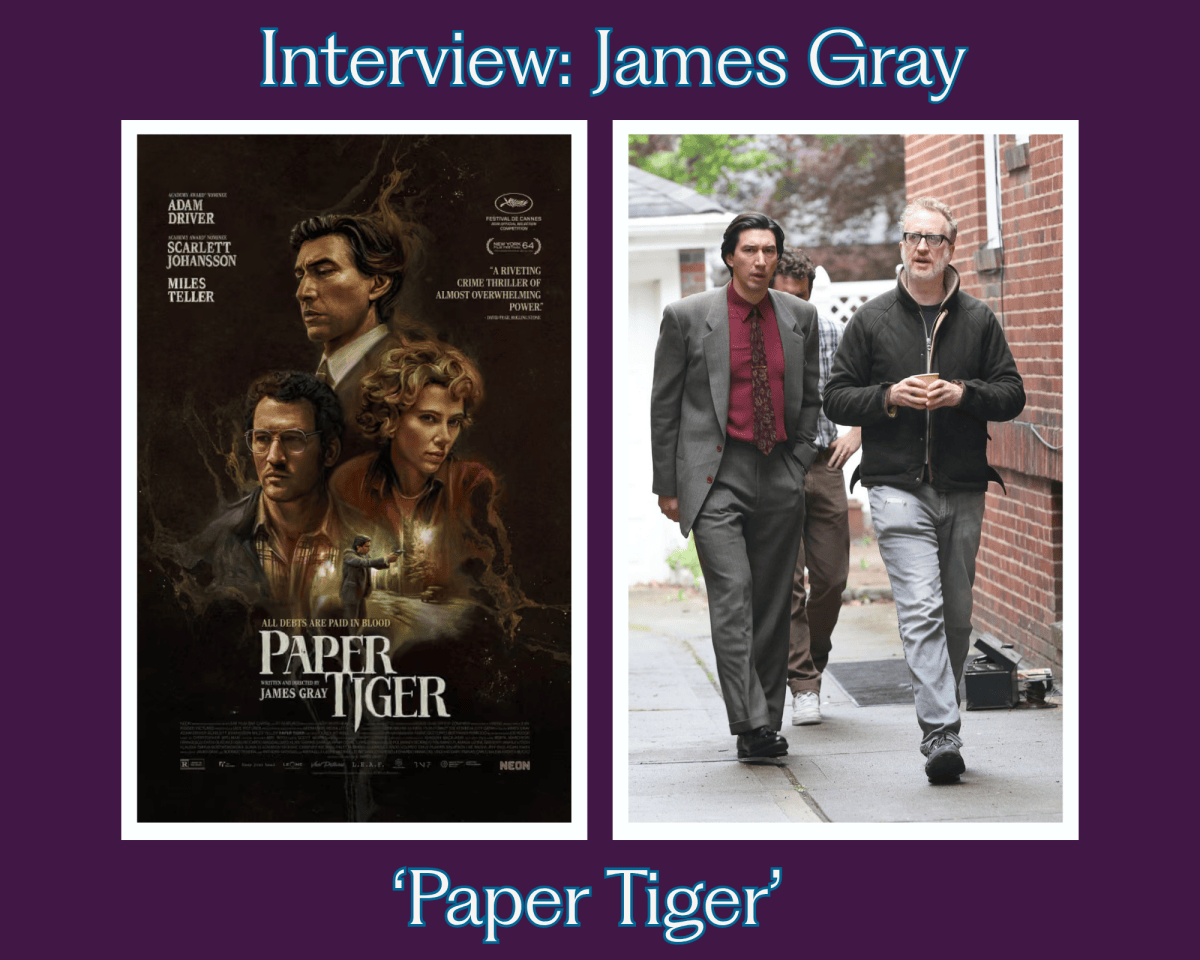
For over thirty years, James Gray has pried open the heart of the American Dream and the people who live and die by it. His ninth feature, Paper Tiger, is his most direct confrontation of the rot at the heart of the nation.
Set in 1980s New York, Gray follows Irwin and Hester Pearl (Miles Teller and Scarlett Johansson), working class parents trying to steer their kids to greater success than either of them had. Like a charming whirlwind busting down their door, Irwin’s brother Gary (Adam Driver) comes to their front door with a proposition, with strings attached to the Russian mafia, lucrative enough to change their lives and dangerous enough to end it.
Paper Tiger finds Gray at his most personal and most suspenseful as he interrogates what makes people yearn for more and why maybe nobody can ever have enough under a capitalist society. During the 49th Mill Valley Film Festival, where Gray was bestowed with the MVFF Director Award, Gray spoke with me about a disappearing New York, his operatic and painterly influences, and the film’s epigraph, pulled from Aeschylus’s Agamemnon.
Mild spoilers on the film near the end of the interview.
August Hammel: “Let there be wealth without tears; enough for the wise man who asks for no further.” Was this a guiding quote in general for the film, when did you first come across this and when did it spark something for you?
James Gray: I wish I could say that I had some grand design and that that was going to be always leading off the movie, but it’s not the way it worked at all. What happened was the movie opens the way it was designed – which is the shot that you see – which is in the trees, going over to the cityscape from 1986, where you see the trade towers and then on to oil drums, but the point there was: when I looked at the film, it was a very good opening. I felt, because you saw the natural world, it looked beautiful, and all of a sudden it became ugly. So I thought, “Oh, this is dramatic,” but what it didn’t do was that it didn’t tell you something was going to go really wrong with that family. It had always been in the DNA of the movie that it would be like a Hitchcock movie, where a normal quote unquote family is greeted with this exterior catastrophe, sort of like The Man Who Knew Too Much. I went back and I looked at The Man Who Knew Too Much because something was bothering me about the opening and at the beginning of that movie, which you could do in the 50s, Hitchcock basically just says, “This is about a tragedy that will befall an American family.” They could do that kind of thing, which of course we can’t. I was trying to think of a quote that could begin the movie that would give you the proper sense of, “Something will go wrong,” but it’s not gonna totally hit you over the head. I had been tasked to read the Aeschylus by a friend of mine who said, “I have to read it because it’s the greatest,” and I had read it in college in 1988 or something, so I didn’t remember. I said, “I’ll reread it,” and I came across that quote and it was perfect.
AH: It sets the tone, the opening minutes do feel cozy and you’re lulled into this, which might be misleading if not for the quote, which does set you on edge.
JG: Well, I’m sorry to interrupt you, but it was a balance because what happened was I had other stuff which was much darker than the quote. I had a couple of the henchmen holding a severed head, but that was too much. Then when you see Miles and he’s calling up to his son and saying “the storm windows” and all that, it seemed like, “Oh my God, that guy’s gonna get his head chopped off,” It was too much. So we needed the balance. I didn’t mean to interrupt you.
AH: No, thank you. You were mentioning moving from the natural into the industrial with the trees and the oil and that’s something that really struck me about the movie. It’s a natural New York. It’s exposing these natural worlds and is very much about the encroaching industrialization and globalization of the ’80s and ’90s into a New York that was already feeling kind of tenuous in its relationship with nature. Especially the ending, which I don’t want to speak too much about, it really struck me. Can you speak about your relationship to the natural New York and how it influenced this movie in particular?
JG: Yeah, I mean, first of all, that’s the first time I’ve been asked that question and it’s a great question.
AH: Thank you.
JG: Thank you. It was always part of the calculus because the whole idea was that the urban pollution and the wreckage wrought upon the city was a metaphor for an unending darkness undertow of corruption. There was an undertow of darkness through the whole system and that pollution is only the obvious surface evidence of a culture and a society rooted and built upon violence and corruption. In that way, and I didn’t think of this making the movie, but it is a bit thematically similar to David Lynch’s movie Blue Velvet. I don’t know if you’ve seen that movie, but if you recall the film, this man is watering his lawn and he has a stroke or something happens to him and he collapses and the camera goes deeper and deeper and deeper into close-ups of bugs of ants. What I was trying to do was – obviously I wasn’t going to rip that off – I was trying to come up with a similar analogy, so what I chose was the natural world being destroyed routinely by the urban one and not just by the urban one, but by the the urban and debased and polluted one. May I say, the essay about New York urban life has been done so brilliantly well, of course, by Martin Scorsese and in another by Sidney Lumet. I Obviously those guys – Martin Scorsese is obviously a titan and Sidney Lumet made so many great films – but I needed to differentiate myself and do something personal. And I’m from Queens, I’m not a Manhattan boy. Queens still had some vague evidence of the land that was there before. For example, when I grew up, there was a farm that was about 10 blocks away from my house where we would shop. A farm. Queens was farmland until 1946, ’47. So there is still a bucolic aspect, but at the same time that there was a farm near me, you smelled only jet fuel in the air because two airports are there. Constant airplanes. Air always smells a little bit like jet fuel. So that contradiction, I thought, would be something new.
AH: You can kind of smell the jet fuel in the last scene with Adam, which I don’t want to talk about.
JG: The movie prior I did has a walk and talk between these two kids outside my public school where I grew up. It was about a two minute tracking shot as they talk, get to know each other, and when we were scouting it, I looked at my watch, I heard a plane fly overhead. I put the timer on and 45 seconds later, there was another plane. I said, “Oh, well, I’m in big trouble because I’m not going to get this walk and talk straight through.” And we never got – I think we did 26 takes and I never got one without an airplane. We finally used one with an airplane and I had to replace some of the dialogue. My point is, I realized immediately, not just the sound, which I had blocked out as a kid, but the smell. That fuel smell. That can’t be good for you.
AH: You can feel it in the texture of this too, and Armageddon Time. Well, I want to speak a little bit about your collaborators and one in particular that you’re re-teaming with here, Joaquín [Baca-Asay], your DP. This movie does feel like the films that he shot, I was thinking a lot of We Own the Night and the last stretch of the movie especially, but [composer] Christopher Spelman. This score gives the movie at the beginning this sort of operatic sense that builds the tonality throughout. Can you speak about what it’s like collaborating – you’ve worked with Spelman pretty consistently as of late – but then re-teaming with someone who you’ve worked with before and what it means to build those relationships over time and how they’ve culminated here?
JG: I have a shorthand with Chris. We have ridiculous non-conversations and I find myself insulting him a lot. “Yeah, what you did is terrible. That doesn’t work.” But of course, a day later, I’ll listen. I’ll go, “Wait, that’s pretty good,” and he tolerates me. I would say beyond his talent, one of the things that is best about him is that he is tolerant of my idiocy because filmmakers, we’re under a considerable amount of pressure and we say and do stupid things all the time and we make incorrect decisions a lot, which most of the time, fortunately, we can reconsider and watch and look at again and say, “Huh, did we make a mistake there?” In that case, he tolerates all of that messiness and he always knows to wait a day for my true opinion to emerge. We had talked about Puccini. We had talked about exactly what you just said, to treat – I don’t want to be pretentious here or anything, but I love opera so much and I think it’s the most like movies of any of the other art forms that were invented before it. One of the things that it specializes in is the intimacy of emotion. Now opera does it in a different way, right? Opera does it through the music and the singing and a devotion to the emotion, whereas movies are very intimate, but the idea is the same. The music of Puccini, well, Puccini started a movement called Verismo, which was all about forecasting or showcasing – excuse me, that’s the right word – showcasing what we might call ordinary people, not kings or queens, and making their stories elevated in importance in drama along with kings and queens. That cultural tradition carried over into the American movies of the ’60s and ’70s, which I was taught by. Those were the movies I first watched as a kid. You feel it, like I just mentioned, the Mascagni music, which is opera, in Raging Bull that Scorsese uses, which lifts the film into a whole other dimension. We used that as a roadmap and you’ll hear evidence or hints of a particular opera by Puccini called Il tabarro. That’s that.
Baca is a different story because Baca – Joaquín Baca – I said I had not worked with him, as you correctly point out, for almost 20 years. We’d stayed in contact because I like him. But I loved what he did with me back in 2006 and 2008. I had a wonderful experience. I think those movies look really great and I tried to get him to do The Immigrant with me, which was the film that followed Two Lovers, the later film that he shot. He was far too happy making huge amounts of money doing television commercials. But after doing that for 20 years, I said to him, “Don’t you need something to fill up the soul?” And he was like, “Yeah, let’s do another movie.” He seemed ready. We had an amazing experience because it was as though not a single beat was dropped. It was very weird because most of the time, my experience has been that people change quite a bit, but with him, we had a shorthand that was right there. I would say to him, “I want this lens,” and he would know exactly what to do. It got to the point about halfway through the shoot, because I work with a cinematographer almost like a lighting cameraman, I’ll set the shot with the lens, and the lighting cameraman weighs in on how the light looks, but towards the middle of the shoot, he started setting up shots and he would say, “What do you think?” And I would have then showed him my notes, which were exactly what he had just done. That’s very rewarding. He seemed to understand what it was I was trying to communicate with the movie. I think the movie looks amazing. We also made some key choices, which are a little bit unusual. We shot Super 35 on film, with all these Super Baltar lenses, which are very old and actually don’t have great optics. They’re a little soft at times, and soft in very unpredictable ways. We shot with exclusively tungsten, which is not the light that’s used now for movies. What’s used now for movies is LED.
AH: It gives it that very period, not just accurate, but evocative feel. It feels very hazy, like a memory.
JG: Absolutely. And the only way to get to that now is with the old lights. Once those burn out, they’re done. So there is a sense of loss that I felt making the film because I’m using very antiquated – even the cameras, there’s not been a film camera made for 35 millimeter motion pictures in 35 years. I think the most recent one was built in 1993, I think by Ariflex, and they stopped making them. They break down a lot. They’re not wholly reliable. But it was very rewarding.
Mild spoilers ahead for Paper Tiger and The Immigrant
AH: I want to ask about the last shot without talking about it too explicitly, because it feels like for you almost variations on a theme with, I was thinking, The Immigrant and The Lost City of Z. Where did that image first come to you and why has it repeated in your work?
JG: I wish I could say that I had planned for a variations thing, which I think is actually a very high calling if you can achieve that because it’s that great idea where you’re trying to focus in on perfecting this one thing. We overrate a diverse artistic portfolio. You know, you look at how many times Van Gogh painted himself trying to discover some greater truth about his own face and what it would reveal about his identity and how elusive that was to him. He kept trying to get it right, or the great Japanese artist Hokusai, how many times he depicted a wave. You’re trying to get at something that reduces your expression to something pure and honest and simple, not simplistic, or easy, but simple, which is very hard to do. I suppose on a conscious level, that wasn’t there, but maybe on an unconscious level, that was desire. On a conscious level, that happened, what happened was, it was written that he looks out the window and he sees the kids walk away. I was like, “Okay, I have a shot of him, and then you see the kids, then you come back to him,” and it was a little bit stiff, you know? I was watching Miles in the close-up through the glass, and I saw the kids talking to each other in the reflection. So I said, “Okay, well, let’s combine the shot so that it can be poetic.” And then, as these things go, it turned out to be literally impossible. As you well know, if you put the camera so that you could see the reflection of those boys, you would see the camera. What you’re seeing is him through the glass, shot practically with the reflection of the boys at an angle so that you don’t see the camera superimposed on the shot of his face. It’s a visual effect.
AH: Was it similar for the last shot of The Immigrant, or was that all in-camera?
JG: That was totally VFX. Now, that shot was designed from the beginning. That was in the script. because that was a very complicated shot. Much more so than it looks, because there’s a move in it. He’s walking away in a reflection of glass. They’re in a boat, nothing could be shot practically. At Ellis Island, the building is two stories up, so you’re seeing only sky. You can’t see the water, it’s a cheat. So that had to be shot as a separate element, that boat, and then put in as a visual effect. Then in the glass, again, you have that issue. You can’t shoot into glass because you then would see the camera. So that has to be shot with him walking away from the camera, reversed, put into a glass-type look. I mean, it was a huge deal, actually. I remember Darius Khondji photographed that film for me. I don’t think he made heads or tails of what I was trying to say and I don’t think he had any faith that it would work. I mean, he did it. I think he was like, “This seems too complicated.” And I like that ending shot quite a lot, I think it communicates something interesting, which is: they both go off to very different fates. That you have, it’s very bittersweet because, Joaquin, his life is going to be ruined. And her life is sort of ruined, but she is going on. She’s going to win in the end.
AH: And there’s something, there’s opportunity ahead.
JG: Exactly.
AH: And it’s similar with the kids in the window of this.
JG: Exactly. You’re quite right. I hadn’t thought of it that way, but you’re right. The kids have opportunity ahead of them. And he has financial opportunity ahead of him, but something terrible is going to hit him very soon. So it’s a complicated thing. As for what you’re trying to do, I was very much enamored with the idea that it’s not really – movies don’t really handle tragedy very well because the movies are like a dream. When your dream ends tragically, which by the way, some dreams do, it’s very disquieting and your day is wrecked. But an upbeat dream is better described as a pleasant fantasy, and that’s altogether not that interesting either. The best endings are kind of like Shakespearean histories, where you have both the sweet and the bitter, that are both in this moment. The Graduate, they escape, but what now? The Godfather, he’s the king, but he’s lied horribly and killed a bunch of people. Even, as stupid as this sounds, you could apply it totally to the first two Star Wars movies, where they win their medals, but Darth Vader gets away, and [George Lucas] was smart enough. He did that before knowing the movie would be a success. He did it before there was supposed to be a sequel. So you know that George Lucas had the idea for story. You’re looking for something that gives you both levels. It’s not so easy.
AH: I always think of Titanic in that regard. It somehow sends you out on a high note, somehow.
JG: Isn’t that weird? It’s kind of a brilliant sleight of hand by Cameron because what was it, 1,300 people died, and the protagonist – I guess it’s the co-protagonist, split protagonist – one of the protagonists freezes to death with hypothermia and sinks to the bottom of the Atlantic. The other one survives, but her true love is gone. I don’t know how he pulled that off. That’s pretty good.
AH: And in this, Miles’s smile and walk away conveys kind of the same thing. It’s balancing both.
JG: Well, that’s what you’re trying to do. By the way, something that is really, really important, the idea of the happy ending, it’s actually not a studio film concept. People mistake that for a studio film concept, it isn’t. It’s a concept that started probably in the late ’80s, because people forget that the end of the, in many cases, rightfully maligned now, but hugely successful Gone with the Wind is Rhett Butler saying to [Scarlett O’Hara], literally, “Frankly, my dear, I don’t give a damn.” And he leaves her. That’s not really a happy ending. I mean, he says to the protagonist, I don’t give a shit about you, I’m done. Even The Wizard of Oz, right? She has to go back to Dust Bowl Depression Kansas at the end. It’s a Wonderful Life has such a melancholic pull. His life has been brutalized. So I think the beauty of these films – certainly Vertigo, I wouldn’t call that a happy ending. Psycho, the body count, you know – what they had was a beauty of story where they were satisfying but not condescending.
AH: Paper Tiger manages that in spades.
JG: Wow, I think I like you. I appreciate that very much.
[We get the signal that it’s time to wrap up]
JG: [to me] Do you want to ask me one more? Ask me one more.
AH: Do you have time for one more?
JG: One more. I’m throwing down. One more. Quick question.
AH: This film is about these two brothers, but Miles Teller’s children are also two brothers. There’s obviously a lot of parallels within this narrative, but there’s a lot of parallels to your work. Could you speak about your personal ties – because you’ve spoken about this being a deeply personal film and tied to Armageddon Time in that way. So how is it personal in regards to the brotherhood?
JG: Inside that relationship with your brother, It could extend to, of course, to sisters, but that familial relationship is endlessly fascinating because, again, like we just talked about with the bitter and the sweet, it’s like that line from the great play, A Long Day’s Journey to Night, where he says to Jamie, his brother says, “I love you more than I hate you, kid.” That these things act in parallel. The resentments are built up from a very early age, but so is the love. So you have the capacity to explore both sides of the human condition. That’s what I think.
Paper Tiger opens in limited release on November 13 from NEON and will expand on November 20.
 August Hammel is a recent graduate from San Francisco State University’s journalism program and has written reviews and conducted interviews for AwardsWatch. He was born in San Diego and lives in San Francisco. When not writing, he can be found in a theater as he searches for what he wants to write about next and why. August can be reached at his email [email protected]. Latest posts by August Hammel (see all)
Continue Reading