
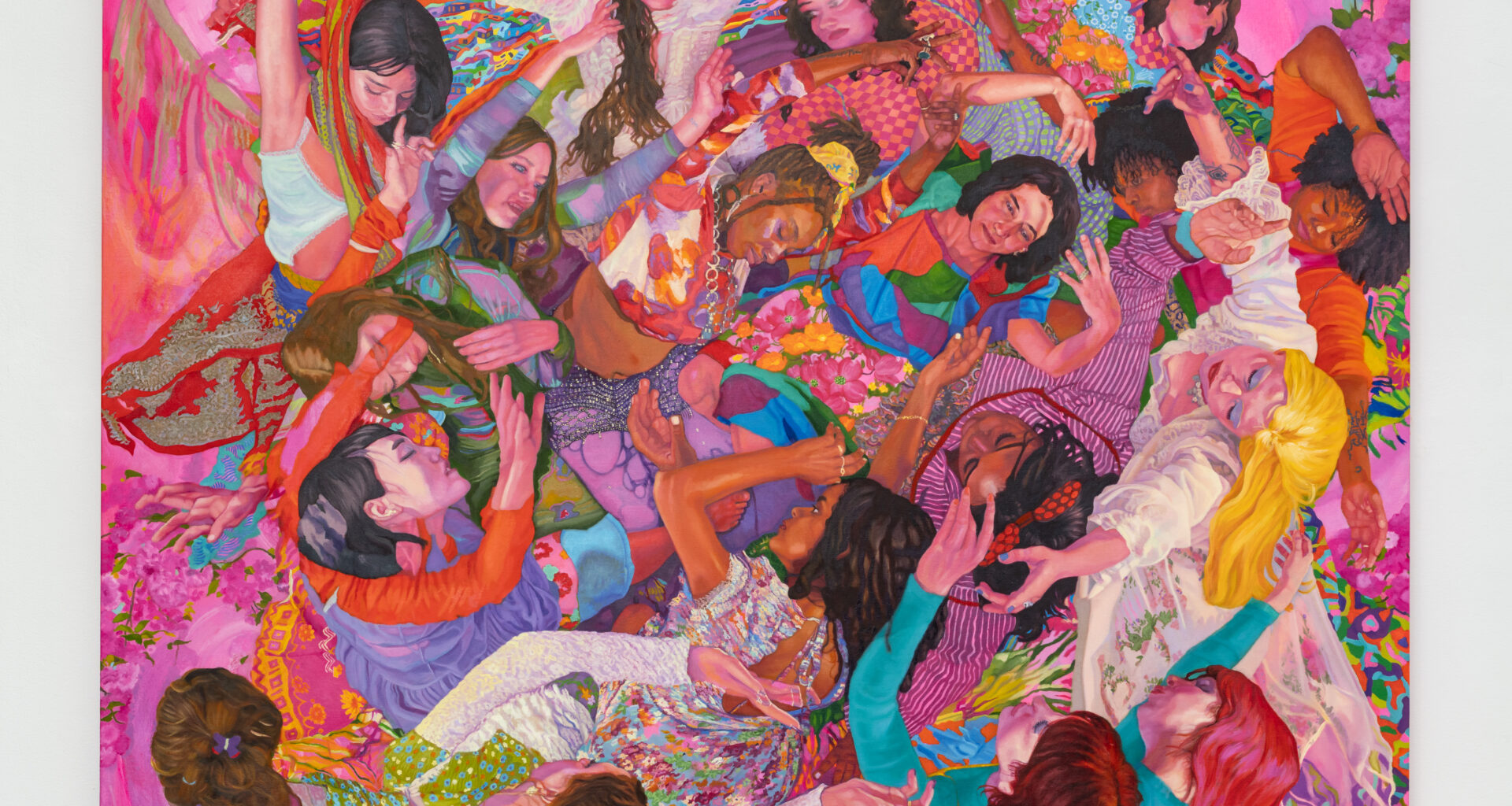
Patches For a Broken Harmony
Kravets Wehby Gallery
September 10–October 10, 2026
New York
The people in Savci’s life finding their way into her work are the window through which she lets viewers into her home world. Although some of her models are people she’s met since her move to New York twenty years ago, others are old kin from Turkey. (She realized her creative ambitions in adulthood after immigrating from Istanbul.) By grounding her kin in oneiric fantasies of rest, Savci assembles places that push relaxation into a context of labor.
The emotional qualities that make nostalgia unattainable are embodied in the decompressed figures she features. In Fractured Harmony (all works 2026), creased floral dresses and bundles of lush curls—attention to sumptuous details—hint at Savci’s Symbolist inspirations, her first inspirations being Edvard Munch and Gustav Klimt.
While using polished mediums to render fabrics with oil paint, Savci enlivens her work by cradling focal weight through the variety of patterns. The audience’s eyes are led by the rhythm of its distribution. Her painterly cadence animates a pattern that overlaps feint geometry, and the patterns of her life become reliable symbols that dress how she reflects on her relationships through time.
By painting kin from Turkey and associates from New York City, she subverts distance. In Savci’s earlier works, inflatables conveyed immigration-related imagery that reached security through survival. Patches For a Broken Harmony abandons symbols of survival to extract meaning from communal security.
Her nostalgia-steeped inspirations carry her mother’s work as a seamstress and her father’s eye for history. The storied past of dyed cottons, wools, and hemp in Turkish textiles awakened her attraction to pattern in youth. As a child in her mother’s bridal boutique, Savci used excess fabrics to dress her dolls. Her zeal to drape sumptuous textiles over choreographed bodies in paintings reproduces her adolescent alacrity to adorn dolls.
Savci’s formative reproductions emerge in Ghost of a Ballerina. Thirteenth-century Persian ogee arches surround refined women whose poses point downward to a ballerina bounding in ethereal blues. Rhythm directs focus and uses spectacle to hide mourning. Perpetual suspension liquidates grief and protects nostalgia as a site for reverence. Fourth-century Greek and Byzantine ruins, shown to her by her father, echo her juvenile aspirations and serve as symbols of Savci’s past to help express her ambitions into the future.