
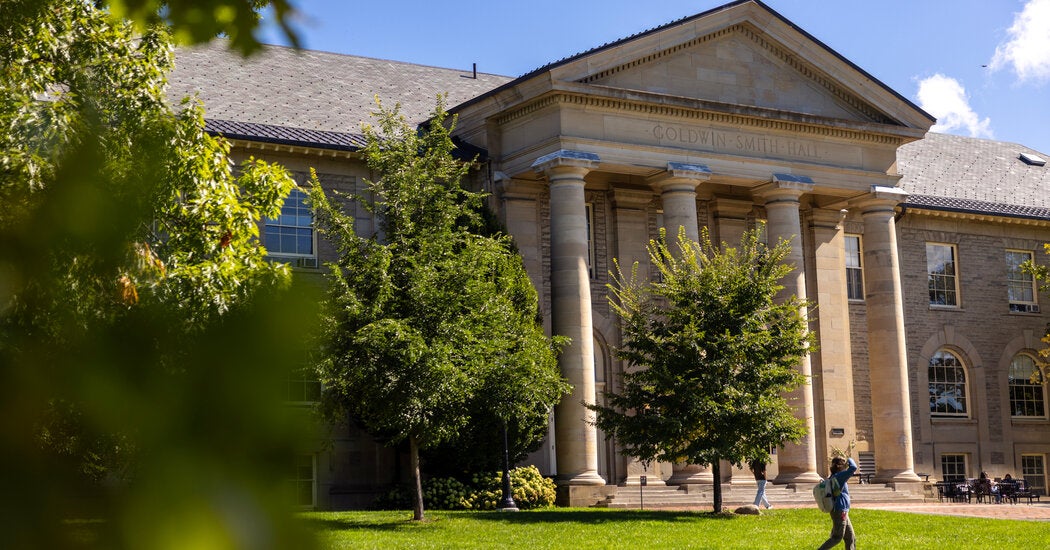
The leaders of Cornell University, already embattled over the school’s handling of sexual assault allegations on campus, received another blow late Monday when the school’s faculty senate gave notice of plans to vote on a rare resolution of no confidence in the school’s administrators.
Although largely symbolic, the measure and its apparent support among faculty members promised to increase pressure on the university’s president, Michael Kotlikoff, and other leaders as they face condemnation over Cornell’s handling of a reported sexual assault on campus in 2024.
“The faculty senate has no confidence in the ability of the central administration to effectively address the ongoing crisis of sexual assault at Cornell University,” a draft of the resolution read as of Monday night.
A university spokeswoman did not respond to requests for comment.
The measure comes as Cornell has grappled with its response to a lawsuit filed by a former student, identified as Jane Doe, who accused seven members of the Chi Phi fraternity of sexual assault at a house party in October 2024.
Less than 24 hours after faculty senators began sharing their plans for the vote, a panel of 11 university officials held a virtual webinar-like meeting with professors and staff members, reading prepared remarks and taking vetted questions.
Mr. Kotlikoff called what happened a “horrific” assault several times and said that he wanted Cornell to “become a model for what it looks like to change culture,” according to a recording obtained by The New York Times.
In interviews with four faculty and staff members who attended the meeting, though, all said they were frustrated by parts of the response — and the rigid format of what was promoted as a “town hall.”
Mr. Kotlikoff expressed concern that shutting down fraternities could simply move problems “into the shadows.” To several who attended, that statement felt like a retreat from his Saturday pledge to take a “a serious look at the role of fraternities and sororities on campus.”
The meeting featured a lengthy discussion of the Title IX process for investigating allegations of sexual assault, but some saw an administration whose central message was: The system we have in place ultimately did its job.
“I was very unsatisfied,” said Anne Marie Brady, a research director in the Worker Institute at the university’s School of Industrial and Labor Relations.
“They’re very much on the defensive,” she said. “They’re in the phase of just not wanting to acknowledge that this administration played a crucial role in why we’re at this place that we are today.”
Another member of the faculty senate, Iris Packman, said that she walked away with questions left unanswered.
“I did not see any concrete examples of how change has happened,” Ms. Packman said. “To me, it’s also quite shocking that the president would call it horrific sexual assault, name it for what it is. But then also say ‘Well, we did nothing wrong.’”
She added: “I certainly think he has lost the confidence of many of the faculty and staff, students and alumni.”
The turmoil on Cornell’s campus followed Jane Doe’s allegations that she was plied with drugs and raped over several hours beginning on Oct. 19, 2024.
The Tompkins County district attorney reviewed a complaint filed by the woman in 2024 and declined to prosecute. All the accused men have denied wrongdoing, and none have been charged with a crime.
If the faculty was to pass a no-confidence resolution concerning the university’s administrators, it would not lead to their removal, Richard Bensel, a professor of government and a member of the senate, acknowledged on Monday.
But he added that it would be potent, still, for the sting of disapproval it would deliver to those in charge of the university.
Ariana Kim, an associate music professor and faculty senator, summed up the message such a vote would send to Cornell’s leadership: “We don’t believe you’re fit to run this institution.”
Last week, Gov. Kathy Hochul appointed the state attorney general, Letitia James, as special prosecutor, empowering her to conduct her own criminal investigation into Jane Doe’s allegations.
And on Monday, thousands of students, joined by some faculty members, gathered in protest in the center of the university’s campus and marched to a main administrative building. Many members of the Cornell community who attended the protest directed their frustration at the university president, Mr. Kotlikoff.
Administrators were expected to hold another meeting Wednesday afternoon with a select group of alumni volunteers and leaders.
In their meeting with faculty and staff members on Tuesday, college officials noted that some are teaching classes in which accused men who remain on campus are among the enrolled students — which those instructors say has been a challenge to navigate.
Kavita Bala, the provost, promised that Cornell would help find solutions for the “difficult situations that you’re dealing with.”