
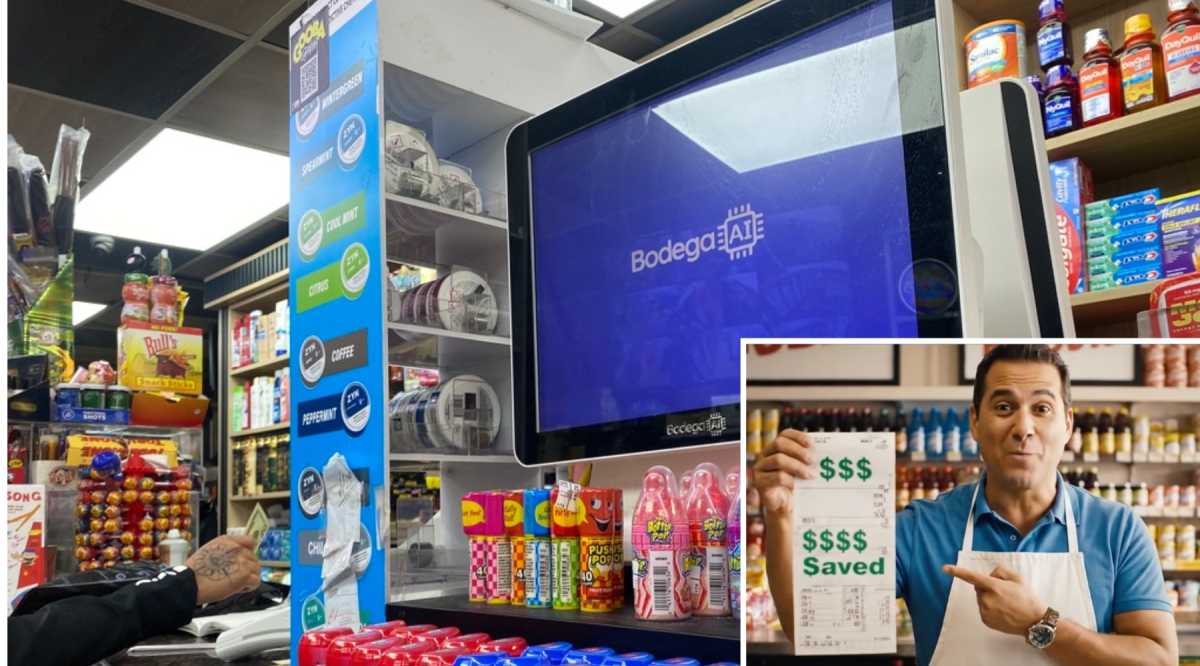
New Yorkers are getting used to seeing AI-generated signs and posters on neighborhood storefronts, from bodega windows to signs at deli counters. Less visible is what the technology is starting to do behind the counter — including helping some stores decide what to charge.
At one Brooklyn deli Tuesday afternoon, a worker scanned a box of Life Cinnamon cereal into the store’s new point-of-sale system, Bodega AI, while showing amNewYork how it handles pricing. The price of the cereal was set at $5. Directly underneath, a purple box offered some advice.
“AI Suggested Pricing: $5.00,” the Bodega AI register read. “Stores in your area offer higher/lower at a $5.00 average.”
A sliding scale put $2.50 at the low end and $7.50 at the high end.
The pricing feature is built into the point-of-sale system, though the recommendation does not pop up every time an item is rung up for a customer. A worker can scan an existing product, open its price-editing screen and see Bodega AI’s recommendation.
When the worker did that with a bottle of Coca-Cola Zero, the store had $2.49 entered in the price field. Bodega AI suggested $4.95 and displayed what it called the average price at stores in the area, along with a range from $2.48 to $7.43.
The system does not automatically impose those prices. But it puts information about what other stores are charging directly in front of a merchant as the merchant decides what to charge.
And those comparisons can be localized.
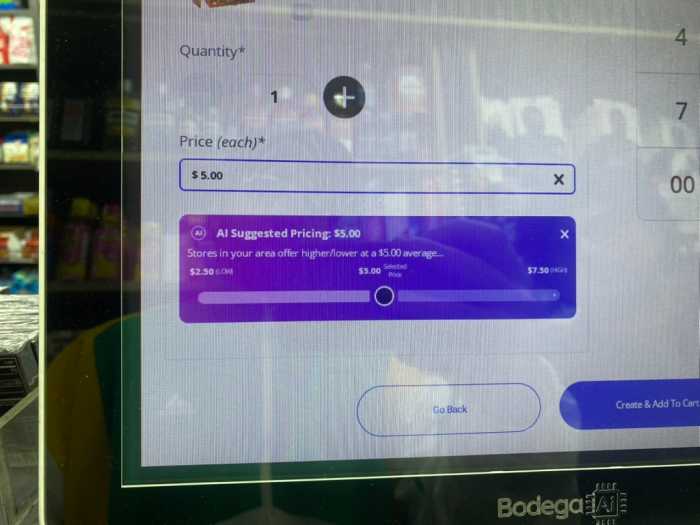 A Bodega AI point-of-sale system at a Sunset Park deli shows an AI-suggested price alongside what it describes as the average and price range at other stores in the area. Photo by Adam Daly
Charles Sepulveda, co-founder and CEO of Xtraspots, an authorized Bodega AI distributor, told amNewYork the pricing system draws from Bodega AI users as well as outside sources.
“It’s public data and also actual Bodega AI user data,” Sepulveda said.
He said merchants can narrow the information geographically, including down to a ZIP code. Sepulveda also said the pricing data are continually updated and that a price entered by a Bodega AI merchant can feed back into the database.
That means a neighborhood store can use information about prices in its surrounding market when deciding whether it is charging too much or too little. He noted that merchants do not see other stores’ private information, but can see a range based on the comparison.
The merchant still makes the final call
“It will never change itself,” Sepulveda said. “It’ll give you recommendations, but it’ll never change itself.”
He said Bodega AI does not currently engage in the kind of automatic surge pricing that could, for example, make the iconic bacon, egg and cheese sandwich more expensive at a busy time of day. Instead, he said, the system compares a store’s price with prices elsewhere and tells the merchant where it stands.
Sepulveda said the system also does not prevent a merchant from manually changing a price again later the same day.
The difference matters as lawmakers weigh new restrictions on high-tech pricing and the role algorithms can play in helping set prices.
The worker in Sunset Park said his store does not simply follow whatever number appears on the screen.
The store already has established prices for many of the products it regularly sells. For less familiar or less frequently sold items, he said, staff sometimes look at Bodega AI’s recommendation.
Their starting point remains the delivery receipt. The worker described calculating what the store paid for each item in a case and then deciding how much of a markup made sense. A small deli buying fewer products at a time, he said, can pay more per item than a supermarket placing larger orders.
“That’s how we price ourselves, and we compare that to it too,” he said.
The result is a blend of traditional corner-store pricing and the kind of market data more readily available to larger retailers. The store still sets the price, but an algorithm is now offering another number to consider.
Bodega AI appears to have begun gaining a foothold in NYC.
amNewYork has directly seen Bodega AI terminals at two Brooklyn stores. At a Greenpoint bodega, the protective plastic was still on the screen, and a worker said he was pleased with the new system.
The worker in Sunset Park said his cousin’s deli in Park Slope also uses Bodega AI.
Sepulveda said Xtraspots had placed “about 50” Bodega AI systems, though he did not specify where those stores were located, adding that they have “a lot of pending installations” on the books.
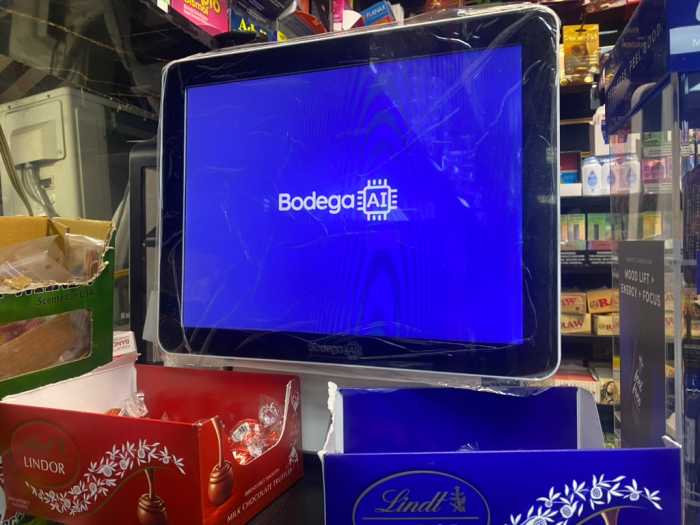 A newly installed Bodega AI point-of-sale system at a Greenpoint bodega, with the protective plastic still covering the screen. Photo by Adam Daly
‘Stop Guessing & Losing $’
Price optimization is a central part of Bodega AI’s pitch to independent stores.
In one of several AI-generated promotional videos on its website, a character says, “Bodega AI price recommendations helped pay my electricity bill last month.”
Another says, “Before Bodega AI, I was operating blind, working too hard and burning money.”
A September sales and training presentation reviewed by amNewYork calls one feature “AI Price Optimization: Identify underpriced items.” Another section promotes “AI Price & Product Recs” with the phrase “Stop Guessing & Losing $.”
The same deck tells sales representatives to reassure skeptical merchants that the AI is a helper and that store owners remain in control.
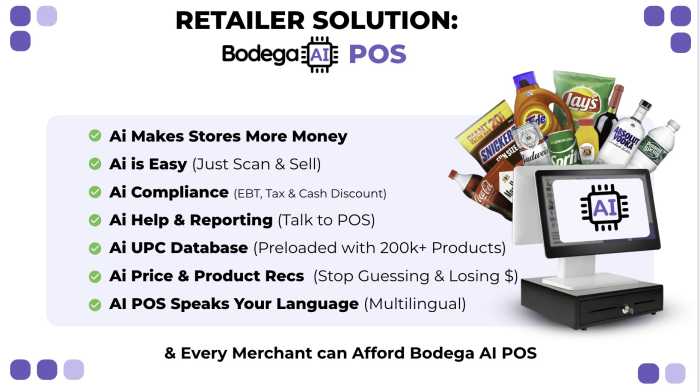 A September Bodega AI sales and training presentation promotes the system’s AI pricing tools as a way for merchants to identify underpriced items and “Stop Guessing & Losing $.” Obtained by amNY
In a demonstration of its AI recommendations, Bodega AI says the system is designed to help merchants make decisions based on what it is seeing “in the market and in other stores near you,” including what products to carry and “what you should be pricing.”
The demo shows separate reports for items priced below and above average. When showing the below-average report, Bodega AI says the information can help merchants make pricing decisions “so you can maximize profits.” For products priced above average, it says lowering the price could help increase sales.
Another Bodega AI video aimed at payment-system sellers describes its pricing agent as comparing “every single SKU against a massive network of benchmarks,” flagging what is overpriced and, “more importantly,” what is underpriced. The video claims the tool can uncover “a hidden 10% or more in margin” for store owners.
Bodega AI’s public blog calls the feature “peer benchmarking” and says it compares a store with “comparable stores.” The system amNewYork viewed in Sunset Park included separate reports for items priced below and above average.
Exactly how Bodega AI builds those comparisons is less clear.
 A still from an AI-generated Bodega AI promotional video shows a fictional bodega owner saying that before using the system, he was “operating blind, working too hard and burning money.”Photo via Bodega AI
Sepulveda said the system uses Bodega AI user data and public information, and he said merchants can drill the comparison down geographically.
But Bodega AI did not respond to questions from amNewYork about which merchant information is used to calculate a benchmark, how the stores included in an average are selected or how those averages are calculated.
The company’s partner materials say Bodega AI owns the POS platform, data and infrastructure.
The Sunset Park worker said the POS’ comparisons are not always useful.
He recalled one product for which the system showed what he considered an obviously unrealistic average price. He said the store contacts support when it encounters problems with the information.
He also said his store would not raise a price simply because Bodega AI indicated that it could.
But when asked whether another merchant might use a higher recommendation as a reason to charge more, he said he could imagine it.
“I could see people taking advantage of it,” he said.
The workers amNewYork spoke with said they liked the system, and the Sunset Park worker described the pricing recommendation as one consideration alongside the store’s wholesale costs and its own judgment. Sepulveda also argued the system can give shoppers more transparency at checkout because its second screen shows items and prices as they are rung up.
Antimonopoly advocates have, however, warned the City Council about third-party platforms influencing prices across independent businesses.
That issue is now beginning to overlap with an unfinished debate at City Hall.
City weighs rules for high-tech pricing
A bill introduced earlier this year by Council Member Shaun Abreu would prohibit covered retail food stores from increasing the price of an item more than once in 24 hours.
The legislation would limit the frequency of price increases regardless of what prompted a store to raise the price. It would not prevent a store from lowering a price.
Bodega AI itself does not automatically make repeated price changes, but merchants retain control over the prices they enter into the system and can manually change a price more than once in a day.
Intro. 892 remains laid over in the Council’s Committee on Consumer and Worker Protection after a June hearing.
Abreu said his office is continuing to discuss the bill with stakeholders as pricing technology develops.
“We are continuing to talk with stakeholders about the bill to determine the best path forward for it,” Abreu said. “With pricing technology evolving, we need to ensure consumer protection and transparency, and we’re committed to getting the bill right.”
Council Speaker Julie Menin’s Intro. 891 addresses a different practice: surveillance pricing.
The bill would prohibit businesses from offering different prices to specific consumers or groups based on personal data collected through surveillance technology.
There’s no evidence Bodega AI is changing prices based on who the customer is. The system is giving the store a recommended price for the item.
Menin reiterated at an Oct. 6 press conference that she wants the city to act on surveillance pricing while the state pursues its own legislation.
“We are looking to pass a bill on surveillance pricing in the city of New York, the state is looking to do their surveillance pricing bills,” Menin said. “Those go hand in hand, and we’re working in lockstep with the state. It’s beneficial to have both from a regulatory purview.”
Her bill also remains laid over in committee.
State lawmakers passed the One Fair Price Act in June. The current version would prohibit surveillance pricing statewide, including the use of personal data to offer different consumers different prices for the same goods or services. The measure has passed the Senate and Assembly but has not been enacted.
Those city and state proposals are aimed principally at two practices: using information about a consumer to personalize prices and, in Abreu’s bill, repeatedly increasing grocery prices within a single day.
Bodega AI presents a somewhat different issue. Its recommendations, based on the information available to amNewYork, draw on information about products, stores and markets rather than personal information about the shopper. And the recommendation goes to the merchant, who decides whether to act on it.
That concern surfaced in written testimony submitted to the Council after its June hearing.
The American Economic Liberties Project, an antimonopoly advocacy group, urged lawmakers to amend Menin’s proposal to “restrict third-party platforms from restricting, influencing, coercing, or setting the prices of independent businesses who use their platform.”
In the same testimony, AELP cautioned that Abreu’s bill could end up targeting independent grocers, which it said largely do not engage in surge pricing and can themselves be squeezed by larger companies and online platforms.
Lee Hepner, senior legal counsel for the group, told amNewYork that its use of “influencing” was intended to include situations in which a third-party service recommends prices even if it does not directly set them.
“When third-party pricing services integrate with multiple independent businesses and start aligning their competitive pricing strategies, that’s no different than the old-school price-fixing agreements formed in smoke-filled backrooms,” Hepner said.
Hepner said his concern extends beyond automatic surge pricing or surveillance pricing.
“We also know that small businesses don’t do things like surge pricing or surveillance pricing,” he said. “But integrating with third-party tech can lead to the same harms.”
Hepner was describing what he sees as a broader competition risk from shared pricing platforms. amNewYork found no evidence that Bodega AI forces merchants to follow its recommendations, penalizes stores that reject them or automatically coordinates the final prices charged by different businesses.
Bodega AI’s materials and the merchants interviewed by amNewYork instead indicate that the final decision remains with the individual store.
Business groups have also warned the Council against restricting technology that could help smaller retailers compete.
In its testimony, the Manhattan Chamber of Commerce told lawmakers in June that the businesses it represents are not the companies running surveillance or dynamic pricing and that many are on the receiving end of pricing set by data-rich competitors.
Bodega AI makes a similar case in its marketing.
Its sales materials frame the system as a way for smaller stores to use data and pricing tools more commonly associated with larger retailers. One section describes the confidence a merchant might gain from feeling, “I’m finally running my store like the big chains do.”
Sepulveda said the AI pricing feature is one of Bodega AI’s biggest selling points, particularly for merchants moving from basic registers or older payment terminals.
For the Sunset Park worker, however, the decision still begins with something much simpler.
He looks at what the store paid. Then he looks at what the computer says.
“That’s how we price ourselves,” he said, “and we compare that to it too.”