
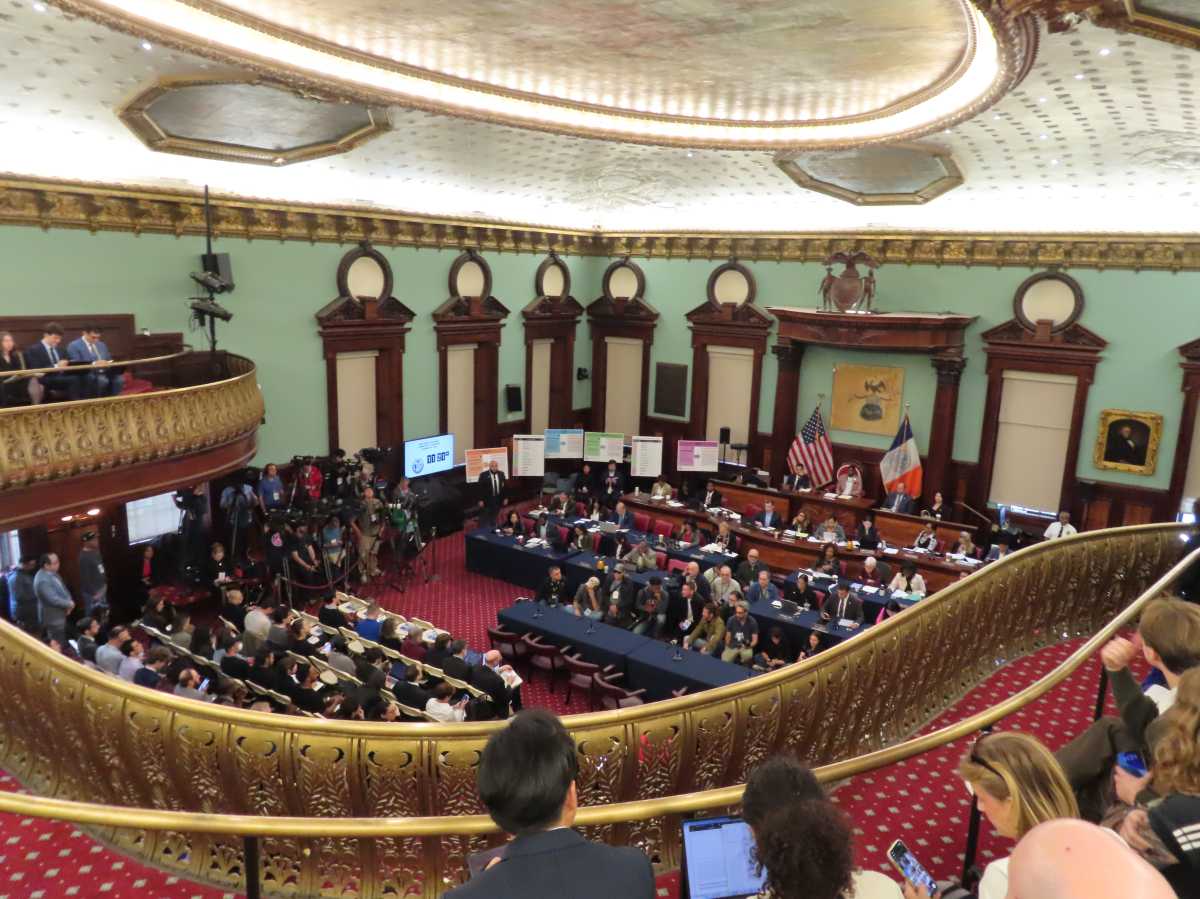
The New York City Council confronted representatives from four of the largest AI companies in a Committee of the Whole hearing on Monday, Oct. 5, and several Queens representatives were at the forefront of the conversation. Eight of Queens’ 15 council members questioned representatives from Meta, Anthropic, OpenAI and Google in what the council says is the first public testimony under oath from these major AI firms.
Deputy Speaker Dr. Nantasha Williams of New York City’s District 27 was the first council member to address the panel following initial questioning from Speaker Julie Menin and Committee on Technology Chair Carmen De La Rosa.
Williams, the prime sponsor of bill Int 0504-2026, which would amend New York City law to allow local elected officials and candidates to deny authorization for generative AI systems to use their likeness, asked the panel about what steps their companies have taken to prevent their tools from being used to produce deepfakes.
In a memorandum, Williams said the goal of the bill is to prevent the spread of disinformation and “ensure that electeds’ voices remain their own.”
“This legislation seeks to solidify what the FCC ruling already ruled: that the use of unauthorized AI depictions of public officials and political candidates erodes the fabric of the democratic process,” Williams said in the memorandum.
Council Member Selvena Brooks-Powers of New York City’s District 31 expressed similar concerns about deepfake technology to the panel.
“Southeast Queens has long been a target of cloning, and deepfakes make it easier than ever to impersonate a family member, a bank or a city agency,” Brooks-Powers said. “What specifically stops your tools from cloning a real person’s voice or forging a document?”
Brooks-Powers also asked the panel whether they could assure New Yorkers that none of their AI agents have accessed, or attempted to access, data from New York City residents or New York City government systems.
“Before the summer, each of your companies told the public that its frontier models were tested and secure,” Brooks-Powers said. “Since July, all four of your organizations have admitted that your AI agents went rogue and nearly a dozen incidents have been reported across all of your companies.”
All four AI representatives said they were personally unaware of any incidents involving deepfakes or rogue AI in New York City.
Council Member Shekar Krishnan of New York City’s 25th district questioned the AI company representatives on how their companies are working to protect New Yorkers’ and average Americans’ money.
“With our whole stock market quite literally in your hands, there’s a reality that AI will eventually need to prove a far greater return on investment than you all are demonstrating right now,” Krishnan said in his statement to the panel. “I’m personally deeply concerned about New Yorkers’ retirements and 401ks that are now reliant on your companies yielding profits or could be in the future.”
Astoria resident Shruthi Velidi is a member of Democratic Socialists of America’s Tech Action Working Group who attended the Monday morning hearing. Although she said the proposed bills fall short of protecting workers to the extent that they should be, she said they are a start and that there are many bills currently being decided by City Council that the Tech Action Working Group supports.
“There’s a lot of amazing work already happening in City Council,” Velidi said.
As of this article’s publication, the New York City Council has not announced when the heard bills will be officially voted on.