

As the Jewish community gathered at memorials across New York City and around the globe to remember the 1,200 victims of the Oct. 7 Hamas terror attack in Israel in 2023, local lawmakers and community leaders gathered in Gravesend to call for a permanent memorial honoring the victims.
The group, which included Jewish politicians State Sen. Sam Sutton, U.S. Rep. Dan Goldman, NYC Comptroller Mark Levine, NYC Council Speaker Julie Menin and Council Member Eric Dinowitz, made the call at a press conference in Gravesend.
The proposed tribute would be installed at the Mickey Kairey Garden at Avenue R and E. 5th Street. Kairey was a decorated combat medic in World War II and a founding father of the Magen David Synagogue. The 6-foot-by-6-foot installation would occupy part of the triangular green space, making it the first permanent public site honoring those killed and taken hostage three years ago.
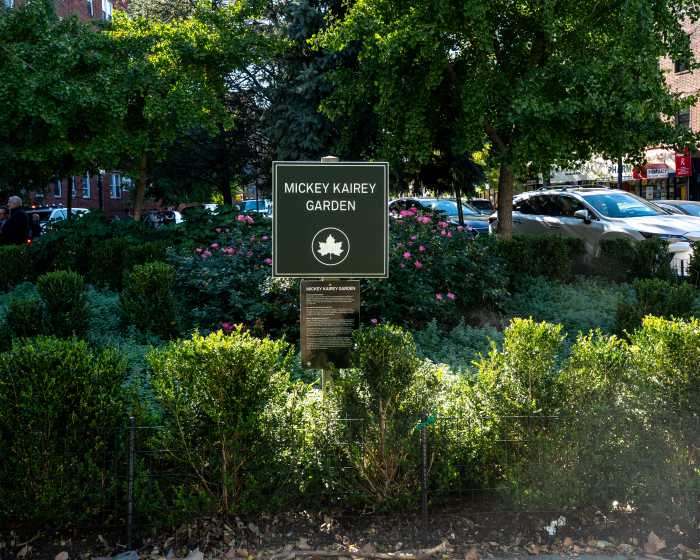 The Oct. 7 memorial would be installed at the Mickey Kairey Garden located at Ave R and E 5th Street. Photo by Gabriele Holtermann
State Sen. Sutton (D-Brooklyn), who hosted the press event alongside District Leader Joey Saban, vowed that the Jewish community would not be intimidated or silenced amid increased antisemitic attacks.
“We will not let them rewrite history. We cannot erase the blood of the innocent. We cannot erase the agony of the hostages. You cannot erase the sheer savagery of that day. No, sir. That is why we are here. That is why this memorial is needed,” Sutton said. “This sanctuary of memory will declare to the world: We remember. We know the truth. And as long as we live in this great city, those who were stolen from us will never be forgotten.”
Community members would privately fund the design, installation and upkeep of the memorial. Sutton noted that the project must be approved by the New York City Department of Parks and Recreation. He said the waiting period for memorials is 10 years after an event. However, NYC Parks’ rules require “there be a minimum of five (5) to ten (10) years between an event and its commemoration to allow for sufficient historical perspective.”
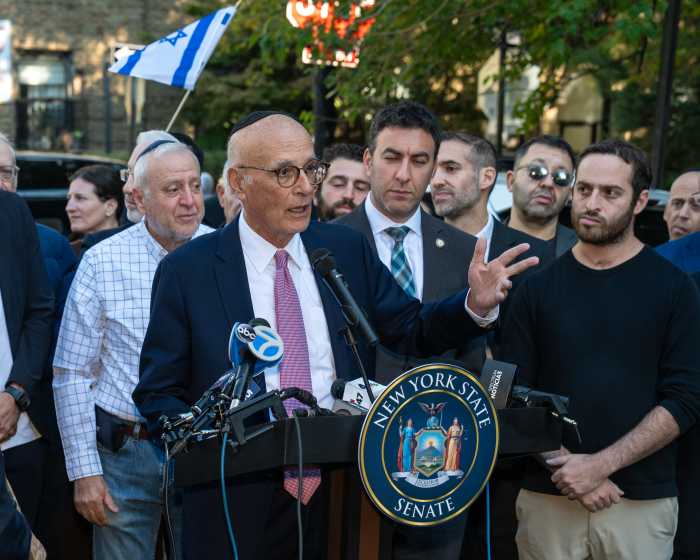 State Senator James Sutton called on the Parks Department to approve the memorial. Photo by Gabriele Holtermann
However, Sutton was confident Parks would make an exception to its rules, especially given the support from high-profile politicians and the department’s previous exception for the 9/11 Memorial. The Parks Department had not yet returned requests for comment by press time.
“We believe we will make enough of an effort to make sure this gets passed and gets passed soon,” Sutton said.
Menin, the daughter of Holocaust survivors, said Oct. 7 was a difficult day for the Jewish community and pointed out that the heart of the message “Never Forget” was to “Never repeat.”
“Yet, as attacks on the Jewish community skyrocket right here in our great city, and those attacks are often met with a mute response, it feels as though that message is fading into the background,” Menin said. “And yet we must endeavor to implement that lesson — a critical one anywhere, but especially right here in New York City, home to the largest Jewish community outside of Israel.”
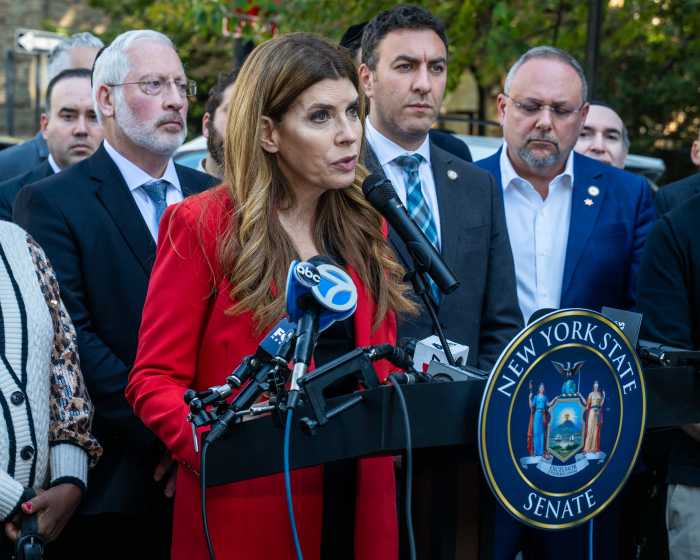 Council Speaker Julie Menin pointed out that the heart of the message “Never Forget” was to “Never repeat.” Photo by Gabriele Holtermann
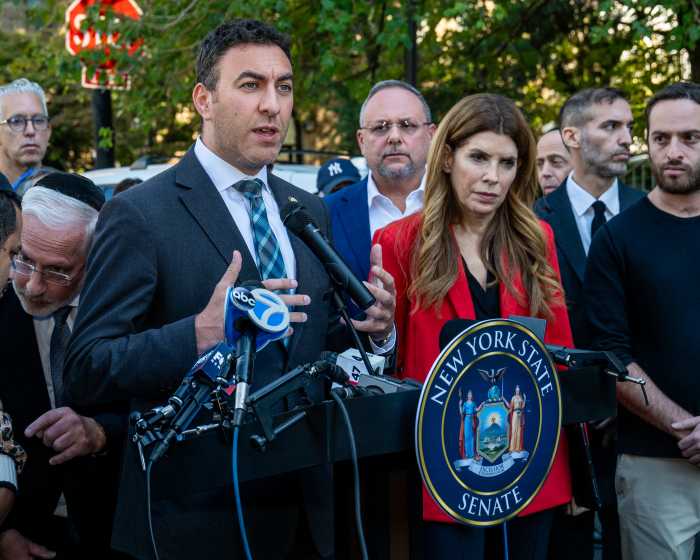 Council Member Eric Dinowitz visited the Nova Festival Victims Memorial where he met a survivor. Photo by Gabriele Holtermann
Dinowitz visited the Nova Festival Victims Memorial, which includes photos of the victims, last summer. There, he met a survivor who told him she had acted dead for hours while people around her, including two of her friends, were killed.
“She took us over to the picture [of her friends], and I just had this image of her just putting her hand on the picture, like she was clinging to the memory of her friends. She was trying to cling on to what she remembered of them, and she was just mourning the loss. She was sharing the story with us so that we would all know, and none of us would forget,” Dinowitz recalled.
Deputy Consul General of Israel in New York Eyal David said a permanent memorial is critical in the face of rising antisemitism.
“[The Memorial] will serve as a sanctuary to remember those murdered and taken hostage, to honor their grieving families, and most importantly, to educate future generations and ensure the truth prevails over political distortion,” David said.
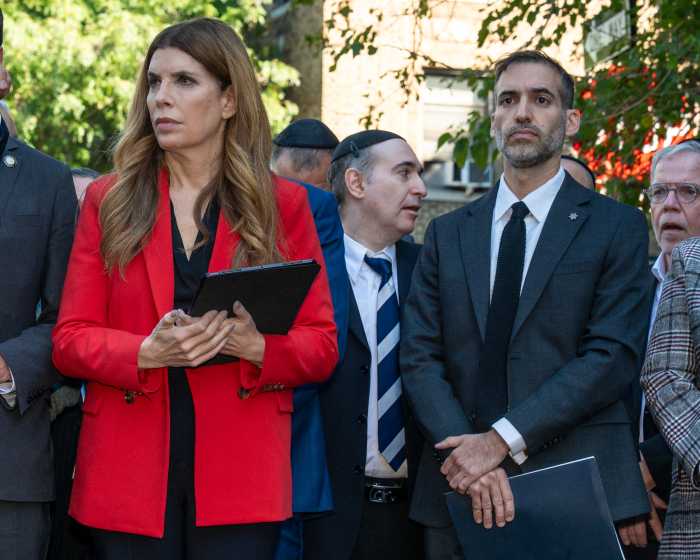 Council Speaker Julie Menin and Deputy Consul General of Israel in New York, Eyal David attend the press conference. Photo by Gabriele Holtermann
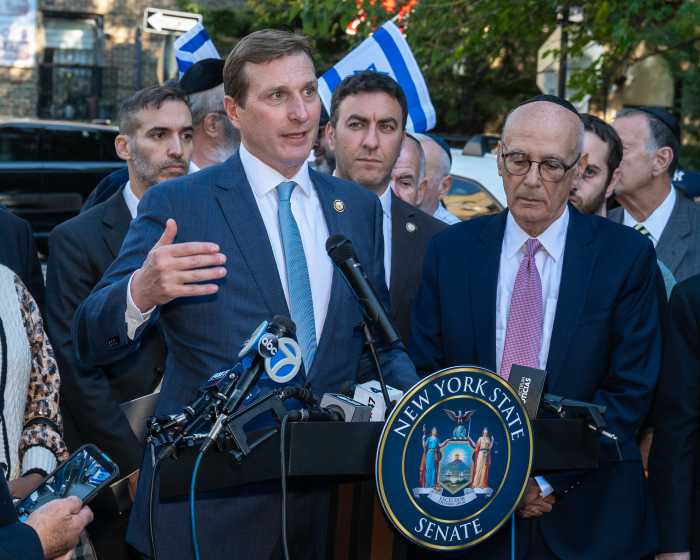 Congressman Dan Goldman said that Oct. 7 was also a day to remember that Israel was created in the aftermath of the Holocaust. Photo by Gabriele Holtermann
Rep. Goldman, who was in Tel Aviv with his family on Oct. 7, 2023, recalled how they had to scurry to a bomb shelter to avoid rocket fire from Hamas. He said the day was also a reminder that Israel was created in the aftermath of the Holocaust, which he described as the “worst genocide in the history of mankind.”
“Many countries refused to accept Jews, and so a state was created as a safe haven for Jews, not to the exclusion of anyone else, but just so that Jews will have, always have, a place to live in their ancestral homeland. And today, that fight is more important than ever. And it’s important to keep in mind, it’s not a fight that excludes anyone else from having their own state,” the outgoing congressman said. “We will continue to remember this day as a hallmark, as a signal of all those from Iran to their terrorist proxies that solely have a mission to eradicate Israel and defeat democracy.”
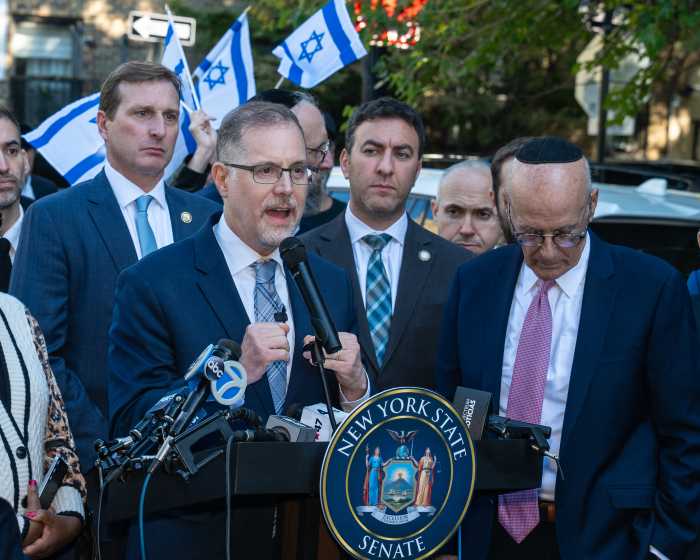 City Comptroller Mark Levine stressed the importance of a physical place to remember the Oct. 7 victims. Photo by Gabriele Holtermann
While a design for the memorial has yet to be finalized, Comptroller Levine said it was important for New Yorkers, who experienced the tragedy so viscerally, to have a physical place to remember the victims of the Oct. 7 attacks.
“That we have a place where a teacher can bring students and tell the stories of the victims; where a family can come, and a child can ask their parents, ‘Who were these people? What were their stories? Why were they murdered?’” Levine said. “The least we owe those victims is memory. It is to tell their stories; it is to answer those children’s questions, so that never, ever again such a horror is perpetrated on our people.”