
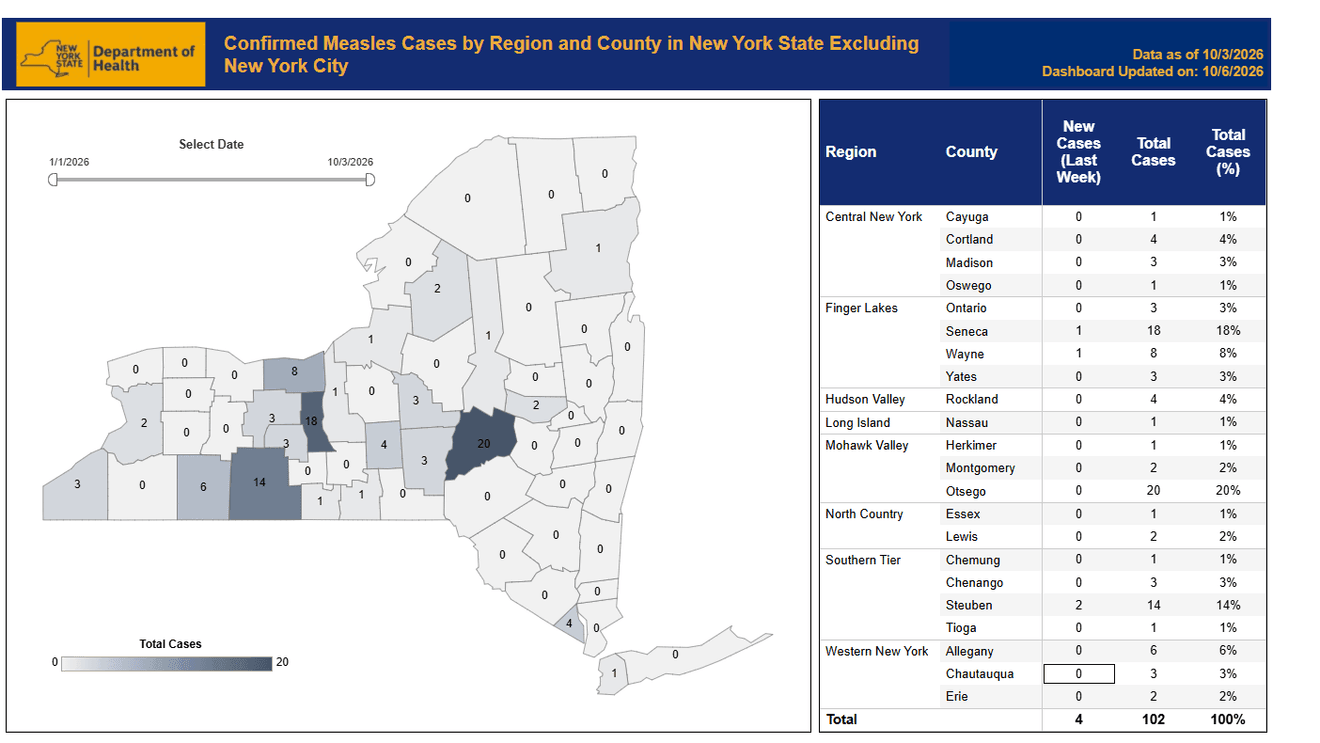
Measles cases are rising in New York as outbreaks continue across the country, with 100 cases reported statewide, including two in nearby Montgomery County. As the virus spreads, Gov. Kathy Hochul has declared a state of emergency.
The latest case map shows the biggest concentrations of measles in Otsego and Seneca counties.
In Montgomery County, Health Department Director Sara Boerenko said about a dozen people have been tested after reaching out for help because they believed they might have symptoms. “Individuals have called us and asked us for assistance in getting tested because they thought, perhaps they had a rash that could mock measles or they had some symptoms such as a cough or a high fever, but we’ve only had two confirmed positive cases at this point,” Boerenko said.
Of those tested, only two were confirmed positive, and neither person was vaccinated. After confirmation, Boerenko said the health department contacted the patients to conduct contact tracing and worked with their doctors to ensure they were getting the treatment they needed while monitoring symptoms. “So a simple cough might turn into something a little more extensive, the rash might become a little more irritable or irritant spread,” Boerenko said.
Boerenko said the two confirmed cases have already made a full recovery with the help of antibiotics, ointments, rest and fluids. But she warned the illness should not be taken lightly. “We should always be concerned about the measles because it is 100% preventable and if it is a severe case of measles and somebody has severe symptoms, it can be fatal, there have been deaths again for measles in the state,” Boerenko said.
Doctors say vaccination is the best way to fight measles. Dr. Lauren Jen, vice president of the New York American Academy of Pediatrics, Chapter 3, said, “If you’ve been vaccinated and your children have been vaccinated, you can feel very comfortable. This is a very effective vaccine.”
Symptoms of measles may include a bad cough, fever or rash.
Doctors say there is little reason for concern for people who are vaccinated, but there is concern for those most vulnerable, including infants less than 6 months old.