
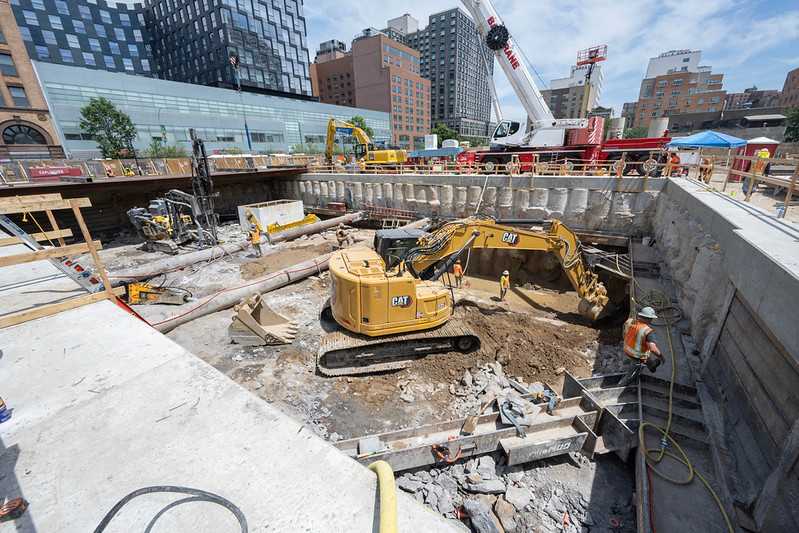
The MTA is moving ahead with expanding the Second Avenue Subway stretch of the Q line underneath 125th Street west to Broadway with the same massive drills it is currently using to carve Phase 2 of the project below East Harlem.
The transit authority formally kicked off on Thursday the environmental review process for the project’s next phase with the release of a draft scoping document, which outlines the various studies that the MTA will undertake to assess the project’s impact on Central Harlem.
The agency also launched the project’s public comment period, during which area residents will be able to weigh in on the scoping document’s contents at public sessions and via mail, which began on Oct. 7 and continues through Nov. 13.
There will be two virtual public meetings via Zoom on Thursday, Oct. 22 — one from noon to 2 p.m. and another from 6 to 8 p.m. An in-person gathering will take place on Tuesday, Oct. 27 from 6 to 8 p.m. at the Adam Clayton Powell, Jr. State Office Building.
“Given the huge potential to save time and money, it would be irresponsible not to explore options to keep digging westward under 125th Street,” MTA Chair and CEO Janno Lieber said in a statement. “And we are of course making it a priority to get community input and feedback as we kick off the environmental review process.”
Some Harlem community leaders, including heads of the 125th Street Business Improvement District and Manhattan Community Board 10, aired concerns directly to Lieber this week about the MTA moving forward without including them. For his part, Lieber said the project is in the early stages and that they will get to provide input during the environmental review.
The agency will compile the results of those studies, along with public feedback it gathers on the contents of the scoping document, in a draft environmental impact statement that it will release for the project — likely in the first quarter of next year.
MTA Construction and Development President Jamie Torres-Springer said that keeping the tunnel boring machines running is a way to expedite the creation of a crosstown Harlem train line, while saving hundreds of millions of dollars. Those findings came from a feasibility study that Gov. Kathy Hochul directed the MTA to conduct in 2024 on keeping the tunnel boring machines going past the Phase 2 terminus.
“The 125 Street tunnel extension is another example of the MTA’s commitment to explore ways to deliver upgrades better, faster, and cheaper—saving time and money by reusing the tunnel boring machines already in motion for the Second Avenue Subway,” Torres-Springer said in a statement.
However, the project entering environmental review only involves boring the new tunnel tubes, along with infrastructure required to maintain the passages, such as egress shafts and ventilation equipment.
It does not include new stations, tracks, power, and other elements needed for train operation. Those parts of the project will receive a separate, future environmental review.
Once the overall project is complete, there will be three new Q train stations on 125th Street at Lenox Avenue, St. Nicholas Avenue, and Broadway. Those stations will connect the Q to seven north-south Manhattan train lines: the 1, 2, 3, A, B, C, and D.
The MTA projected the undertaking will cost $7.55 billion in its latest 20 Year Needs Assessment, where the effort was first proposed, and will benefit 240,000 daily riders.