
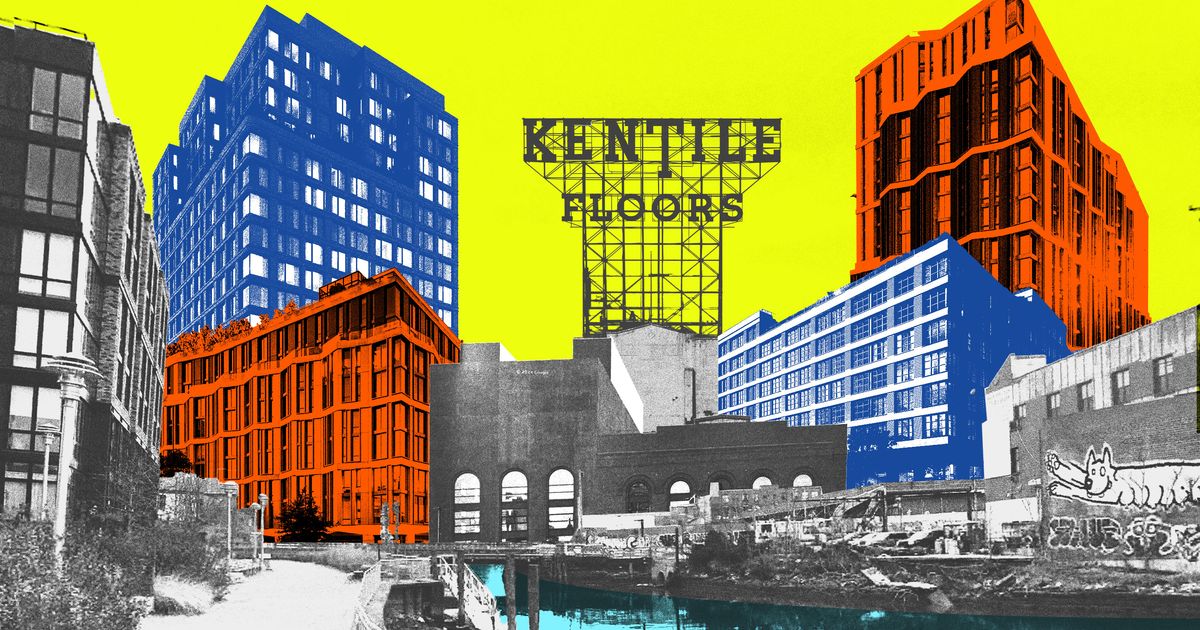
Photo-Illustration: Curbed; Photos: Field Condition, FXC, Getty, Google Earth, HELLER, VMI Studio for IF Studio
Jamie Courville and her husband, Chris Reynolds, moved to Gowanus in 2009, a year before the canal was designated a Superfund site and the federal clean-up process kicked off. As filmmakers, they were drawn to the unexpected beauty of the desolate, postindustrial landscape. “You couldn’t take a bad photo of it,” says Courville. Besides all the visual stimulation, those warehouses and defunct factories also made for excellent studio spaces, and while there wasn’t much housing other than the NYCHA projects, apartments tended to be cheap and spacious, if a bit rundown. Courville and Reynolds rented a well-size 1,100-square-foot apartment in one of the older residential buildings for around $2,000 a month, where they also worked. At a time when other industrial neighborhoods like Williamsburg and Long Island City were being remade into shinier, more generic versions of their former selves, Gowanus still felt mysterious and full of possibility. “There was a lot going on behind closed doors,” says Courville. It felt feral and gross and hopeful and free.
Of course, there was a reason why Gowanus was still a haven for artists in 2009, when so many of the surrounding Brooklyn neighborhoods had gentrified: the noxious, flood-prone canal running through it, filled with sewage, toxic sludge, and pretty much “every imaginable pathogen.” “I used to say I would never raise kids here,” said Karen Gibbons, an artist who moved there in the early 1980s. But she and her husband did — three of them, plus numerous cats and dogs. As with a lot of life decisions in New York, real estate was part of it — they ended up with two sprawling lofts, one protected under loft law, one a shared studio space — and, like Courville and Reynolds, had fallen under the spell of the place.
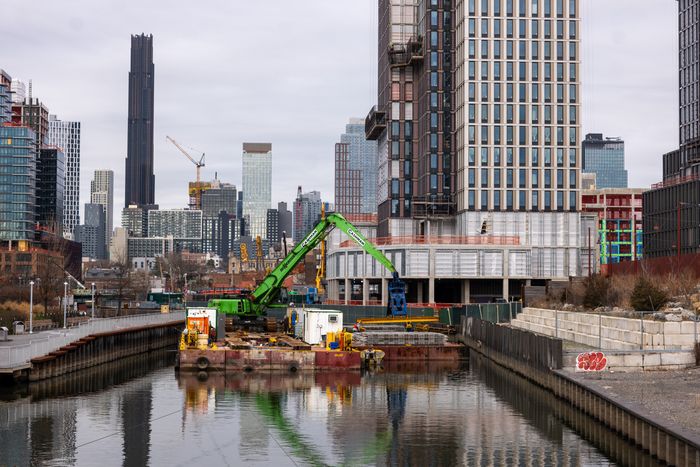
The canal is also a construction site: Two massive combined sewage overflow tanks are being built there, which are expected to be completed in 2029.
Photo: Spencer Platt/Getty Images
Almost anywhere else, a Superfund designation would have spooked real-estate developers, but in Gowanus, it amounted to open season, signaling to investors that the federal government would soon be cleaning up the century-old cesspool that had hindered previous development schemes. Not long after, Whole Foods announced that it was opening a gigantic store with a rooftop greenhouse on a bleak, windswept corner of Third Avenue and 3rd Street. Other of-the-moment businesses soon followed: Lavender Lake, a bar with a huge outdoor patio that served local draft beer and kale Caesar salads, opened in 2011, Dinosaur Bar-B-Q in 2013, and Royal Palms Shuffleboard Club in 2014. Developers who’d been buying up land for decades started applying for spot rezonings to build luxury housing.
If the community didn’t get out ahead of the changes that were clearly already happening, argued Brad Lander, the then-local councilmember, it would lose its power to shape them along with any potential benefits. As a former community organizer and urban planner, Lander painted a vision of what Gowanus could become: a thriving, economically diverse neighborhood with thousands of new affordable apartments, stabilized artists’ studios, freshly renovated public housing, and a public esplanade along the canal. In short, it could create, from the remediated soil up, a neighborhood that felt like it was actually for New Yorkers, rather than a plutocrat’s fantasy of New York. Lander was adamant that rezonings didn’t have to go the way of Williamsburg. Or worse, Hudson Yards. In 2016, he kick-started a five-year process to rezone the industrial neighborhood to allow for a massive amount of new housing. It not only gave developers an avenue to build residential towers but also opened the door for a package of community benefits that was, as Lander had sketched out, far more abundant than in any previous rezonings.
Courville and Reynolds started filming the neighborhood in 2013, after a redbrick building around the corner on Douglas and Third was knocked down. They documented demolition, new construction, and workers hauling toxic sludge out of the canal on barges as well as the public meetings, political rallies, and neighborhood parties leading up to the 2021 rezoning, collecting what would eventually swell to more than 400 hours of footage. (Gowanus Current, their documentary on the rezoning, came out last year.) “What happened is such a complex thing. People call it gentrification, but it’s not,” Courville tells me. “The neighborhood was knocked down and a new one was built.” That doesn’t feel like an exaggeration. In the past few years, dozens of new rental buildings have gone up, and dozens more are currently under construction. The Gowanus rezoning covers 82 blocks and every one seems to have either a newly completed building, an active construction site, or a soon-to-be-developed lot. By the end of the decade, the neighborhood is expected to add 9,000 new units.
While it’s nice to think that in a decade’s time the neighborhood could be, as one development executive mused, a mini Copenhagen, with a canal so clean you could swim in it, a lot of people remain doubtful. Gowanus isn’t in some socially democratic Northern European city, where these kinds of transformations happen sanely and smoothly. It’s in New York, where public benefits have to be messily, imperfectly squeezed out of private companies through baroque bureaucratic processes. And it’s still a patchwork of brownfields, laden with coal tar and chemical solvents. Is it really a good idea to dig up, cart out, and cap toxic muck as an influx of new residents move in? Artists may have loved the old Gowanus, reeking green canal and all, but who would pay luxury rents to live in the new one?
One of the first buildings to open after the 2021 rezoning was a luxury rental tower at 544 Carroll Street, on the corner of Fourth Avenue. When I asked developer Brian Ezra, a founding partner of Avery Hall, why he’d decided to build it, he said it was obvious: “Gowanus is hugged up right against Park Slope on one side and Carroll Gardens on the other. It was inevitable someone was going to develop it.” The question wasn’t whether or not to build for luxury renters, it was what tier of luxury renters to build for. Fourth Avenue, the neighborhood’s eastern border with Park Slope, already had $5.5 million condos by then, and Avery Hall aimed high: The apartments have Bosch appliances, panelized fridges, and marble countertops — the only available apartment for rent today is a two-bedroom for nearly $8,000. Last summer, the building became the subject of local gossip when its duplex penthouse hit the market for a seemingly absurd $25,000 a month.
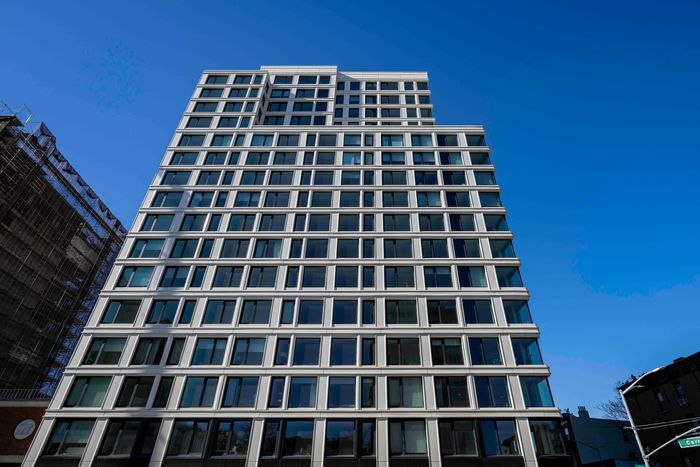
544 Carroll Street: The Avery Hall development on the corner of Fourth Avenue has a $25,000-a-month penthouse.
Photo: Field Condition
“Leaving it as it was wasn’t possible. The gentrification was already underway — there was ax throwing and self-storage in former industrial warehouses,” says Andrea Parker, the executive director of the Gowanus Canal Conservancy, an environmental stewardship group. If the neighborhood hadn’t been rezoned, she says, it would have been more of the same — luxury housing, bougie recreation — with scant infrastructure or community improvements. It would look like Lightstone Development’s 360 Bond, a luxury rental complex built in 2016 after the approval of a site-specific rezoning, where one of the most visible concessions to the public is a strip of grass that mostly functions as a dog toilet.
Lander saw a city rezoning as an opportunity to demand much more of developers than a small fraction of affordable housing units. He and Michelle de la Uz, the executive director of nonprofit developer the Fifth Avenue Committee and a city-planning commissioner, spent years building a community coalition around the effort. The rezoning that came out of the five-year negotiations was a first on many levels: the first in the city to include money for NYCHA repairs ($200 million) and the earliest to conduct a racial-impact study on how the rezoning would change the makeup of neighborhood, finding that it would, in fact, make it less white. It also included a mandatory inclusionary housing requirement, meaning that any development built under it would have to be 25 percent affordable for those earning between 40 and 80 percent of the area median income. And, of course, it included provisions for cleaning up the pollution: Individual developers are responsible for overseeing the cleanup at their own sites, with the cost for both canal and brownfield cleanup to be paid by the original polluters whenever possible. Not only would the canal be clean, it would be the main attraction, flanked on both sides by a public esplanade lined, in the vision of community activist Salvatore “Buddy” Scotto, with restaurants, cafés, boutiques, and benches. The “Venice of Brooklyn,” as he told the New York Times in 2001.
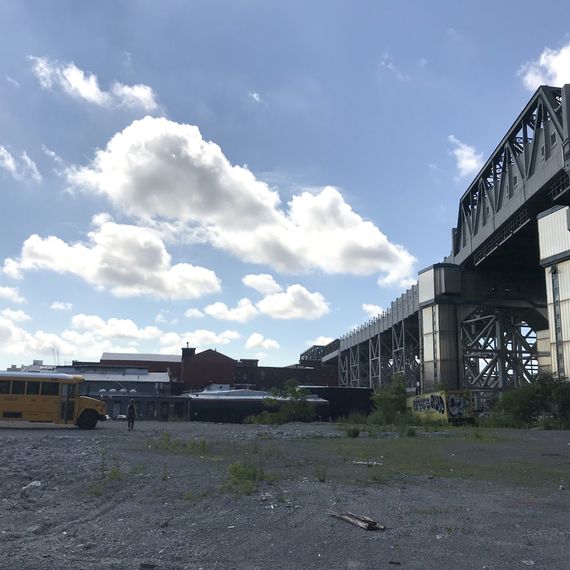
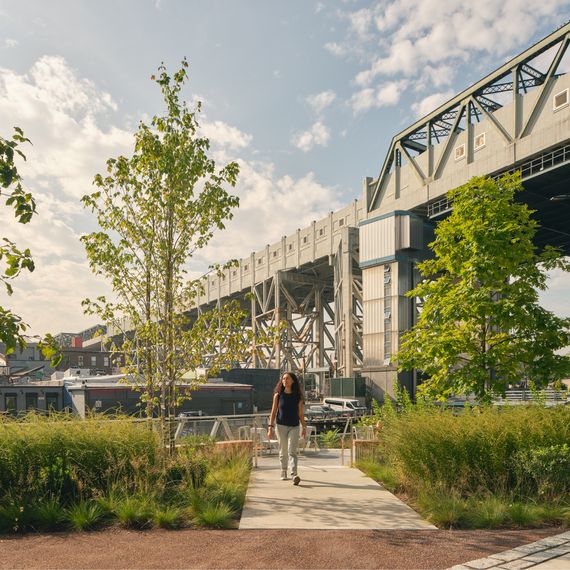
From left: The banks of the canal are also being transformed. A walkway before a SCAPE design is implemented. Photo: SCAPEEsplanade with landscape design by SCAPE. Photo: Ty Cole
From top: The banks of the canal are also being transformed. A walkway before a SCAPE design is implemented. Photo: SCAPEEsplanade with landscape desi… more
From top: The banks of the canal are also being transformed. A walkway before a SCAPE design is implemented. Photo: SCAPEEsplanade with landscape design by SCAPE. Photo: Ty Cole
Almost as soon as it passed in late 2021, developers started breaking ground. The rezoning coincided with the fast-approaching expiration of 421-A, an affordable-housing tax break, the following June, which set off a construction frenzy that made the Williamsburg development boom of the early aughts seem sluggish by comparison (developers had to get shovels in the ground before the tax break ended to qualify). As of last year, 46 projects comprising 5,000 units were either completed or are under construction, and plans for another 43 projects have been filed, according to data analytics firm Marketproof. “Williamsburg evolved over the course of 20 years,” says Deborah Rieders, a veteran Corcoran broker who specializes in Brooklyn new development. “Gowanus is happening much more quickly since so many developers had been sitting on sites and they all started building at the same time.”
But the pace of the cleanup has lagged far behind. Only the first of three sections of the 1.8-mile-long canal has been dredged and capped and costs have ballooned from $500 million to $1.5 billion. The combined sewage-overflow tanks that are supposed to divert sewage from running into the canal won’t be complete until 2029 — a seven-year delay that might require parts of the canal to be re-dredged again to remove the contamination. And while the luxury towers are shooting up seemingly by the day, Gowanus Green, a 957-unit, 100 percent affordable housing project planned for the site of a manufactured gas plant on Fifth and Smith Street, has been stalled for years due to disagreements between locals, developers, regulatory agencies, and National Grid over the cleanup standards. (Although this project may finally see some movement this fall; the Department of Environmental Conservation recently approved an application filed by the developers of Gowanus Green and National Grid to remediate the site in phases, which would allow construction to start.) The delays are not exactly surprising, nor does the blame for them lie with the city — a number of state and federal agencies are in charge here, each navigating their own bureaucratic mazes.
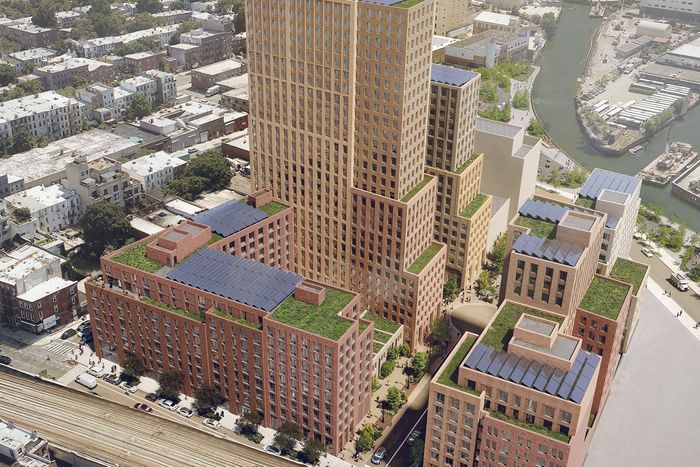
Gowanus Green, as shown in this rendering, is planned to be 100 percent affordable, but construction stalled due to disagreements over cleanup standards. But the DEC recently approved a new remediation plan.
Photo: Marvel Architects
Even if the waterway is still full of actual shit, it hasn’t dissuaded developers from playing up their waterfront locations. A few months after residents started moving into 420 Carroll, the first development of the rezoning to open, I toured the project with Jason Hill, marketing director at the Domain Companies. As we walked around 420’s esplanade section, its landscaping done in the current fashion of artfully arranged, somewhat scrubby-looking native plantings, Hill pointed to an unmanicured area at the property’s southern edge filled with weeds. “We are the only corner lot by the turn basin,” he said, explaining that this, too, would be dredged in time, giving the property not one but two waterfront exposures. This was an advantage? I asked. “Absolutely,” Hill responded, adding that within six months of leasing, the building had been 50 percent rented.
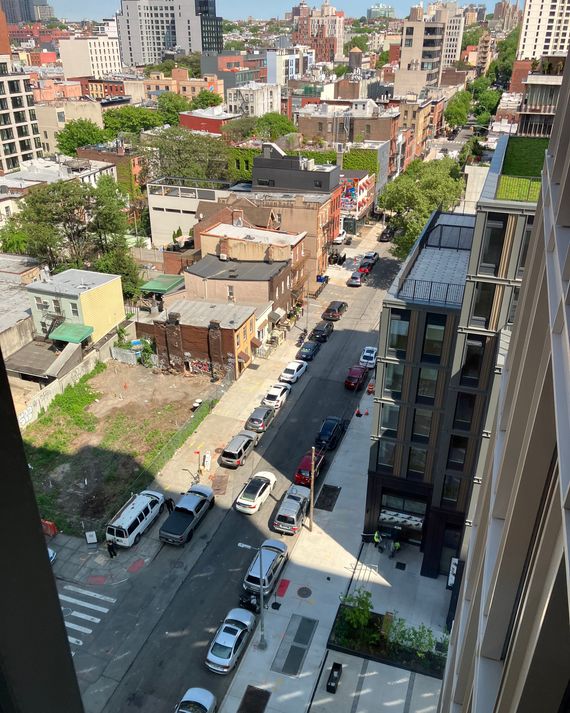
Each of Gowanus’s 82 blocks seems to have a new building, an active construction site, or an empty lot.
Photo: Kim Velsey
Developers are eager to conjure up associations with the waterway even when their buildings aren’t on it. Tavros Capital and Charney Companies’ Gowanus Wharf complex includes Union Channel, Nevins Landing North and South, Douglass Port, and a newly approved project, the 1,000-unit 175 Third Street, designed by Bjarke Ingels Group. Of the five, only Nevins Landing and 175 Third are canal-side. That such nautical branding now comes across as a bit of harmless developer spin shows just how much perceptions have changed since 2016, when 365 Bond, Lightstone’s “Paris-on-the-Gowanus” luxury rental complex, was widely mocked for renderings of people cavorting on and alongside the canal. On the day I visited with Hill, that vision appeared almost fully realized. The canal sparkled gray-green in the sunlight and on the opposite bank, people walked their dogs and relaxed on benches along 365’s esplanade. The scene felt a little stilted and sterile, not unlike a rendering, but it was real enough.
The Sackett Place esplanade.
The waterfront at 420 Carroll.
A rendering of 175 Third Street, designed by Bjarke Ingels Group, now under construction.
533 Carroll Street
Photographs by Ty Cole, bucharest studio, Avery Hall
Gowanus is hardly the only postindustrial New York neighborhood rife with toxic waste — in Williamsburg and Greenpoint, the extent of toxic contamination is still being uncovered and mitigated in an ad hoc fashion. The difference in Gowanus is that it’s being done openly, all at once, and in coordination with the rezoning. That cleanup is finally happening is undeniably a good thing, but living through it has been a miserable and sometimes scary process: Residents have complained of terrible smells, headaches and nausea from coal tar remediation in the canal, which state health officials warned could be side effects of the cleanup. The EPA has said that naphthalene — the active ingredient in moth balls that is in the sludge dredged from the canal — can cause those symptoms even at low (and safe) concentrations. A few summers ago, the stench was so strong that officials resorted to tarps, odor-suppressing foam, and misting the area with pine- and cinnamon-scented deodorant, which some residents said made the smell even worse. “It’s like there’s a bucket of gasoline next to my pillow,” one wrote to local officials.
Going into it, everyone knew that the canal and the former manufactured gas plants would be the biggest hurdles of the neighborhood’s transformation, requiring daunting, expensive cleanups. But the rezoning has also exposed pollution that had been hidden for more than a century. In late 2023, the public learned, via a freedom-of-information request filed by Voice of Gowanus, a local environmental activist group, that toxic trichloroethylene vapors were rising up through the basements of a number of local buildings, including the Royal Palms Shuffleboard Club and a public school. Inside Royal Palms, the DEC had detected levels of the odorless chemical vapor that were 20 times above the state’s allowable guidelines two years prior (and 10,000 times above them underneath the building). TCE, a popular 20th-century solvent used in dry cleaning, oil extraction, and as a degreaser in the paint factories that lined the canal, is a carcinogen that’s also known to cause birth defects and Parkinson’s disease. “It’s particularly dangerous for people during pregnancy, early childhood — that’s when the chemical really has a chance to do damage — kidney, liver cancers, things that don’t show up until much later in life,” says professor Ana Navas-Acien, the chair of environmental health at Columbia University. “We know with cancer that the latency is very long and you’re basically playing the lottery if you’re exposed.”
Dumped out on the ground — a common disposal method in the past — TCE sinks into the dirt, where it mixes with the groundwater and evaporates. In the open air, that vapor dissipates to harmless levels, but in basements it can seep into cracks and build up to dangerous levels. Across from Royal Palms, DEC testing found that a former box factory at 543 Union that had been converted to artists’ studios also showed unsafe levels, raising the possibility of an underground vapor plume beneath numerous buildings rather than a one-off contaminated site that could be remediated and capped before anything was built on it.
“When the news first broke, the whole league community was like, ‘WTF,’” says a shuffleboard player I spoke with. While contaminated buildings can vent out toxic vapors, bringing indoor air to safe levels (Royal Palms had a system in place by the time its problem was publicly revealed), the specter of poisonous gases wafting up through basements was still alarming and not exactly in keeping with the narrative of a neighborhood rendered safe for tens of thousands of new residents. At the box factory, the testing led to a fix that involved installing a strawlike contraption to draw the chemical out of the basement into the open air; after a year of periodic testing of the basement and studio lofts, the Times reported that the TCE was mostly gone, although still detectable in the building’s unfinished basement, which a small stream runs through. But the box factory, a commercial condo, was unique in both its openness to testing and revealing the findings to the public.
While developers are required to conduct environmental testing before construction — it was, in fact, such testing that had revealed the problem at the Royal Palms — the owners of existing buildings can opt into testing or refuse it. Unsurprisingly, many have opted out: Between 2024 and 2025, the DEC reached out to 1,604 properties; just 258 were actually sampled, or about 16 percent. Owners of contaminated buildings then have to disclose to tenants if dangerous levels of TCE are discovered, which discourages them from testing in the first place and makes it harder to gauge the magnitude of the problem. There are no penalties for not testing, which state health and environmental officials say is beyond their control: Private-property owners cannot be compelled to do it, and agencies cannot disclose information about specific properties without owner consent. Someone who runs a music studio in Gowanus told me that clients started emailing him as soon as the news broke — “there was clearly concern from more than one renter” — but it took the landlord a year to agree to testing, which came back negative.
The situation has led to an ongoing battle between local environmental activists, residents, and city and state officials. Last fall, I went to a public meeting on soil vapor intrusion at the Children’s School — a public school specialized in educating kids with disabilities and neurodivergence that has itself been identified as having this kind of pollution. Before the meeting started, an attendee asked a DEC employee by the sign-in table about the large industrial fans built into the gym’s walls, which were whirring noisily. The official replied that a janitor had told him they couldn’t be turned off because they were venting out the toxic vapors. But the moderator (also from the same agency) later offered a correction when the meeting started; this was not actually the case (given that the fans looked to be about 50 years old, it seemed true enough; TCE vents are far less conspicuous), but it set the adversarial tone of the evening. The meeting’s takeaway — that 80 to 85 percent of the tested sites did not have soil vapor intrusion levels that require mitigation — was, according to officials, less than expected for a neighborhood with a history like Gowanus’s. The attendees saw it differently. “That’s 1 in 10. How is this okay?!” one demanded.
To a large extent, whether or not people are comfortable moving to Gowanus depends on what view they take of that 10 percent. More generally, the ongoing challenge of parsing “safe” levels of toxic pollution and evaluating whether the solutions to address it are sufficient is difficult for any layperson to track. There’s also a difference between acceptable scientific risk and lived experience, especially if you’re the kind of person who worries that every headache could be a sign of brain cancer. Containing pollution, especially gas and chemical contamination, can prove to be wily, requiring ongoing monitoring and fixes. Just last month, classes were temporarily moved out of the basement of the Children School’s annex after officials discovered that the mitigation system wasn’t working well enough.
It might seem unlikely that people of means would opt to live in Gowanus, at least while workers are still actively unearthing its many buried toxins, but this betrays a fundamental misunderstanding of the Brooklyn real-estate market. At 365 Bond, the decade-old rental, only seven of the 430 apartments are currently available for rent. Ethan Russell, who runs a commercial film production company with his brother in Dumbo, moved into a three-bedroom, two-bath at Union Channel with his wife and kindergarten-age daughter last June. (The sticker price is $7,700 a month, but like all new buildings in the neighborhood, there are incentives, so he pays closer to $7,000.) Before moving to Gowanus, they’d lived for nine years in a 1.5-bedroom on the first floor of a Park Slope brownstone, for which they were paying $4,000 a month. They wanted something slightly nicer — central air, a second bathroom — but, as Russell explains, “there was just no inventory in Park Slope. To upgrade we would have had to pay $9,000 a month.” Their Gowanus apartment has about the same amount of square feet as their old one but has a better layout and access to a gym and a rooftop pool. It’s only two blocks from where they used to live and an easy walk to their daughter’s school. He admits the neighborhood’s pollution would be a consideration if they were buying, but as a renter it doesn’t trouble him. “I have friends who are like, ‘You’re insane — it’s toxic there.’ But I was not particularly concerned about that, living on the fifth floor in the short term,” says Russell. “We’re also in a flood zone. Would I ever buy something in a flood zone? Hell no. But it’s a rental.”
The building, he adds, is filled with families, something that seems to have caught the developers by surprise — the playroom is in a sister building a quarter mile away — but the Park Slope rental market is brutal and the building is a short walk to P.S. 321, Park Slope’s premiere elementary school. (Once kids enroll at a New York City public school, they’re allowed to stay there, even if they later move.) Another couple who moved to the building around the same time, Katie Alice and Dom Learey, also came from Park Slope, where they were zoned for a great public school but had to settle for living in a dark railroad apartment with their three kids. “We went to the Tenement Museum and the floors, the layout, everything was exactly the same,” says Katie Alice. The rent: $7,200 a month.
At another new rental development, built on a remediated brownfield site, I asked the leasing director if any families had been concerned about the pollution there. He told me he’d been surprised by how few people brought it up. “One family with young kids did ask about it,” he says. “I thought it might be more of a thing, but by the time people are looking here, they’re already okay with it.” It helps that the newest residents aren’t moving into the 19th century buildings with cracks in the basement, but into towers built atop remediated soil, with concrete slabs and other pollution barriers to seal out lingering contaminants, fitted out with pollution monitors, flood gates, and noise-proof windows.
While most of the new development apartments I toured felt somewhat cramped, even when elegantly staged, this is true of almost all new development rentals. And it’s not as though Brooklyn has a wealth of compelling new construction options in desirable neighborhoods. The closest alternatives are Fourth Avenue, famously once dismissed as a “canyon of mediocrity,” and Downtown Brooklyn, mangled into incohesiveness by a series of bad urban renewal schemes. “I always found Fourth Avenue to be a place where I didn’t want to walk around outside,” says Paul Saunders, chief of cardiothoracic surgery at Maimonides who moved into 420 the winter it opened. Downtown Brooklyn, likewise, didn’t appeal. Yes, he’d wanted conveniences given his erratic work schedule: a garage, a doorman, a high-end gym in the building (another renter described the gym at 420, approvingly, as “Equinox-level”). But he also wanted to live in the kind of neighborhood that has interesting restaurants, natural wine bars, galleries. In short, a vibe. And Gowanus, for now, has still retained some of its human-scale landscape of auto garages, art studios, coffee shops, dive bars, restaurants, rowhouses, warehouses, and breweries as well as a climbing gym and several concert venues. It’s largely true that if you pack a luxury tower with enough amenities, renters will tolerate being merely adjacent to a nice neighborhood, but most renters prefer to actually be in the nice neighborhood, even one that’s built on toxic sludge. The reason those Venice/Copenhagen/Paris of Brooklyn comparisons half land is that if you squint, you can see it.
Most of the new Gowanus residents I spoke with were longtime New Yorkers who had been biking or driving or walking around Gowanus for years. They’d gone climbing at Brooklyn Boulders or to birthday parties at Lavender Lake or met friends for beers at Finback. They felt a connection to the place and were intrigued, and mostly excited by, the changes.
Of all the residents I spoke with, the most unfussed was the one who had lived there the longest. Renee Flowers, a life-long Gowanus Houses resident, now 67, retired from a career with the post office a few years ago. Working at the nearby branch on Atlantic and Fourth, she’s long seen celebrities and knew it was only a matter of time before Gowanus went the way of Boerum Hill. At least the community got something out of it, she pointed out, like new affordable housing that a handful of people she knows have moved into. The rezoning has certainly kept some residents there who would have otherwise left, like Michael Kulikowski, an architect who moved into Gowanus in 2019. His first apartment in the neighborhood, in a four-unit building with a courtyard where everyone hung out, was $2,600, and all his friends ended up living within a ten-block radius, meeting up for shuffleboard at Royal Palms and spending the pandemic under the space heaters at Lavender Lake and Pig Beach. But work turned spotty after the pandemic and the rent on the two-bedroom he shared rose to $3,200. Then he won the housing lottery for an affordable one-bedroom in one of the newer buildings. “The rezoning is literally the only way I’m able to stay here,” he says. “From an urban-planner perspective it just makes so much sense — put affordable housing in a neighborhood of underutilized, low-rise, industrial properties that need to be remediated in the middle of the most desirable neighborhoods of Brooklyn.” Even so, he’s sad about some casualties of the transformation, like Lavender Lake, which closed in late 2021, after the building’s owner decided to demolish it for residential construction. The bar later reopened in (of all places) a Williamsburg new development.

Arts Gowanus worked with the city to negotiate more than 100 affordable art studios in new-development buildings, with annual rent increases capped at no more than 2 percent.
Photo: Courtesy of Arts Gowanus
Johnny Thornton, the executive director of Arts Gowanus, who first came to the neighborhood in 2015, believes the key to maintaining the neighborhood’s identity is keeping the artists there. “We saw what happened in Williamsburg — the vibe is gone. In Bushwick, they maintained the aesthetic and there are all these cool, graffitied buildings, but then it’s $19 for a taco,” he says. Williamsburg was rezoned, Bushwick wasn’t, but both experienced rapid gentrification and a mass exodus of artists. So, he says, “we took the pragmatic route and negotiated.”
Unlike in Williamsburg and Soho, where artists’-loft conversions catalyzed subsequent real-estate booms, Gowanus artists mostly live in the surrounding neighborhoods rather than in Gowanus itself. This means that keeping them around is a more realistic goal than it might be elsewhere — it’s easier to extract a 200-square-foot windowless art studio from a developer than a Westbeth-style live-work space. Art studios also bolster the allure of new rental developments. Arts Gowanus was able to get more than 100 affordable art studios, 22 of which have been filled so far, as part of the rezoning’s community-benefits agreement, and last spring, the organization announced its first fellow, a mixed-media artist from the Red Hook Houses named Shelby Jackson, who got a year of free studio space. Eventually there will be 11. The studios will rent for $20 per square foot, significantly under market value, with no more than a 2 percent increase annually. There will also be a community center and one low-income $12-per-square-foot studio per building. Many lack windows, but all are above ground — an important provision in a place with Gowanus’s flood risk. Even residents who are unhappy with most aspects of the rezoning admit that the studios were a win.
There are other signs that the scrabbly, experimental Gowanus of yore might still survive. Unlike Hudson Yards, where the Vessel and the Shed read like clumsy attempts to graft something lively onto a dead landscape, new arts venues have opened there independently: Public Records, a vegan experimental-music venue, came to the north side of the neighborhood in 2019. A few years later, Powerhouse Arts, an arts and fabrication studio, opened in the former BRT power station, a gift of eccentric billionaire Joshua Rechnitz, who also paid for a huge Herzog & de Meuron–designed addition.
For all that, the new Gowanus does feel fundamentally different than what came before. The new rental towers, with brick elements that artfully reference the neighborhood’s 19th-century warehouses, are a lot more subtle and contextual than what went up after previous city rezonings (i.e., the glassy, generic towers of the first waves of Long Island City or Williamsburg development), but there is something alien and strange about how they sit in the landscape. “The changes are overpowering,” says Courville, the filmmaker who left in the process of making the documentary — her apartment was increasingly expensive, and increasingly rundown, and she and her husband weren’t able to find anything else in the neighborhood. “It’s not just like, ‘Oh, I don’t like how it looks now.’ It’s a cultural shift. I miss the randomness that used to exist here.”
In late winter, I learned that the $25,000-a-month penthouse had been rented to a Brooklyn family for the full amount. They were, I was told, “super-private” and didn’t want to talk about why they were paying more than a quarter-million dollars a year to rent in Gowanus.
When I brought it up, people were more amused than surprised. The canal, while still polluted, smells better than it once did. Plus the windows in the luxury towers are pretty effective at blocking out odors and the omnipresent construction noise. As a renter living on the 14th floor of 420 told me: “I think the canal view is pretty serene. I have a corner unit, and I can see the Statue of Liberty.”