
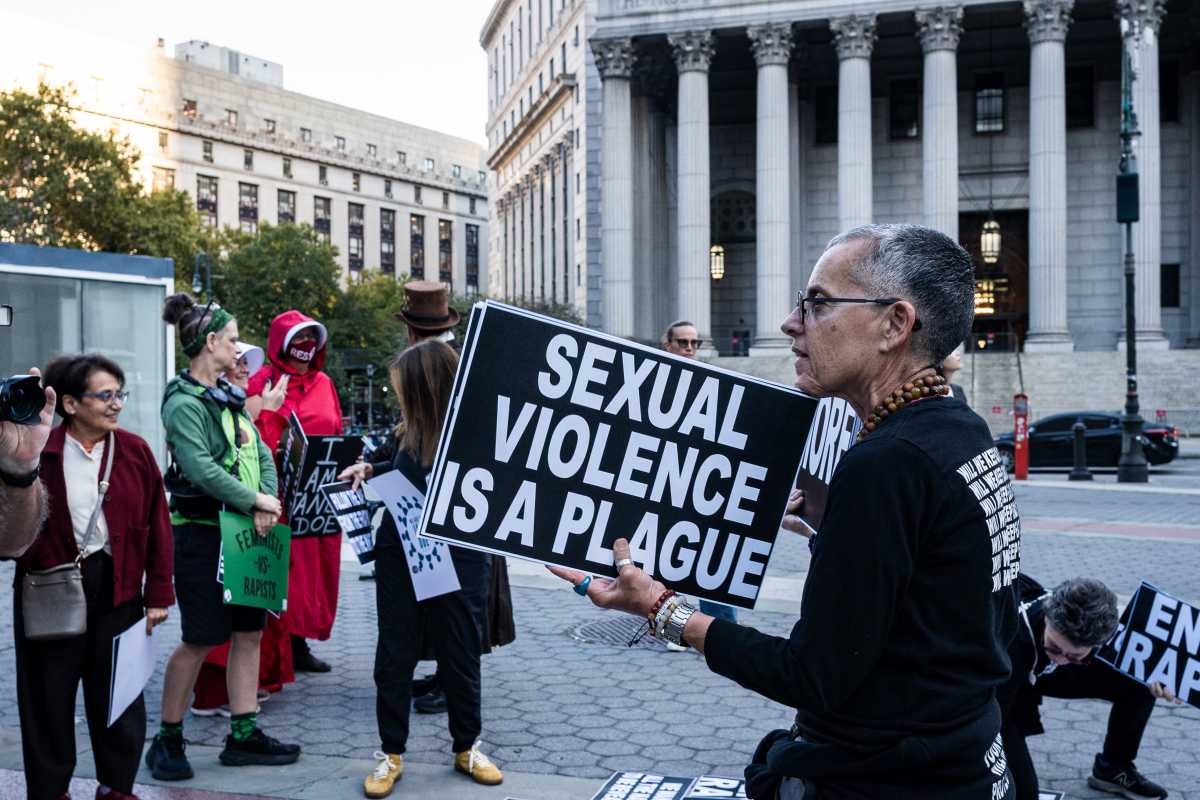
Requirements for reporting rape and sexual assault on college campuses would expand under a New York bill introduced in the state assembly on Oct. 8.
The legislation, sponsored by Assembly Member Linda Rosenthal (Upper West Side-Hell’s Kitchen), is an expansion of New York’s Enough is Enough Law, a 2015 measure that requires all college campuses to establish policies to prevent sexual assault.
Rosenthal introduced the legislation last week in response to the ongoing “Cornell 7” case, a high-profile civil lawsuit filed by a former student at the Ivy League school who was allegedly drugged and raped by a group of university students. Among the allegations, the suit claims the institution failed to punish the alleged perpetrators adequately after the incident came to light.
New York State law currently requires colleges and universities to inform all sexual assault victims of their right to file a report with university police, local or state law enforcement, or to not file a formal report at all, Rosenthal explained.
“It is up to the victim to determine how they choose to report the incident, and that is something they may also discuss with the school’s Title IX coordinator,” the assembly member told amNewYork.
How would the bill improve rape reporting on campus?
The 2015 law requires all colleges and universities to survey students every other year and report their findings in an online campus climate assessment. However, the assembly member explained that the information that must be collected and published focuses on students’ awareness of campus policies to combat sexual assault, their understanding of affirmative consent, reporting procedures and similar topics.
“What’s missing from these reports is clear data on how often rape and sexual assaults are occurring on college campuses around the state and how those cases are being handled,” Rosenthal explained. “To tackle this issue head-on, we need to know how many assaults are being reported at each campus, to whom students are reporting most often and what results from these reports.”
Further, she explained, the reports should be easy to find on the state’s website, not buried elsewhere to uncover.
“It is also important that each institution’s report be clearly accessible on the New York State Education Department’s website and not buried deep in the pages of a university’s website,” Rosenthal said.
How often does sexual assault actually occur on college campuses?
According to the Rape, Abuse and Incest National Network (RAINN), approximately one in four undergraduate women experience non-consensual sexual contact after enrolling in school.
Gerard Lennon, a retired NYPD lieutenant and retired university public safety sergeant in New York, said that most alleged perpetrators of rape or sexual assault are friends or acquaintances of the victim.
“Sexual assault is very underreported for a number of reasons,” he said. “It is traumatic for victims to keep reliving the incident in the process of prosecution. Also, at first, the victim is often scared to come forward because they erroneously feel embarrassed, and that no one will believe them. We’ve even had students switch schools after the incident came to the attention of public safety, even though the victim themselves didn’t report the incident.”
Lennon also explained that some victims do not come forward because they are concerned about hurting the reputation of their attacker.
“Sometimes victims blame themselves — but they shouldn’t. We want victims to come to us. Law enforcement takes these incidents very seriously,” Lennon said. “A perpetrator needs to be held accountable for their actions.”
Rosenthal added that victim-blaming is often part of the equation. The consumption of alcohol and other drugs has been another factor in the ongoing Cornell case, so much so that the state legislature is working to pass another bill that would make it easier to prosecute certain sexual assault cases when a victim is too impaired by drugs, including alcohol, to understand what is happening or consent to sexual activity.
“Victim blaming has been part of the conversation around sexual assault for far too long and it excuses the behavior of the abuser,” she said. “No one asks a robbery victim whether they had a drink before the crime occurred, suggesting that they brought the crime upon themselves, but it has unfortunately become commonplace in sexual assault cases.”
Rosenthal said her bill would give more transparency on how often sexual violence occurs on campuses, and how individual schools are choosing to respond.
“With this data out in the open, it is my hope that all institutions will take these crimes more seriously and do everything in their power to prevent sexual assaults from occurring,” she said.