
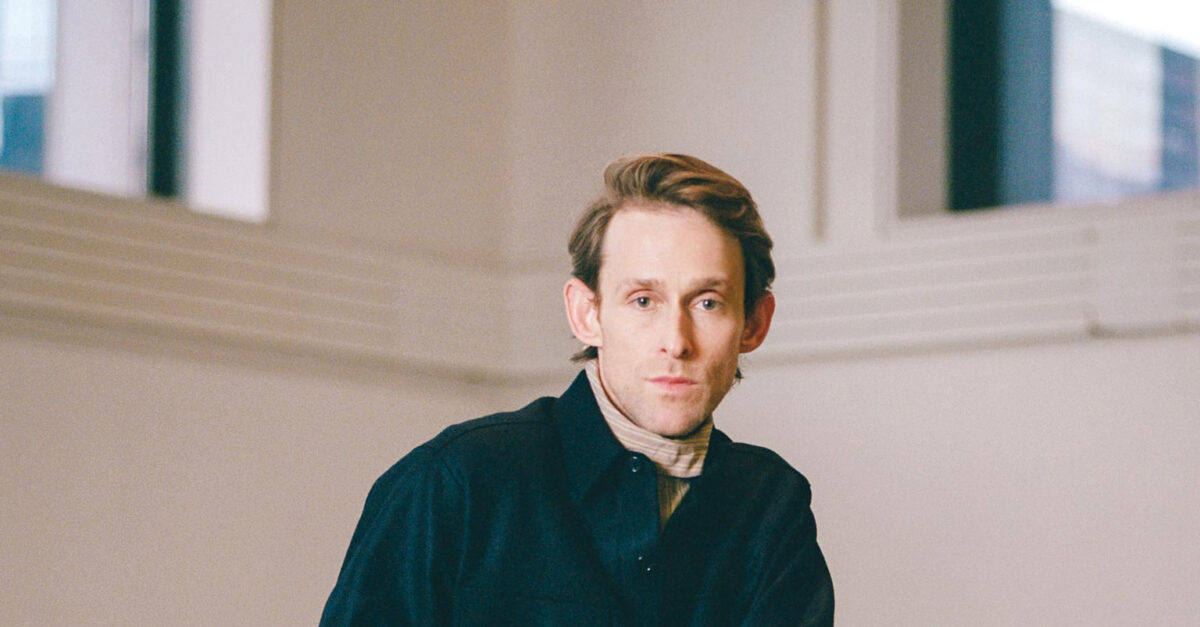
At the conclusion of the 2026 Fall Season, Principal Dancer Adrian Danchig-Waring will give his farewell performance with New York City Ballet, October 18. Here, he writes about the program he has curated—The Four Temperaments and Agon by George Balanchine, Each In Their Own Time by Lar Lubovitch, and a world premiere by Pam Tanowitz—as he prepares for a new chapter, expanding his work as the Artistic Director of the New York Choreographic Institute, a role he has held since 2018.
It’s always been about making new work. George Balanchine’s insatiable need to create and innovate gave birth to everything we now know as New York City Ballet. It has been a house of modernism from the start, where the vocabulary of ballet became a vehicle for bold and iconoclastic ideas. Young dancers flocked here hungry for experience, for artistic growth, and to be part of Balanchine’s vanguard. They came first to the School of American Ballet to train in his technique, then poured themselves—bodies and souls—into the company, where their daily practice fleshed out musical forms and exploded into dances that defined a new era for ballet.
Even though I was born a year after Balanchine died, I, too, followed this path. For 24 years his choreography has shaped the way I move through the world: upright and attuned, dancing between rigor and play. When I set out to curate my farewell program, I knew immediately it would begin with The Four Temperaments. This ballet was made in 1946, two years before NYCB formally existed, and it announces its modernist intentions from the first gesture. The curtain rises on a tension; the arm traces da Vinci’s Vitruvian circle, outlining the spiritual realm, then the foot points and flexes, the leg plies, and we’re grounded in the material world. This is the First Theme, and it lays the foundation for all that follows. It was also the first roleI danced in a black-and-white ballet, though I soon graduated to the Third Theme, then Sanguinic, then Phlegmatic. Each role ignites a different way of being. You never act the part. You discover its essence.
Ballet is a ritual. In the court of Louis XIV, the steps were a way of ordering the body toward something higher. The disciplined, daily practice became a way to get closer to the heavens, and closer to God. That impulse survives every time we take the barre. Each morning, dancers repeat the same exercises in the same order. The repetition is not mere maintenance; it is communion with our ancestors, a connection to source. There is a direct line of transmission from the body of the Sun King into the bodies that alight the stage each night.
Every generation inherits a language and sensibility, then adapts both to its own moment. The ritual may be 400 years old, but the medium—the human body—is alive and present. As Balanchine put it, “There is only now. Right now.”
In that spirit, the middle of the program belongs to the choreographers I am working with today. Lar Lubovitch and Pam Tanowitz both hold ballet in great reverence, and each stretches it somewhere unexpected. Lar builds from the knowledge that ballet is never an end in itself but a tool in service of something greater, a way for vision to become movement. If ballet is a language, a choreographer is a poet, philosopher, and storyteller. Even when a work is abstract, we cannot help but map meaning onto it. The choreographer is our compass rose.
I have danced 21 Balanchine ballets over the arc of my career, and I can feel each of them on a cellular level. Performing a work I collaborated on from its inception asks something different of me. The choreographer is the author, yet the piece is inevitably shaped by my own instincts, ideas, and identity along the way. Pam’s new quartet is still being made as I write these lines. During the creative process, she tries to look at all of dance history at once. So we play with phrases from Serenade, Apollo, and Stravinsky Violin Concerto, excavating them from our embodied archives. What Balanchine described as “abstract memories of form” is how choreography passes from body to body, generation to generation. His memories live on in us.
Agon (1957), which closes my farewell program, radically reorients the relationship between music, movement, politics, and sex. Balanchine’s modernism stripped ballet of narrative and spectacle but kept its academy and its pointe shoes intact. He made the code itself the subject and the score its governing structure. The most radical thing about Balanchine is that he never had to break the instrument to remake the art. He proved that modernism could be achieved through the classical vocabulary, not against it.In the process, he showed us the liberatory potential of ballet.
I have been a beneficiary of this freedom for more than half my life. Now, as I close out my performing career, I’m channeling that creative energy toward the next generation of artists. Who gets to do this work? Who gets to experience its transformational power?
My next chapter takes root at the New York Choreographic Institute, where artists can take big risks and bring us to the edge of what’s possible. My stewardship of this legacy has lived through my dancing body; now it finds another form. No longer a channel for the work, I have the privilege of creating space and structure in which it can thrive. Through theInstitute, Balanchine’s modernist spirit continues to move.
Visit NYCBallet.com.