
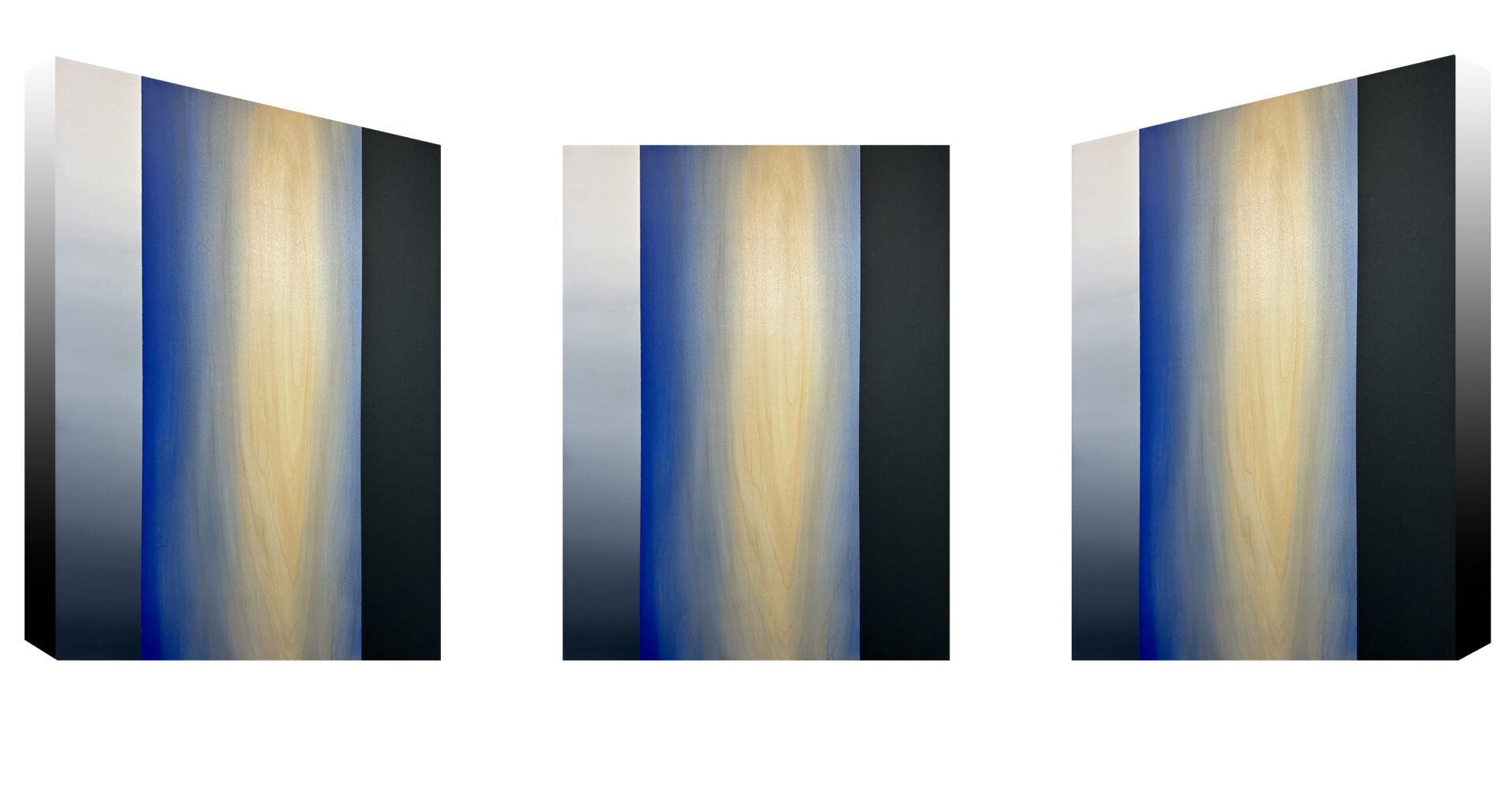
Music and my visual work have kept company for more than fifty years. That is not the new thing. The two have coincided, drifted apart, and found each other again across the whole span of the work, and I stopped being surprised by it a long time ago. What is new is the wood. The relationship I have lately to raw panel and open grain is moving the visual work forward, and moving my language with it, and this painting, following in progression after Striker (2026), is where I can watch that happening.
What holds the center of it is wood. Not a picture of wood, not wood described—the grain itself, left open, stained thin enough that the tree’s own record comes up through the color. To either side I laid what the making asked for: a blue that runs to its own saturation, a black that closes the right edge, a column at the left that falls from light to dark on its own gradient. Those are decisions. The grain is not a decision. The grain is what the tree did over years. I had no part in it, and my whole task at the center was to keep from covering it.
The blue and the black are not the opposite of that. I don’t think of them as construction fighting the disclosure at the center. They are pressure. They stand at the border of the grain and hold it to its own showing, the way a room falls quiet around a sound so the sound can be what it is. Paint, used this way, does not depict. It attends. That is the thing I mean by disclosure, and I have said it before about the studio: the difference between imposing a meaning on the material and letting the material show what it already carries. Construction lays a prior idea over the surface. Disclosure gets out of the way.
The grain you are looking at is a record of duration—each line a season the tree lived through, sediment laid down and kept. I did not make that time. I respected it. But the left side of the panel is not attending to anything. The column that falls there from light to dark is a light I made—a gradient laid on, imposed rather than found. I set it against the light at the center, which I did not make and could not: the light endemic to the wood, belonging to its record of growth. So the panel is doing two opposite things at once, and means to. Disclosure holds the center; construction stands at the left; and neither is asked to dissolve into the other.
The word for that is not a painter’s word. It is counterpoint—two voices sounded together, each keeping its own line, the sense of the thing arising because they refuse to merge. This is not the way music usually enters a painting. It is not mood borrowed, or a piece’s feeling leaking into a surface for inspiration. It is music entering as structure, as a principle of how truth moves through the making. A made light and a given light are held in one frame so that each is kept to what it is—precisely because the other will not let it pass for something else. The construction is what keeps the disclosure honest. That is the rhythm of truth I find in the process: not a serenity arrived at, but two claims held in tension long enough to be reckoned with.
The music comes in on the level of substrate, too. When I have written about substrate in sound, I have meant something close to this: the actual sounded body, the string and the reed and the air moved in a room, the once-ness of a note undergone this time and not another. What a synthetic reproduction misses is not the pitch—it gets the pitch. It misses that the sound was undergone, that a particular body carried a particular duration and let it out. The grain of a musical performance is that duration made audible. You cannot fake what was lived through. You can only lay something over it.
There is also the plain matter of how each one fills a room. Sound fills a room the way weather fills it. It does not wait to be approached; it arrives, all at once and from every side, and you are inside it before you have decided anything. You cannot face a sound or turn your back on it—there is no front to it. It takes the whole volume of the air and pressures it, and then it decays, and the filling it did is gone with it. Sound fills time. Its way of occupying a room is to spend itself there.
An image, I used to say, fills a room the other way. It does not come to you; you go to it. It asks for a front—a place to stand, a distance, a direction of the body—and it holds that place whether or not anyone takes it. It does not decay. It waits. A panel fills a room the way a window or a hearth fills one: not by pressure but by gathering, by giving the space somewhere to be oriented toward. Sound fills the room and leaves; the image fills the room and stays. I approached it that way for a long time. This panel has been quietly taking it apart.