
A partnership unravels
When 52-year-old former U.S. Marine Osbert Orduña opened The Cannabis Place in Jersey City on Nov. 9, 2023, he pitched the dispensary as more than just another cannabis business.
The dispensary on John F. Kennedy Boulevard featured a community room and positioned itself as a neighborhood gathering place.
Several months later, in 2024, the dispensary became the backdrop for a celebration of organized labor.
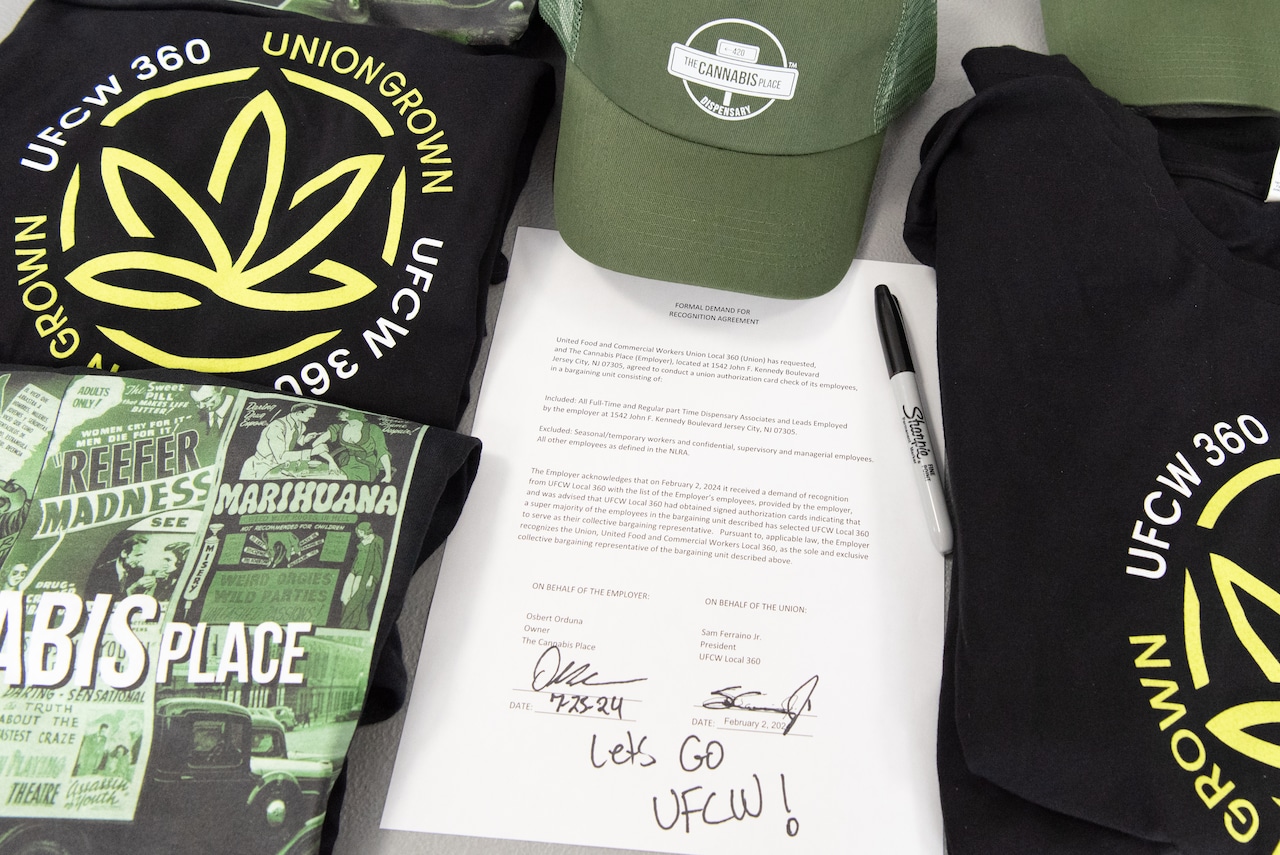
Banners and promotional materials filled the building as union officials, local leaders and former Senate President Steve Sweeney gathered to mark the signing of an agreement between The Cannabis Place and the United Food and Commercial Workers Union, or UFCW.
Sweeney, one of the chief architects of New Jersey’s cannabis legalization law, had championed a provision requiring cannabis businesses to enter labor peace agreements with labor organizations. The agreements meant companies would allow unions access to their stores and neither side would engage in hostile actions toward the other.
At the event, Sweeney pointed to Orduña’s decision to go the extra step and recognize a union shortly after opening as proof the system was working “exactly the way it was supposed to be.”
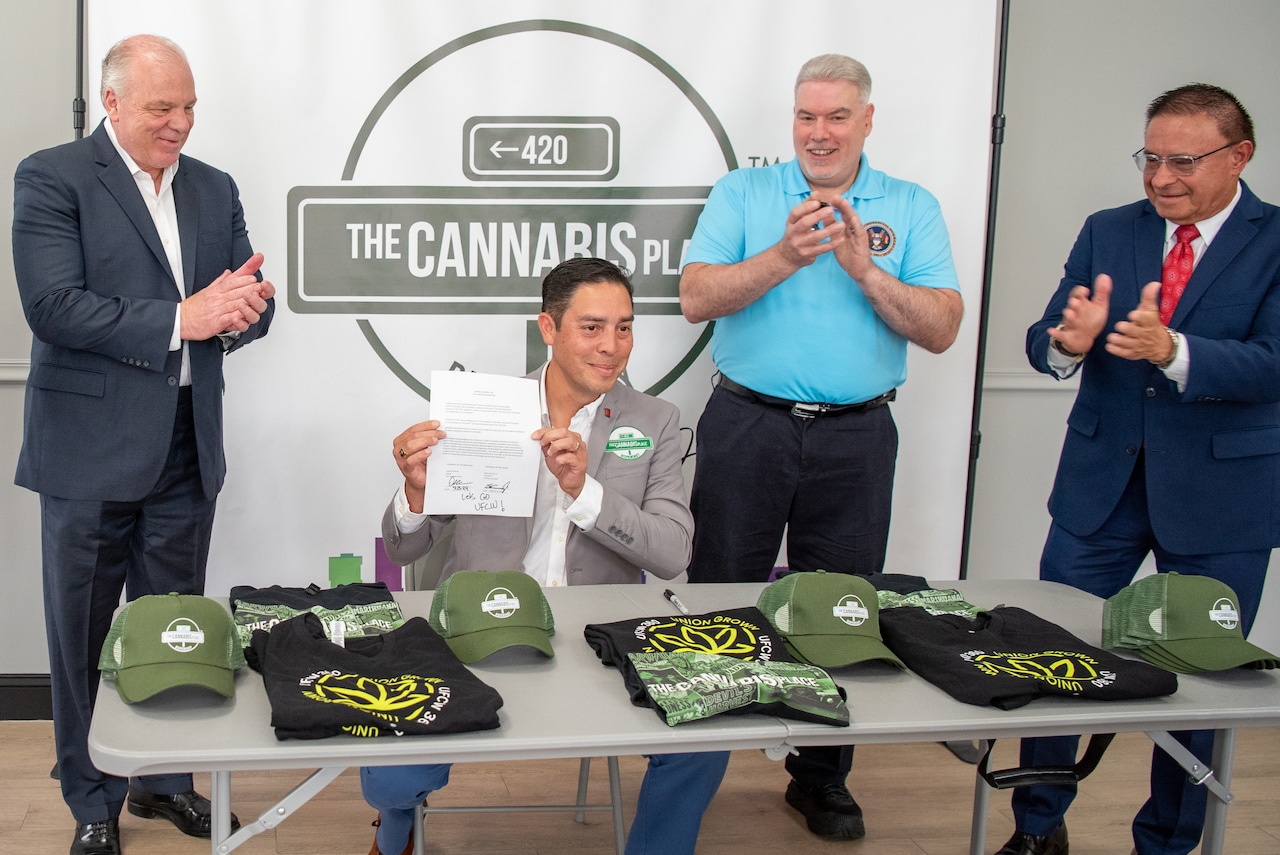 Osbert Orduna, owner of The Cannabis Place in Jersey City, holds the union recognition agreement he signed with the UFCW Local 360 on July 25, 2024. Applauding are, from left, former State Senate President Steve Sweeney, who is running for governor; UFCW Local 360 President Sam Ferraino Jr.; and Hudson County Clerk E. Junior Maldonado, a minority owner of the dispensary.Reena Rose Sibayan | The Jersey Journal
Orduña was with UFCW Local 360 Executive Vice President Hugh Giordano as the agreement was signed.
Giordano, who brokered the deal, shook Orduña’s hand and watched as pictures were taken. The two men had known each other for months throughout the process, and this photo-op had been the culmination of that relationship thus far.
But now, the two men and the entities they represent find themselves on opposite sides of a federal lawsuit.
The Jersey City cannabis dispensary that once celebrated its partnership with the state’s largest cannabis union is now suing New Jersey’s cannabis labor law, arguing it has effectively created a one-union monopoly.
Now there is no union recognition celebration, and there is no peace between the two.
The dispute begins
When Orduña had a falling-out with the UFCW over contract renegotiations this year, his lawsuit alleges the store opted to go to other unions instead.
The lawsuit alleges that the store went to every available labor organization it could find, but none would challenge the UFCW. Orduña argues that the situation creates an effective monopoly that is backed by cannabis regulators who, under the law, will not renew the license of an operator that does not have a peace agreement with a union.
“New Jersey’s mandate doesn’t protect workers; it creates a state-sponsored cartel that holds minority and veteran entrepreneurs hostage,” Orduña said.
Both the state Attorney General’s Office and the Cannabis Regulatory Commission (CRC) declined to comment.
The legal fight has also spilled into a separate dispute with Jersey City. Court records show a federal judge temporarily blocked the expiration of The Cannabis Place’s local cannabis license after the Jersey City Council failed to approve a renewal measure due to the dispute.
The Cannabis Place’s suit appears to be the first challenge brought by an independent dispensary against the state’s labor peace agreement requirement. One of the state’s largest cannabis operators, Curaleaf, filed a similar lawsuit last year. Another major cannabis operator, Verano, also filed suit this year.
In legal documents, state regulators argue that The Cannabis Place is not facing immediate harm because the CRC has administratively approved the company’s license renewal and has not issued a Notice of Violation while the Curaleaf case proceeds.
“So Plaintiff’s Complaint—much less its request for emergency relief—is woefully premature,” said state lawyers in a legal filing. “Plaintiff is not suffering, and will not suffer, any harm from its failure to maintain an LPA.”
Orduña argues that misses the point. He contends that even the prospect of a future Notice of Violation can carry consequences for a cannabis business, affecting how banks, landlords, vendors and local regulators view the company.
Orduña’s lawsuit represents an escalation of the legal fight over New Jersey’s cannabis labor laws, but it is also different from the challenges that came before it.
The lawsuits were once the province of large cannabis companies with national legal teams. Now the policy is being challenged by a local operator who once was one of the policy’s biggest success stories.
When The Cannabis Place celebrated its labor agreement in 2024, union leaders pointed to the dispensary as proof that organized labor and cannabis business owners could work together.
Today, both sides accuse the other of abandoning that vision.
While Orduña says the system evolved into a one-union structure that limited alternatives, the UFCW leaders argue cannabis operators embraced labor agreements when they needed support and are now trying to walk away from them after becoming established.
“You can’t be pro union and then fight the union,” Giordano said. “It doesn’t make any sense to me. He claims to be pro union and come from a working-class family.”
A pillar of legalization
New Jersey law requires licensed cannabis businesses to enter into labor peace agreements with a labor organization.
The agreements generally prohibit employers from interfering with union-organizing efforts and require both sides to refrain from hostile actions, such as picketing and public attacks against one another.
Orduña, who originally went a step beyond that and recognized the union altogether, alleges the UFCW has used its dominant position in New Jersey’s cannabis industry to wield a position that makes cannabis businesses reliant on it for their license renewals — and to add unfair pressure to any renegotiation that takes place.
“We are taking this fight to federal court to dismantle this unconstitutional regime for every independent business owner in New Jersey,” Orduña said.
Orduña’s constitutional arguments largely mirror claims raised by Curaleaf and Verano, which argued the labor peace agreement requirement improperly delegates authority traditionally reserved for the federal government under U.S. labor law.
In Curaleaf’s case, a federal judge earlier this year allowed the lawsuit to move forward after agreeing the company had raised substantial federal labor law questions.
The lawsuit also points to William Wallace, the Cannabis Regulatory Commission’s director of labor compliance, who previously worked as a UFCW official. The lawsuit cites Wallace’s prior employment as part of its broader allegations regarding the relationship between regulators and the union.
The Cannabis Regulatory Commission declined to comment on Wallace’s role.
“This is no longer just about cannabis. It is about basic constitutional rights, free enterprise, and whether state regulatory bodies can be weaponized as enforcement arms for politically connected labor unions,” said Dean Kpere-Daibo, an attorney with Constangy, Brooks, Smith & Prophete LLP.
The labor peace agreement requirement was never an afterthought in New Jersey’s cannabis legalization framework.
Supporters argued the legal cannabis industry would do more than generate tax revenue and repair some of the damage caused by the War on Drugs — it would also create stable, union-backed jobs in a newly regulated industry.
The provision became one of the core pillars of legalization, surviving the transition from New Jersey’s medical cannabis program to the broader recreational market approved in 2021.
Even then, some legalization advocates and industry insiders said they recognized the requirement could eventually face legal challenges because labor relations are generally governed by federal law.
The mentality at the time was to “leave that fight for another day,” said one lobbyist involved in the legalization effort.
For years, that fight never materialized in a significant way.
Now it has.
Competing Visions
Orduña’s lawsuit arrives as courts weigh similar challenges from larger and better-capitalized cannabis operators.
Curaleaf, the largest cannabis operator in the state and one of the largest in the country, sued in 2025 after state regulators issued a $610,000 enforcement action tied to the labor peace agreement requirement.
The company and regulators had sparred for years over unionization efforts, and labor advocates repeatedly accused the cannabis giant of resisting organizing campaigns.
Earlier this year, a federal judge allowed Curaleaf’s lawsuit to proceed, concluding the company had raised substantial questions involving federal labor law.
Verano later followed with a similar lawsuit, arguing labor relations fall under federal jurisdiction and should not be regulated through New Jersey’s cannabis licensing system.
UFCW officials say the growing wave of litigation is not surprising. They argue companies willingly entered labor agreements when they needed licenses and support to enter the state’s cannabis market, only to later challenge those same requirements as a form of bad-faith negotiation.
The stakes extend well beyond the companies involved in the lawsuits.
If courts ultimately strike down the labor peace agreement requirement, unions could lose one of the most influential organizing tools in New Jersey’s multibillion-dollar cannabis industry.
Cannabis companies argue the state has overstepped its authority. Labor groups counter that the requirement was an essential bargain of legalization, ensuring workers shared in the benefits of an industry built with public approval and government oversight.
UFCW Local 360 Executive Vice President Hugh Giordano, who oversees cannabis organizing efforts in New Jersey, called the lawsuits disappointing and disputed Orduña’s characterization of the union’s role in the latest lawsuit.
The fight has also become deeply personal between Giordano and Orduña.
The two men who once clasped hands at a labor agreement celebration now find themselves on opposite sides of a lawsuit, each convinced the other had abandoned the partnership they helped build.
Orduña says he spent years building The Cannabis Place only to be met with demands he believes treated his small business no differently than some of the state’s largest cannabis operators.
Giordano sees it differently.
“We don’t negotiate from the floor,” he said, defending the union’s bargaining approach.
“You can espouse all you want that you’re pro labor and pro-union. He’s not. The UFCW has done a lot to promote Osbert for years,” Giordano added.
Giordano said the union supported The Cannabis Place throughout its licensing process, attended Jersey City council meetings and met with public officials on the company’s behalf as it sought approval to open.
“It’s kind of like a slap in the face,” Giordano said. “He used us as far as I’m concerned.”