
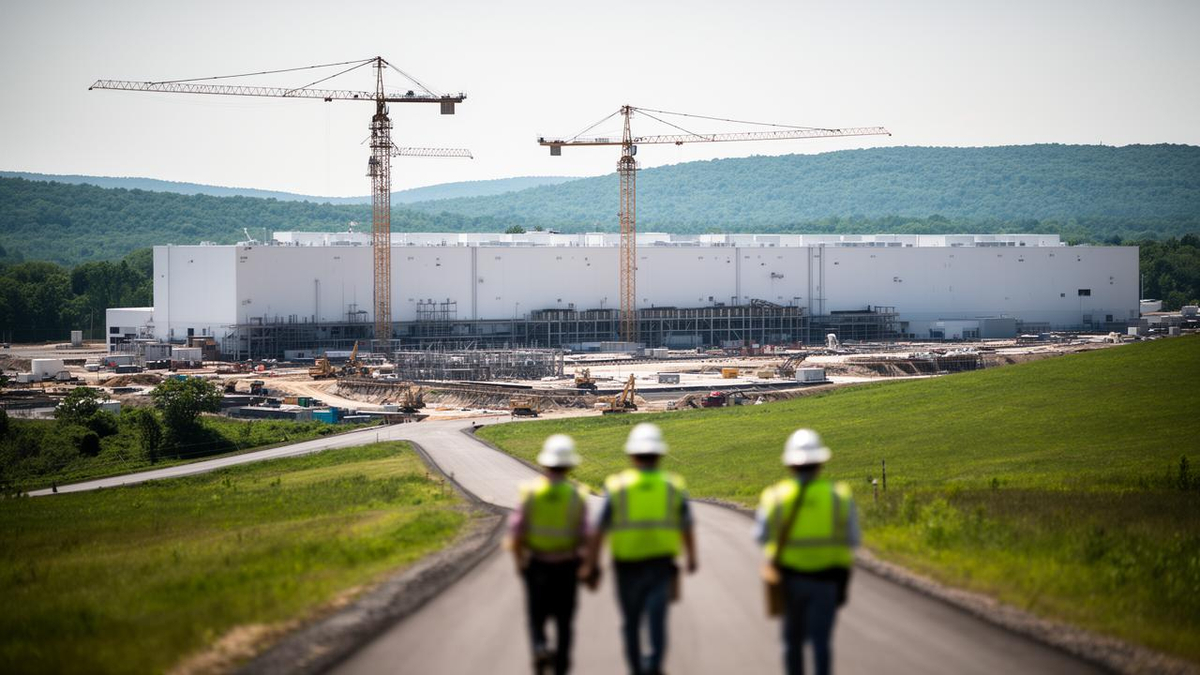
President Donald Trump announced on the 14th (local time) an investment plan to build two semiconductor fabrication plants in Malta, New York, backed by $21 billion in Japanese funding. The project will be constructed and operated by GlobalFoundries (GFS), a semiconductor contract manufacturer, under a structure in which the U.S. government and Japanese parties jointly own the facilities.
In a post on his social media platform Truth Social, President Trump stated that the investment would create approximately 27,000 jobs in the construction and supply chain sectors, along with more than 1,000 jobs in semiconductor manufacturing. He described the plan as “turning subsidies into money-making ventures for America.”
The plant construction stems from the $550 billion U.S. investment agreement that the Trump administration signed with Japan last year. At the time, the U.S. secured Japan’s large-scale investment in exchange for reducing tariffs on Japanese automobiles and other imports from at least 25% to 15%. Under this agreement, Japan has so far announced two tranches of projects totaling more than $100 billion.
According to GlobalFoundries, the investment capital for the new plants will be provided entirely by Japan, but the U.S. government will also hold equity stakes in the facilities. The company is majority-owned by Abu Dhabi sovereign wealth fund Mubadala Investment, and will generate revenue through construction and operations fees, as well as licensing costs for its semiconductor manufacturing technology.
The first plant is targeted to begin operations in 2029, while the timeline for the second plant will be determined based on market demand. Initial customers include Japan’s Renesas Electronics and iPhone maker Apple.
GlobalFoundries CEO Tim Breen said in an interview with Reuters, “We want to give priority to U.S. and Japanese customers,” adding, “Ultimately, we expect companies outside the U.S. and Japan to account for some of the demand, but we will go through a process after the announcement to determine who gets what volumes and when.”
Under a separate agreement, the U.S. government will acquire an additional 4% stake in GlobalFoundries, raising its total ownership to approximately 7%. President Trump stated that the U.S. Department of Commerce has invested $955 million to support silicon photonics, silicon germanium, and advanced packaging technologies, bringing cumulative investment to $1.63 billion. He claimed the government’s GlobalFoundries stake is now worth more than $2 billion. However, this represents unrealized valuation, as the government has not sold its stake or realized any profits.
CEO Breen explained that a significant portion of Japan’s capital investment will flow back to Japanese semiconductor equipment makers such as Tokyo Electron. “We clearly want Japanese equipment suppliers to participate,” he said, emphasizing that the company will “collaborate very actively with the Japanese ecosystem.”
GlobalFoundries shares rose more than 4% in early trading on the day and have gained over 33% year-to-date.
In his announcement, President Trump noted that he is converting investment commitments not only from Japan but also from South Korea and Taiwan into large-scale construction projects. He emphasized that these efforts will expand semiconductor and power supply capacity, strengthen energy security, and create jobs.
The investment structure marks a departure from traditional semiconductor subsidy policies. The Trump administration has cited its government investment in Intel (INTC) as an example, adopting an approach where U.S. taxpayers share in corporate growth through equity stakes rather than outright subsidies. GlobalFoundries will also be permitted to redirect previously awarded CHIPS and Science Act subsidies toward strengthening its manufacturing capabilities.
The profit distribution structure of the Japanese-funded project is also noteworthy. Under the agreement, President Trump directly selects projects to be supported with Japanese funds, and available surplus cash flow generated from investments will be split equally between the U.S. and Japan until certain distribution thresholds are met, after which 90% will accrue to the United States.