
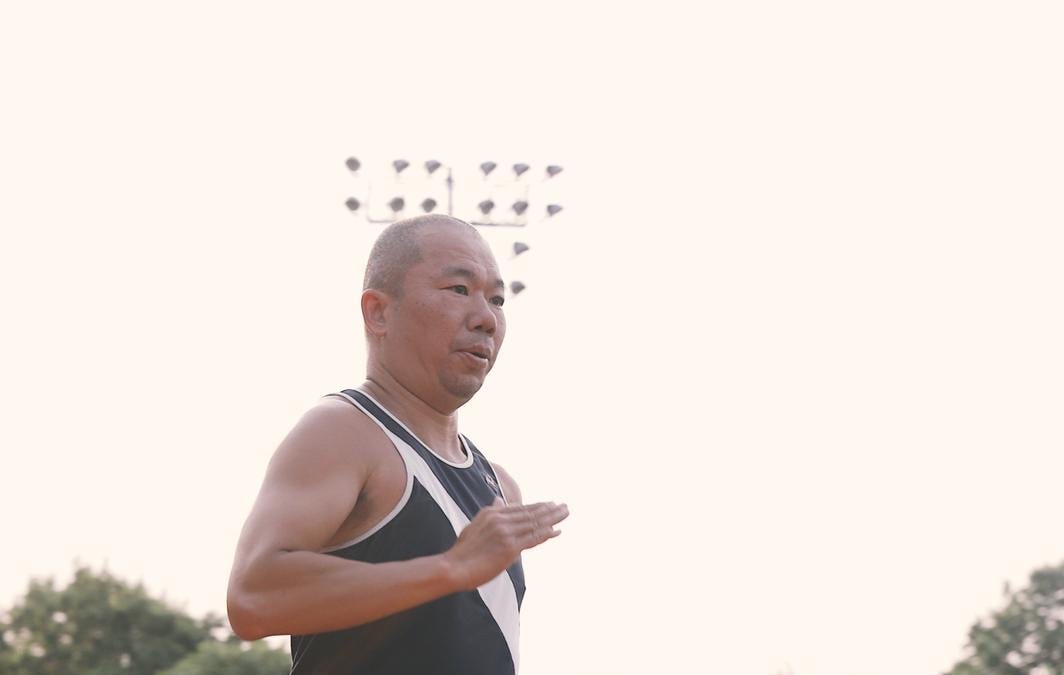
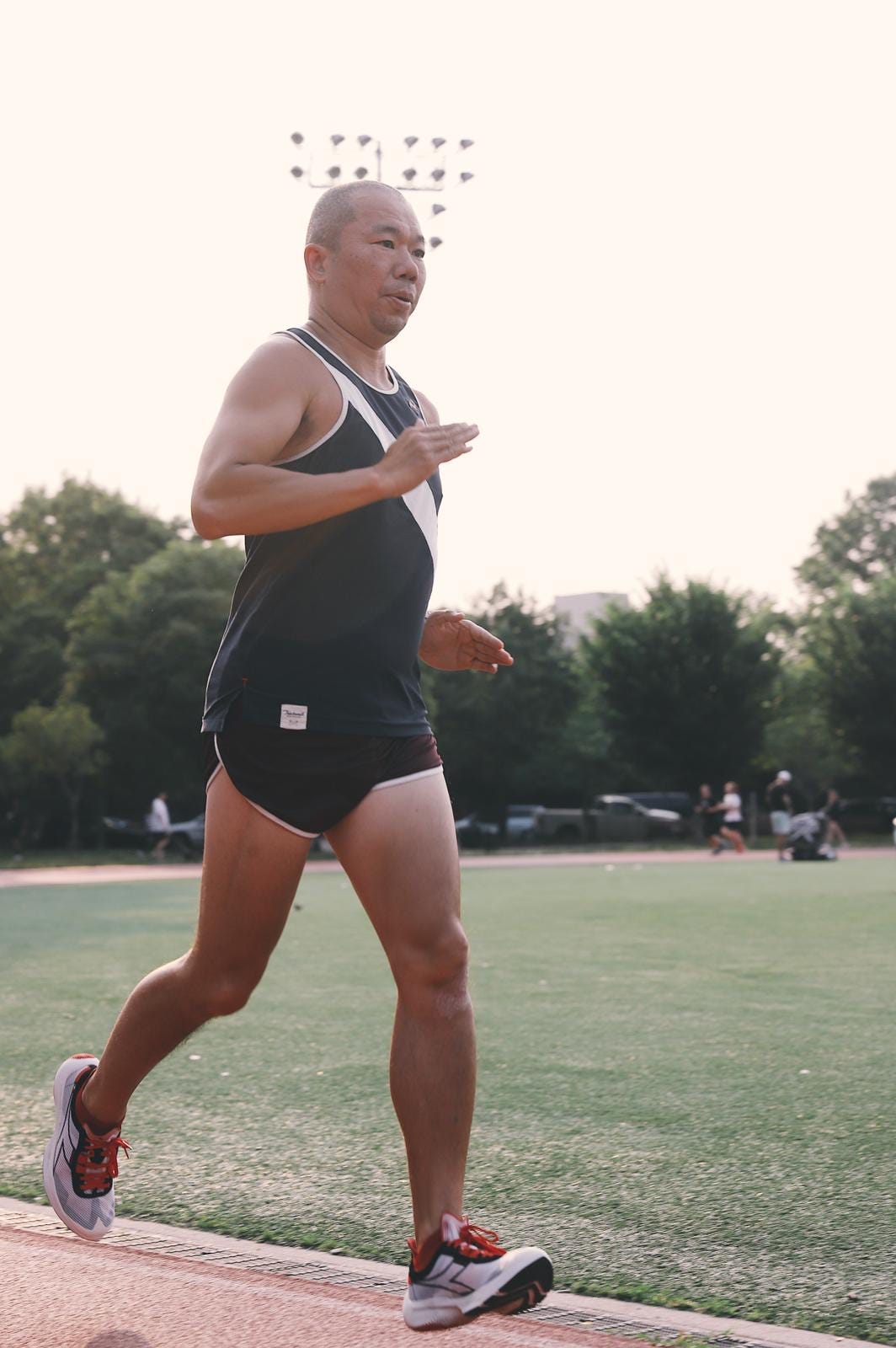
When Tony Ho Loke moved to Long Island City during the pandemic, the first thing he did was look for a run club in the area.
Immediately, he found RunLIC. It began with he and the founder just running together while social distancing, but Tony remained consistent as the city opened up, to the point that he started getting recognized around the neighborhood.
“People were like, ‘There’s that guy that’s running again,’” he remembers. “Or I would stop in at a bar and someone would be like, ‘Hey, aren’t you that guy that runs? Are you part of a running club?’”
Each time Tony would invite them to RunLIC’s next group run, something he says has been instrumental in the club’s growth over the last several years. Tony’s also simultaneously grown as a runner himself over that time period, signing up for his first races and eventually developing into a leader within the RunLIC community and recipient of NYRR’s Community Spirit Award.
But to him, being a leader is less about his own accomplishments and more so how he can give back.
“Leadership is about serving the needs of the people who are part of your club,” he says. “Part of what success as a club means is if I leave tomorrow and the club runs as smoothly as it does [today]. That’s the mark of good leadership.”
We spoke with Tony to discuss watching the NYC Marathon while growing up in Queens, what keeps him coming back to the race now every year, how his background as a rower translates to running and more.
This interview has been edited for length and clarity.
Intro:
I was born in Hong Kong, but my family moved to New York in 1981, I was eight years old. I’ve been here ever since, I’m a Queens kid through and through, raised here, went to elementary and high school here. I did go to Binghamton University in upstate New York for two years, and then I transferred back and I finished off my degree in philosophy at NYU. I’ve really lived in New York ever since, except for six weeks I was in Singapore for a work assignment. So I really consider myself, at heart, a New Yorker….
Running was not something I did in terms of exercising. I’ve always been active. When I was at Binghamton, I was on the rowing team. And that was my first introduction to running as a part of my life, because during the winter season, when you couldn’t get on the water, land practice was all about running. I rowed at NYU for a very short stint, not even a semester, but again the running just kind of kept up with me. So from my 20s on to my 40s, I’ve always used running as a part of my exercise, nothing more than two or three miles.
And then in 2019 I started focusing on running a bit more. I met a group of friends that were part of North Brooklyn Runners, and that was the first time I really got into a community of people where running was a big part of their life and their identity…. For me, seeing that social aspect of running together with people was really exciting, so that was really where it started for me.
I ran with them for probably a good six months. And I was fairly casual in terms of regular running. I considered myself still a newbie, a beginner. During the weekdays, I’d run three times a week, like a 5k, and then on the weekend I’d do a long run of like five miles…. Then the pandemic hit, and one of the really big things I remember from those days was that they didn’t want you to be outside. And it wasn’t even a government thing, but a social thing: if you didn’t have to be outside, don’t be outside—except if you were exercising. And I’ve always been an outdoor person. For me not to spend at least some time outside is just mentally really taxing on me. So it was probably in the summer of 2020, around June, when I really started running a lot, every single day. It’d be about a 10k a day, and I’ve mainly kept that up from then through now.
Running has really become a big part of my life. I’ve made a lot of my current friends through running. We spend a lot of time socializing on the run and off the road. Racing for me was something really new. When I first started running seriously in 2019, I never considered racing, and it took me a while to think about making racing a part of my life. It wasn’t until 2022 that I did my first-ever race, the Brooklyn Half.
By that point, I felt as a runner that I had a lot of mileage under my feet, I felt really comfortable. But not having raced before, not having been a competitive racer in college, I didn’t really get what was so special about it. Getting on a starting line—that’s when I felt the adrenaline, and having people around you that you wanted to run a little faster than. Having that as a part of my running experience was really special, and that’s when I thought, ‘Okay, now I get it.’
You didn’t run competitively in college, but you were a rower. Did that competitive spirit from rowing transfer to running at all?
I think a lot of it does come from that. I was a pretty serious rower. Binghamton had a club team rather than a school-sponsored team, but even then, we were competitive. And part of it was the joy of when you get on the water.
Two things about rowing that translate for me into running—A, it’s an endurance sport. With rowing, the moment you get on the water, you are maxing out your capacity, and you’re doing it for 20 minutes, half an hour, 45 minutes. And the endurance part of it was really appealing to me. You could put me on a treadmill, put me on a road, put me on an erg, and I can go on forever. That kind of challenge, or pain, is something that’s really familiar.
And the other part was the team aspect of it. On a boat, you really need to be in sync with your rowing mates. I was on a lightweight eight, and this was the kind of sport where you could not do anything alone. You had to depend on your teammates. You really needed to rely on them to be rowing in sync with you, to pull as much power as you are, to make everything work.
“The more I’ve run, the more I appreciate that—especially when it comes to racing—it’s not a solo sport”
In the beginning, I thought about running as more of a solo sport, you’re running alone. But the more I’ve run, the more I appreciate that—especially when it comes to racing—it’s not a solo sport. It’s the people around you, whether it’s the race pack that you’re running with that really pulls you along when you’re lagging, or when you’re trying to push yourself and push someone else. There is a psychological push-pull effect that’s really important in racing…. That’s something that’s very familiar from rowing: that dependence, physically and psychologically, on the people around you.
Going back to racing, that competitive spirit really did hit me once I was on the starting line. I’m not in an A corral up front, but I am competitive with the people around me. As you’re in your race, you’re identifying people, you’re mentally thinking, ‘Okay, I’m going to beat that guy,’ or, ‘I’m not going to let this person get in front of me.’ That definitely is a part of it.
You ran your first marathon [at the 2023 NYC Marathon]. Was that always a goal in the back of your mind, or what motivated you to eventually want to do that?
That was a bit of a journey for me. It was really funny how I got into the Brooklyn Half [in 2022] too. I had signed up with North Brooklyn Runners in the winter of 2020 for that year’s Brooklyn Half. Obviously, with the pandemic, that was canceled in 2020, and I believe 2021. And then in 2022, I suddenly get this email in my inbox saying, ‘Congratulations, you’re in the Brooklyn Half.’ I had forgotten that they took that bib and just gave it to me for the first year they were running it back since the pandemic. So for me, that was a nice push into racing. I might have made more baby steps, doing a 5k or 10k before I hit a half marathon, but nothing like jumping into the deep end of the pool.
So I did that, and it was tough. I got as much advice as I could from runners around me. I read as much as I could. But nothing prepares you for actually racing it, and everything you can learn from it. And it was coming out of that half marathon that I thought, ‘I really want to run the marathon.’ Obviously by that point, the ’22 season was too late for me to be a part of, and so I really aimed to run the 2023 New York City Marathon as my first real marathon.
You lived in New York almost your entire life, was the marathon something you watched and thought about in the back of your mind as something you’d end up doing, before you got into consistent running?
I mean, as a lifelong New Yorker, I really loved the New York City Marathon, even as a non-participant. I watched it from the sidelines for years. It wouldn’t be consistent year on year, but you always had a friend that was going for a goal, that was running, that you wanted to support and cheer on. So every November, that was something that was on my calendar: there’s somebody running, and I’m cheering somewhere, probably First Avenue, or meeting them afterward. So for years, it’s been something that looms really large in my mind as a big thing.
I never thought this was something that I wanted to run…. I said before, I love the outdoors. I spent a lot of time in the backcountry hiking through the Southwest, and I love endurance and being active outdoors. I know what hiking 15, 20 miles is, and it’s a lot for your body to handle. And to think, ‘Wow, 26 just seems a little extreme.’ So I had this thought that we’re not meant to do that, and it’s not really great, and I would never do it.
And then as I did my first half marathon and started training a bit more, I was like, ‘Well actually, that’s hard, and you need a lot of recovery, but it’s something that the human body can do,’ given that you treat yourself well, and that you’re smart about not only training, but giving yourself the rest that you need.
You’ve run the New York City Marathon every year since 2023. What about that first experience motivated you to keep doing it?
The funny thing about it is, even though I didn’t have a chance to run the 2022 New York City Marathon, I trained with a bunch of my friends from my local run club, RunLIC, for that marathon. So that whole summer and fall, every weekend, I would do long runs. I would do the 12, 16, 17, 20-mile runs with them. And it was again that camaraderie, doing something hard together. It brought me back to my rowing experience, being on a team of people that was doing something really hard. Part of the joy of distance running is you spend three, four hours with these people, and you see each other at your best, but also at your worst. So there was so much closeness that I found with these guys that I was training with.
And ultimately they went on and got to run that really hot 2022 marathon that was so awful. It was great for spectating. I remember just standing on the side going, ‘Oh, this is really comfortable.’ But I remember afterward seeing everyone and hearing their stories about just how difficult it was in the heat. That was really hard.
So part of the bug that bit me was just being able to spend a lot of really good quality time with people, chatting the entire time, getting to know each other. And it’s not even something that you have in mind when you first start to run. But you spend so much time on the road together, you’re like, ‘Okay, I’m just going to talk about whatever,’ and you get to know people really well, at least the way that I am with my running. So again, I kind of call back to that social, community aspect that’s really special to me.
And then as I was running my first New York City Marathon, it’s so special…. Not only are you part of 50,000 people running it, but the entire city comes out. And people are cheering you on, people are yelling your name when you have your name on your shirt. It gives you a little bit of, ‘Is this what celebrities feel like in their everyday life?’ Strangers are yelling your name, and you’re whooping your head around, going, ‘Who just called my name? Was it a friend, was it a stranger?’ And it’s really cool. It’s something that you don’t get to experience every day, having so much support from strangers. And this happens over the course of four hours. I think it’s extraordinarily special….
I’ve run every year since ’23, and I see myself continuing to do this. Part of what makes it special is that as I continue to run this year after year, I’m pulling on my own experience, but I’m also having the opportunity to guide new runners who are running the marathon for the first time, or running any distance for the first time. For me, it’s really exciting to bring people along, to show them what I think is exciting, but also let people run as they want to.
I’ve met a lot of people through RunLIC. The club right now probably has about 300, 400 active runners, and it really has grown since the pandemic. When I joined the club during the pandemic era, we were like a dozen people. Somehow running has hit a cultural moment, and more people look at it as something that they want to do.
How did you first find RunLIC?
I ran with North Brooklyn Runners, the pandemic came, it was a little bit difficult for me to run with them, and I found myself running solo. By June of 2020, I had moved to Long Island City. I was living in the Financial District before, and during the pandemic, I just felt like I needed more green space, a place to be outside. And as someone who grew up in Queens, I’ve always known about this neighborhood, and it was just really appealing for the amount of open space that was here.
And as soon as I moved here, I was like, ‘Well, I wonder if there are any active running clubs.’ And they did one run every Saturday morning. At first it was just me and this guy Ian, who still runs the club—he and his wife Sabrina have kept this club going. It was me and Ian running a 5k every Saturday, social distancing apart. And then as things loosened up a lot more during the pandemic, they started hosting more runs, two or three runs a week.
I was out running every day, and I would see people, and people would ask me, ‘Oh, are you part of a running club?’ And I loved to stop and talk to people and tell them about RunLIC. So it really feels grassroots in that way. I’m literally running through the neighborhood so often that people were like, ‘There’s that guy that’s running again.’ Or I would stop in at a bar and someone would be like, ‘Hey, aren’t you that guy that runs? Are you part of a running club?’ And so that really was, from my eyes, how the club started growing a lot. There are other people that are running by themselves, or people were curious about running, and we would run by them in one of our group runs and just invite people to come run with us. And we have so many people that joined that way….
It’s been really rewarding for me. I’ve become a run lead in RunLIC, and I organize a lot of runs and a lot of activities for the club. And for me, I come at it from a social aspect of I just want people to come together, have a place where they feel safe, where they feel like they can participate without any kind of judgment. So having a club that’s welcoming to new people moving into the neighborhood is really important. We’re a small, little, local community club, and if you want to run with us as a part of your community, great. It could be once a week, once a month, whenever you want to join.
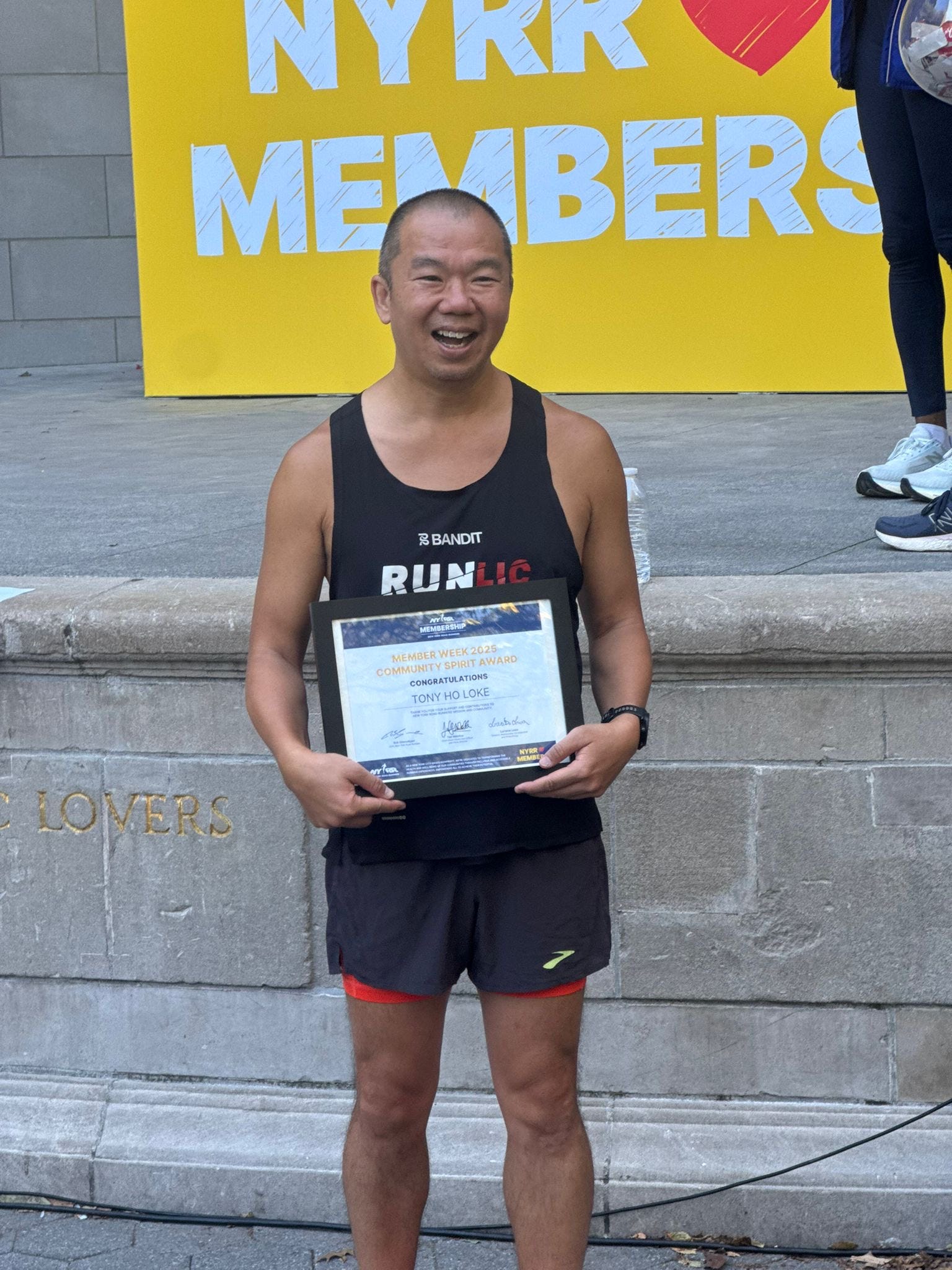 Tony was a recipient of NYRR’s Community Spirit Award last year
You’ve become a leader within RunLIC…. How have you individually grown within the club over the years?
From a leadership standpoint, I feel like that’s something that was just part of the natural progression…. I see myself as someone who leads in terms of finding out what people want out of running and helping them get it, whether it’s something that I can help with, or whether it’s connecting them with other people within the run club, within the community, that can help them with that. I think that’s the most important thing. For me, leadership is about serving the needs of the people who are part of your club or part of your team. What is it that they need, and how can you help provide it to them, even if it’s not something that you do yourself?
So part of what I love doing is to look for other people within the club that can act in those leader roles. I am not a fast runner. I am 53, I am older. I have a certain amount of fitness that I’m really proud of, but I’m never going to be in a competitive AA corral. Well, we have other runners who are like that, and I like to give them the power to say, ‘Hey, you should lead runs. You should lead a faster run, for you to be able to run at the pace that you want and grow as an athlete.’
And then there are people who have a different kind of fitness. As big of a tent as you want to have, it’s not fair for people who run faster to wait for people and spend a lot of time hanging out. And so we created a low-intensity running group, for people who can find each other, who are running at a similar pace, and they can really find their own groove.
“Part of what success as a club means is if I leave tomorrow and the club runs as smoothly as it does [today]. That’s the mark of good leadership”
For me, part of what success as a club means is if I leave tomorrow and the club runs as smoothly as it does [today]. That’s the mark of good leadership. People feel so empowered to do the thing that they want, and to start the thing that they want, that it keeps on going without you. I think that’s what a good organization does.
So for me, it’s a lot of listening. As much as I talk in a group run, I like to also just shut up and hang back and listen to the conversation around me, and hear about what people want. And if it’s something that I can help start—going down to the track once a week to do intervals—I can start it. And then as soon as I see someone else who’s really interested in being a run lead, I’m like, ‘Great. You go do it. I will be as much support as you need. If there’s any kind of need, I will help out, I can be a sounding board.’
Any topics I didn’t ask about that you’d like to touch on, or any closing thoughts?
I think the thing that I love about running is that it’s something everyone can do. And I love that this has really gotten into the culture, that people feel like they can come in and run what they want. Finding a community, a place where you can do it together—and doing it together could be something like you go and talk about it with someone else, but you like to run solo. I think that’s a really great thing. It’s become a really great force for bringing people together, and I love that. And I think the more people get together to run, the better.