
Photo: Anna Connors/Getty Images
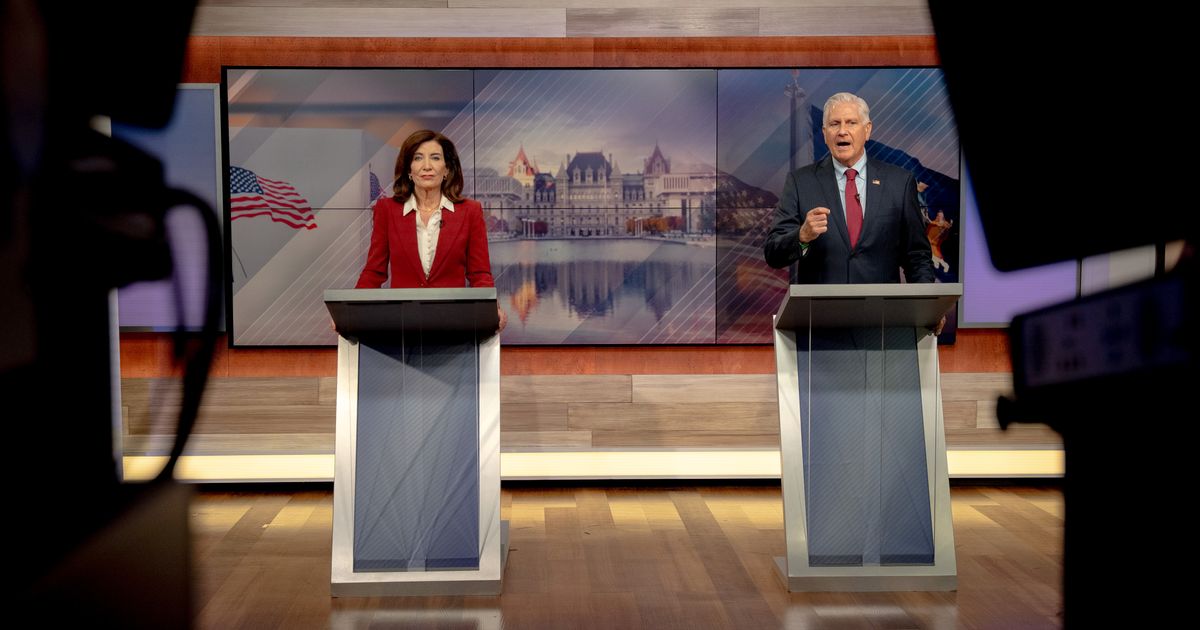
After many hours of preparation, my Spectrum News colleagues and I settled on 11 substantive questions to ask Governor Kathy Hochul and Nassau County executive Bruce Blakeman in their first and only televised debate in the race for governor, and I got through ten of them with my co-moderator, Susan Arbetter, before time ran out. But that still leaves pressing matters we couldn’t fully explore that New York’s governor will have to confront when the State Legislature convenes in January, on topics ranging from housing to food stamps to mental health.
We’re lucky that Hochul and Blakeman agreed to debate at all. New York has no legal requirement that state candidates show up for public debates unless they receive money through the state Campaign Finance Board, and Hochul, flush with campaign cash, hasn’t joined the matching funds program.
It’s too bad we don’t have mandatory debates for important offices; when public, non-scripted discussions of issues are optional, politicians often duck debates for fear of making a verbal or visual stumble that can go viral and send a campaign into a death spiral. Even before a catastrophically shaky debate performance in 2024 ended the reelection chances of President Joe Biden, a generation of campaign consultants routinely warned their clients against repeating disasters like the 1960 Nixon-Kennedy debate. (Nixon, not wanting to appear fancy or phony, declined an offer to put on TV makeup and ended up looking sallow and nervous next to John F. Kennedy’s Hollywood good looks.)
Another cautionary tale, the New York Senate debate of 2000, featured a popular Long Island congressman, Rick Lazio, who never recovered from the ill-advised stunt of marching over to the podium of his opponent, Hillary Clinton, while angrily waving a piece of paper (a pledge not to accept soft-money donations) and demanding that she sign it on the spot.
Wary politicians have overlearned the lessons of the past, and the public has suffered as a result. Nationwide, in 21 out of the 36 states where voters are selecting a governor in November, there have been zero debates between major-party candidates, according to ABC News. That includes close races in consequential states like Georgia, Nevada, and Ohio that are likely to be regional battlegrounds in the 2028 presidential race.
Fortunately, New York’s top contenders are lifelong political animals with too much experience and ego to pass up a turn on the debate stage. “This is my 16th election,” Hochul occasionally mentions in private, a reference to her long climb through the ranks as mayor of Hamburg, clerk of Erie County, and a member of Congress before years of serving as lieutenant governor and governor. Blakeman, who successfully ran for the Hempstead Town Board and Nassau legislature in the 1990s before winning the post as county executive, recalled childhood visits to Albany with his father, a state assemblyman. “I would meet senators and assemblymembers and commissioners and Governor [Nelson] Rockefeller, and I just loved it,” Blakeman once told me. “It was exciting, it was interesting. You got to help people every day. And I’ve had it in my blood since then.”
Blakeman and Hochul clashed over how to handle the Cornell University rape case; the first ICE shooting in New York City; the ailing upstate farm economy; the high cost of energy; the regulation of data centers; the candidates’ different approaches to public safety; and the runaway expenses of the state’s Medicaid program. (You can watch the whole event here.)
I was struck by how the candidates seemed comfortable with, even respectful toward, each other, politely shaking hands before and after the debate and staying cool in the thick of battle, never raising their voices even as they kept up a patter of name-calling with tough words like misery, failure, and pathetic. Those kinds of slashing insults make some candidates erupt with personal rage or even profanity, but Hochul and Blakeman were professional and businesslike, keeping control of their emotions and arguments.
As expected, both candidates tried to link their opponent to political allies who weren’t in the room — Hochul repeatedly referred to Blakeman’s close ties to President Donald Trump, while Blakeman went on a passionate rant about Hochul’s connection to the city’s mayor, saying, “I think Zohran Mamdani is an antisemite. I believe he’s anti-Christian, and I don’t think he has American values.”
But the headline-ready zingers were secondary to a willingness to talk about the nuts and bolts of government and the devilish problems facing the state. While I’m proud of how much ground we covered in 60 minutes, giving voters the opportunity to hear directly from New York’s sitting governor and her potential successor, here are some key questions that didn’t make the cut.
Insurance Imbroglio: New York’s Scaffold Law imposes strict liability for all gravity-related accidents on construction sites no matter who is at fault, contributing to high insurance expenses and higher housing costs across the state. New York is the only state that uses a form of strict liability on construction accidents. Is it time for New York to join the other 49 states?
Upscaling Upstate: Micron, the giant semiconductor manufacturer that’s building the largest private-sector construction project in New York State history just outside of Syracuse, is expected to create 50,000 direct and indirect jobs in the region. But the size of the Micron development is creating enormous pressure on an already tight housing market. While this is arguably a good challenge to have — growth and jobs are positive — some people may be priced out of the market. How will the next governor address that issue?
Food-Stamp Squeeze: About 2.7 million New Yorkers receive the Supplemental Nutrition Assistance Program, SNAP. Under the One Big Beautiful Bill Act, New York State counties must now come up with 75 percent of the money to administer the program, while the federal government spends 25 percent. Multiple counties are now sounding the alarm over the higher costs. Will the state step in and assist counties with these new unfunded mandates?
Census Sense: According to current Census projections, New York State is on track to lose two congressional seats after the next count in 2030. In September, the Trump administration proposed several landmark changes to the Census, including excluding non-U.S. citizens without a green card. If that happens, New York could lose two or as many as five seats. In light of this tremendous overhaul in the way the Census would be counted, do you support the president’s push? And if not, how will you work to ensure that New York’s count is as accurate as possible?
Kendra’s Law: Recently, a 32-year-old woman was stabbed and killed in Times Square by a man with a history of mental illness. Kendra’s Law, named after a woman who was shoved in front of an oncoming subway train in 1999, allows for involuntary outpatient commitment and treatment for people with severe mental illness under certain circumstances. It was recently expanded. Should Kendra’s Law, which is up for renewal in June of 2027, be extended another five years?
When the dust settles after November 3, expect these unasked questions (and many more) to land on the desk of the next governor.
Sign Up for the Intelligencer Newsletter
Daily news about the politics, business, and technology shaping our world.
Vox Media, LLC Terms and Privacy Notice