
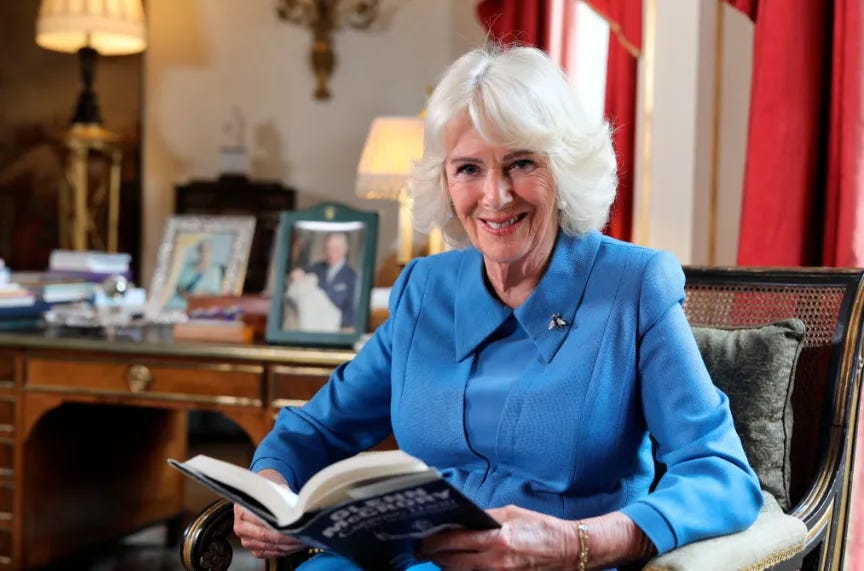
This week the BBC ran a documentary titled “The Book That Changed My Life.” It featured inspiring testimonials about the power of reading from an assortment of people including a former inmate, a Liverpool truck driver…and Queen Camilla. The program was a collaboration with the Queen’s Reading Room, which has been promoting books and authors since 2021. The reviewer in The Guardian described the interviews as “bursts of exuberance, really, going off like fireworks,” and called the documentary “magic.”
The Queen’s comments about her late father, Bruce Shand, were as personal as they were moving, and they are worth presenting in their entirety:
“I think a lot of people do see books as a lifeline. My father. He was captured at El Alamein, nearly at the end of the battle, when they had almost captured Rommel. A sniper shot him through his face. He was incredibly lucky because the bullet went in one side, out the other, didn’t touch his tongue or his teeth. He was taken to a prisoner of war camp and incarcerated for two and a half years. Those places there was not much to do unless you were plotting your escape. So, he said he educated himself, because he read every single book from the Bible to the encyclopedia, whatever was there, he just sat all day long and read and read and read. And that’s I think how he survived it. Like all that generation, they never talked about the war. You bury it all because you’ve seen such horrendous things. So, we never heard him speaking about his wartime experiences. But he wrote it all down in this book, ‘Previous Engagements.’ It was written from the heart. I mean I cried through most of it. I found it so moving. Because I didn’t know anything about it, and reading managed to get him through it.”
As I listened to her, I thought I should share what I wrote about her father in a post for Royals Extra nearly three years ago. It provides more detail about his military service and imprisonment, his memoir, and a selection from his thirty-seven little-known book reviews for Country Life magazine, as well some insights into the Queen’s own literary tastes. To say Bruce Shand was an ardent reader would be an understatement.
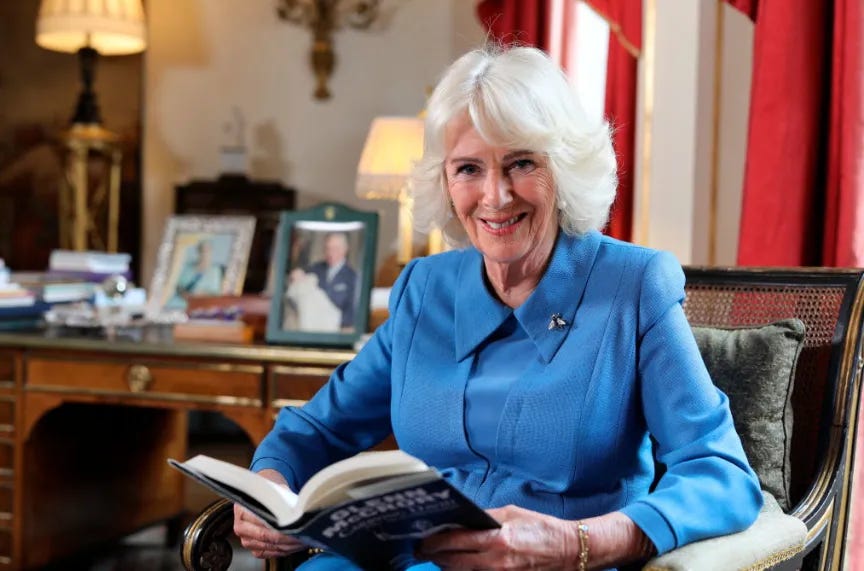 Queen Camilla on the BBC documentary “The Book That Changed My Life,” October 14, 2026
“The love of books is ingrained in us”
Queen Camilla has called her late father, Bruce Shand, “probably the best-read man I’ve come across anywhere. He devoured books. He read to us as children. He chose the books. We listened. I think the love of books is ingrained in us. It was there from such an early age.”
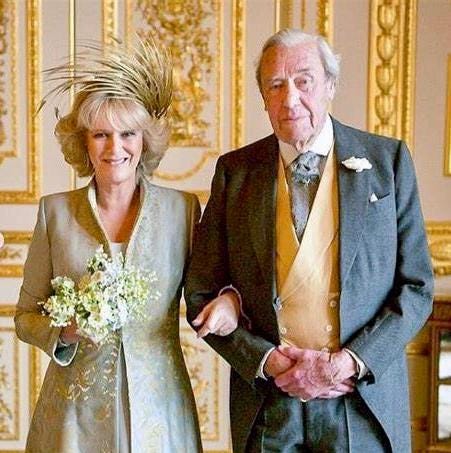 Camilla, the Duchess of Cornwall, with her father, Bruce Shand, after her marriage to Prince Charles on April 9, 2005
That passion for books led to Camilla’s active role in charities promoting literacy. In 2010 she became patron of the National Literacy Trust and rode a double decker bus around London with children’s book authors and a group of kids who happily listened to their stories. For the same charity she promoted “Books Unlocked,” which takes authors into prisons to talk about their books. Among her other literacy enterprises are First Story, which teaches children writing skills, and Coram Beanstalk, which sends volunteers into schools to read with students.
“The first book club I ever joined”
In January 2021, during the first Covid-19 lockdown, Camilla started The Reading Room on Instagram. It was, she said, “the first book club I ever joined.” Her mission was to highlight her favorite books and authors and encourage reading at every age. Last year she inaugurated a literary festival at Hampton Court Palace, and at the beginning of this year she launched her first podcast, The Queen’s Reading Room.
Her literary tastes, much like her father’s, are not highbrow. Christopher Bland, a former chairman of the Royal Shakespeare Company and a board member of First Story, told me when I met him in 2013 that Camilla “would be the first to suggest that Shakespeare is not at the top of her list of favorite things.” But, he added, “she is very bookish, and a keen reader. She likes what I like, middle of the road, literary but not too literary a focus.” She has read The Cazalet Chronicles, a multi-generational five- volume series by Elizabeth Jane Howard, three times. It “takes you out of your world,” Camilla has said. “If you are depressed, go to The Cazalet Chronicles, and someone is having a worse time than you. It is a relief to dig into it and do it again.”
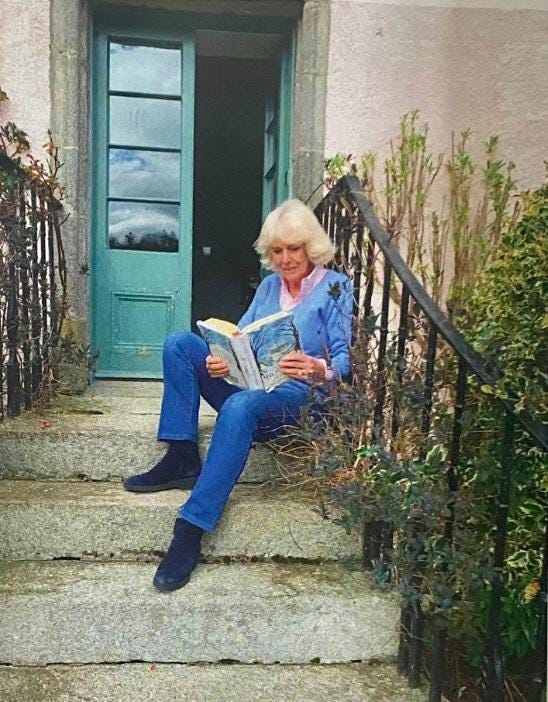 Camilla reading All Change, the fifth volume of The Cazalet Chronicles, at Birkhall, Charles’s home in Scotland on the Balmoral estate during the Covid-19 lockdown in April 2020
“A gifted writer of style and erudition”
While Camilla has credited her father with inspiring her love of literature, she has said little about his own reading habits, much less his talent with words. He wrote Previous Engagements, a memoir about his experiences in the Second World War, prompting the acclaimed military historian Sir John Keegan to call him “a gifted writer of style and erudition.” For nearly fifteen years, Shand contributed to Country Life magazine as a book reviewer. I have read all thirty-seven of his reviews, the last of which he wrote two years before his death at age eighty-nine in 2006. Combined with his memoir, these succinct essays offer a fascinating window into the character, intellect, and personality of the man who, according to his close friends, significantly shaped his elder daughter, the future queen.
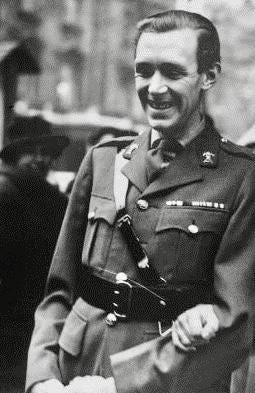 Major Bruce Shand of the 12th Royal Lancers.
“Rather indolent, self-conscious, and invertebrate”
Educated at Rugby and Sandhurst, Bruce Shand had an unstable upbringing in what he called a “rather strange” family. His father, Philip Morton Shand, an architecture critic and expert on food and wine, married four times. Philip’s first wife was Bruce’s mother, from whom he was divorced after three years, leaving their son to be raised by his Shand grandmother. In 1946, Bruce married Rosalind Cubitt, the daughter of the 3rd Baron Ashcombe, whose family had made a vast fortune building on prime real estate in London. Camilla’s father went on to become a well-regarded London wine merchant.
When I think of Bruce Shand, the image that springs to mind is of a twenty-four-year-old army officer arriving in Libya in September 1941 with everything he needed for battle—along with a tea chest filled with books. In his memoir, he described himself as a “rather indolent, self-conscious, and invertebrate” boy who had been transformed by becoming an “omnivorous reader.”