
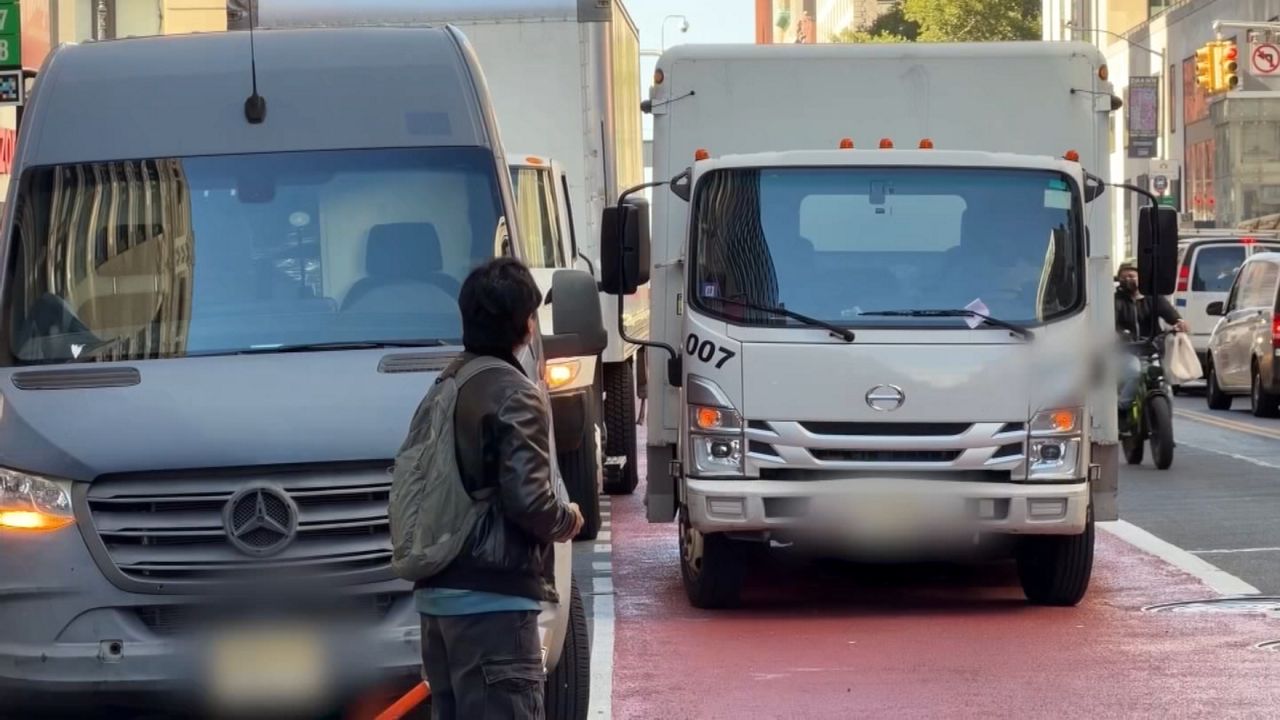
The City Council held a hearing Tuesday on a bill that advocates say would weaken the city’s Citizens Air Reporting Program, which allows residents to submit vehicle idling complaints and receive a portion of the fine collected.
The bill, known as Intro 561-A, is sponsored by Jim Gennaro. It would allow more exemptions from idling enforcement and lower the complainant payout from 25% of the fine collected to a flat fee of $125.
Alicia del Carmen Caballero, a participant of the Citizens Air Complaint Program, says she comes from a family of truck drivers and reports idling vehicles when she encounters them.
“I’m just an everyday New Yorker who’s kind of filming polluting trucks as I see them,” she said.
Caballero is part of the New York Clean Air Collective, a group of residents who report idling through the city program. She says participants must record a video showing the vehicle idling for at least three minutes and one second, then submit information including the license plate, company name and company address.
“If I see a truck on the way to work, I’ll stop and I’ll film it,” Caballero said. “But I’m not one of the super earners.”
The program dates back to 2009. In 2018, the City Council passed a bill requiring the city’s Department of Environmental Protection to clearly state the procedures for reporting idling complaints.
In 2020, then-Mayor Bill de Blasio helped promote the program with musician Billy Idol.
The mayor’s office said there were just over 9,000 complaints in 2009. The DEP said it received more than 160,000 complaints last year.
Fines start at $350, and payouts can be as high as $500 per violation, according to Council Speaker Julie Menin’s office.
Some participants make thousands of dollars through the program.
Alex Camarda, a senior policy adviser at Reinvent Albany, testified Tuesday that the bill would reduce participation and undermine enforcement.
“The loopholes in the bill and the lower payment to complainants will result in complainants participating less, and they could drop out of the program,” Camarda said. “And that will ultimately result in more idling and more air pollution.”
Camarda says the proposed exemptions include allowing private buses to idle at certain points in their routes, which may not be clear to citizen reporters.
Glenn Every, the president of the Bus Association of New York State, says private coach buses sometimes need to keep engines running to maintain safe temperatures for riders and operate key systems.
“The braking and electrical systems, air circulation, the wheelchair lift, the kneeling function, and ironically, even the air pollution mitigation systems — they’re all tied to that engine,” he said.
Every says his members provide the same service as MTA buses, which are exempt from idling enforcement.
Another provision in the bill would require the DEP to issue violations within 60 days or dismiss the complaint. Currently, it can take up to 18 months before a violator receives notice.
Zach Miller, the vice president of government affairs for the Trucking Association of New York (TANY), says the delay creates due process concerns for trucking companies.
“It makes it almost impossible for a trucking company to defend [itself],” Miller said. “You know, accounts change, employees change.”
Camarda said both sides want faster processing, but he said the bill does not provide additional resources to the DEP.
“The Gennaro bill requires that complaints be processed within 60 days without any additional resources,” Camarda said. “The effect of that will be to wipe out all the existing complaints that are processed after 60 days.”
The DEP did not testify at the hearing, citing litigation. In written testimony, the department said it currently has a backlog of 230,000 complaints to review.
The bill has no co-sponsors, and it is unclear whether it has enough votes to pass.