
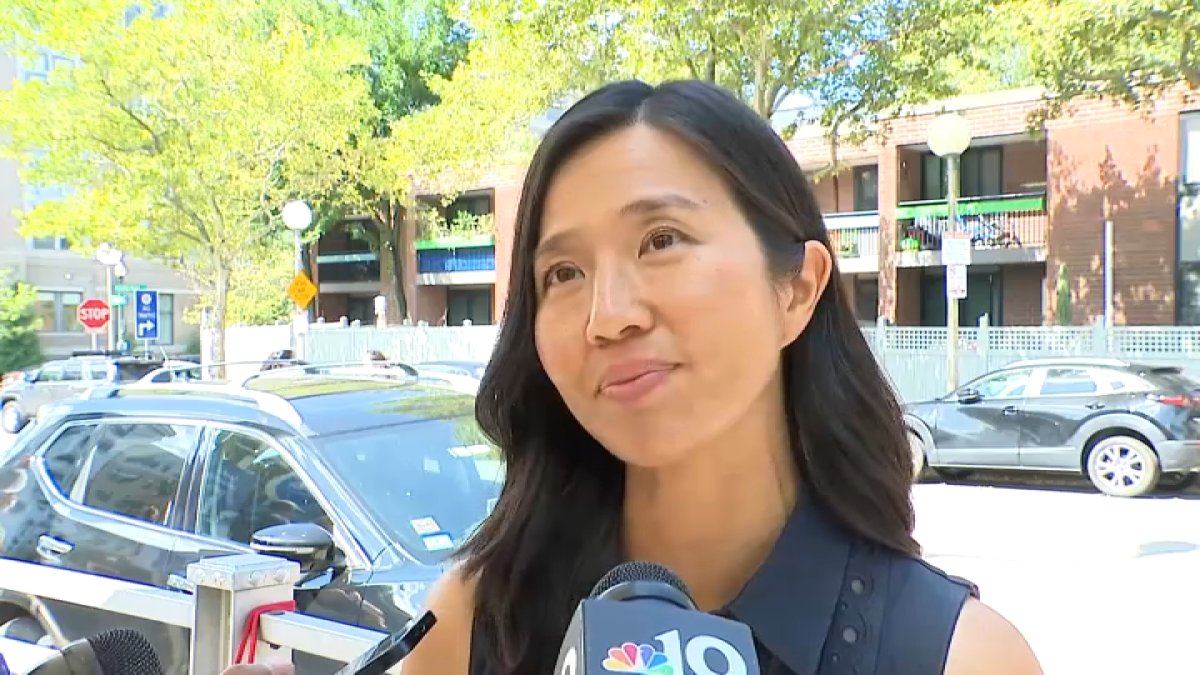
Boston Mayor Michelle Wu told the MBTA Advisory Board on Tuesday that her team has “been in touch a little bit” with New York City to understand its congestion pricing system.
“With the whole transportation system, we have to figure out a way to fund it, and sustainably. I just want to encourage you to not be afraid, you know, of the T word, you know. The tax word. I know that New York has, like, a payroll tax,” board member Len Diggins told Wu.
“I don’t know how we’re going to do it,” he continued. “But I think if you present the public with a plan, a good vision, along with that plan for what will happen with the additional funds for which you’re asking, maybe it can go a long way towards getting the support for that.”
Wu replied, “I thought when you mentioned New York, you were going to talk about congestion pricing, because that’s been a huge source of funding for public transit improvements over there now.”
Vehicles entering New York City’s “Congestion Relief Zone” are charged a toll, the city’s attempt to reduce traffic and travel time and raise revenue for public transit.
Some are looking at New York City’s controversial congestion pricing plan as a possible model to improve traffic in Boston.
Passenger and small commercial vehicles entering the zone pay $9 once daily during “peak” periods, which are in effect from 5 a.m. to 9 p.m. on the weekdays and from 9 a.m. to 9 p.m. on the weekends. Motorcycles pay $4.50 once daily, and trucks and buses pay between $14.40 and $21.60. Overnight tolls are $2.25 for vehicles, $1.05 for motorcycles, and between $3.60 and $5.40 for trucks and buses.
The congestion pricing program generated over $550 million in net revenue during its first year of operation, the Metropolitan Transportation Authority said in January. The MTA also said that congestion pricing resulted in 27 million fewer vehicles entering the zone, representing an 11% reduction in traffic.
“Our teams have been in touch a little bit to just understand, kind of, what they have experienced and the details there,” Wu continued. “Mass. Municipal Association, [Medford] Mayor Lungo-Koehn and I, and the Metro Boston mayors — we’ve all been talking about revenue for a long time now because the economic environment that we’re in is straining cities in general. Record numbers of Prop two-and-a-half override ballot override questions going to the ballot.”
Former Transportation Secretary Monica Tibbits-Nutt said in 2024 that the Transportation Funding Task Force would be “looking at everything,” including congestion pricing, and then faced backlash when she discussed tolling at the borders.
Users of the east-west Massachusetts Turnpike have long paid tolls along that long stretch of highway but there is great sensitivity toward the idea of adding tolls on roads that don’t have them, as well as frustration with congested highways.
Wu joined the Tuesday meeting to discuss the coordination of transportation between Boston and the MBTA, telling the board that its fare-free bus pilot has been “transformational” for Bostonians. There are 150,000 bus rides within Boston alone on any average weekday, she said, accounting for more than half of MBTA ridership.
Wu also discussed Boston’s plans to launch five free, city-run Link Bus routes in Mattapan, Roxbury, Allston-Brighton, Charlestown and the Lower Mystic, and the South Boston waterfront. The service will provide “last-mile service” along an established route between residential neighborhoods and transit stops. The administration is using $11.5 million from the Federal Highway Administration’s Congestion Relief Program to support the new shuttles.
The city is putting out an RFP, Wu said, and will be able to support the program for three years of operation in the current plan.