
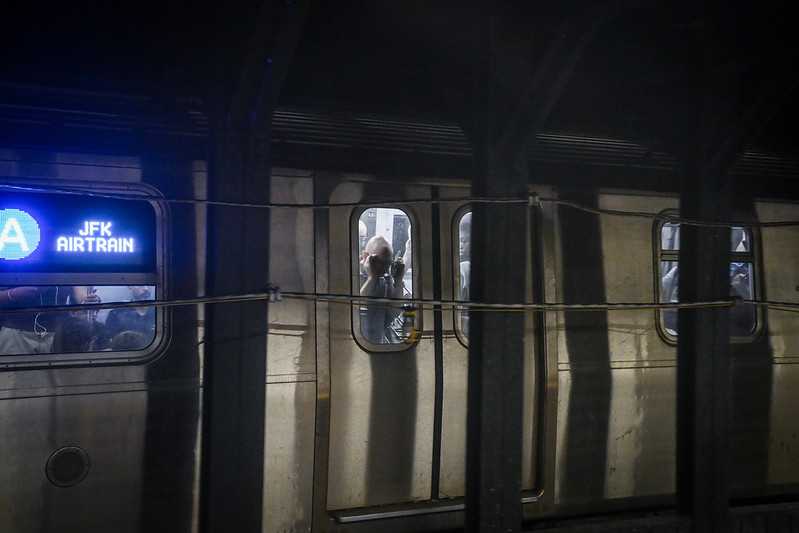
The MTA has begun work on a $1.9 billion effort to replace nearly century-old signals on Brooklyn and Queens’ A and C lines, the agency announced on Thursday.
The project will see the MTA install modern Communications Based Train Control (CBTC) signals along the A and C trains’ Fulton and Liberty Avenue lines between High Street in Brooklyn and Ozone Park-Lefferts Blvd in Queens. The new hardware will replace 1930s-era analog signals, which allow train dispatchers to track their locations and speeds, and will allow for trains to run closer together and, by extension, at faster speeds.
Taken together with track replacements, the undertaking is the largest signal and track replacement in MTA history, according to Gov. Kathy Hochul’s office.
The resignaling and laying of new tracks is effectively entirely funded by revenue from the state’s congestion pricing program, which charges drivers a base $9 toll to enter Manhattan below 60th Street.
“Congestion pricing keeps delivering wins for New Yorkers,” Hochul said in a statement. “Upgrading nearly 100-year-old signals does more than just modernize infrastructure that is long overdue – it is a critical part of our plan to run better and more frequent subway service, shortening waits and slashing delays. When this project is done, hundreds of thousands of A and C train riders will benefit from the world-class service on new, modern trains that New Yorkers deserve.”
Contracts for the project were approved by the MTA board nearly a year ago.
The MTA will conduct the work along 42 miles of track, covering 23 stations that serve 350,000 riders each weekday.
Unlike analog signal systems, which show where trains are on specific sections of track, CBTC allows dispatchers to track their exact locations and speeds. That precision allows for the MTA to safely run trains closer together — yielding more frequent service.
MTA Chair and CEO Janno Lieber, in a statement, said resignaling has a big impact, as signal issues are the “number one cause of subway delays.”
“No surprise considering the ancient relics we’ve been using to direct train traffic,” Lieber said. “Thanks to this almost $2 billion project – the largest of its kind in MTA history – we are going to be able to run more A and C trains faster, safer, and more reliably than ever before.”
Modern signal systems have already boosted train speeds on the lines where they are currently operating — including the entire 7 and L lines and parts of the Queens Boulevard and Culver E, F, M, and R lines in Brooklyn and Queens.
On the 7, on-time performance increased from 68% to 91% after the MTA installed CBTC, according to the MTA. The E line in Queens saw a 10% rise in train speeds when the new signals were activated.
In the first phase of construction, the MTA will replace aging switches and 250 feet of track between 104 St and 99 St in Queens.