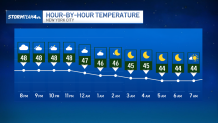
Tuesday night’s extreme geomagnetic activity at the earth’s poles delivered an Aurora Borealis that was quite a show for the tri-state area.
Wednesday night will be another active night, but the tri-state will likely miss out this time.
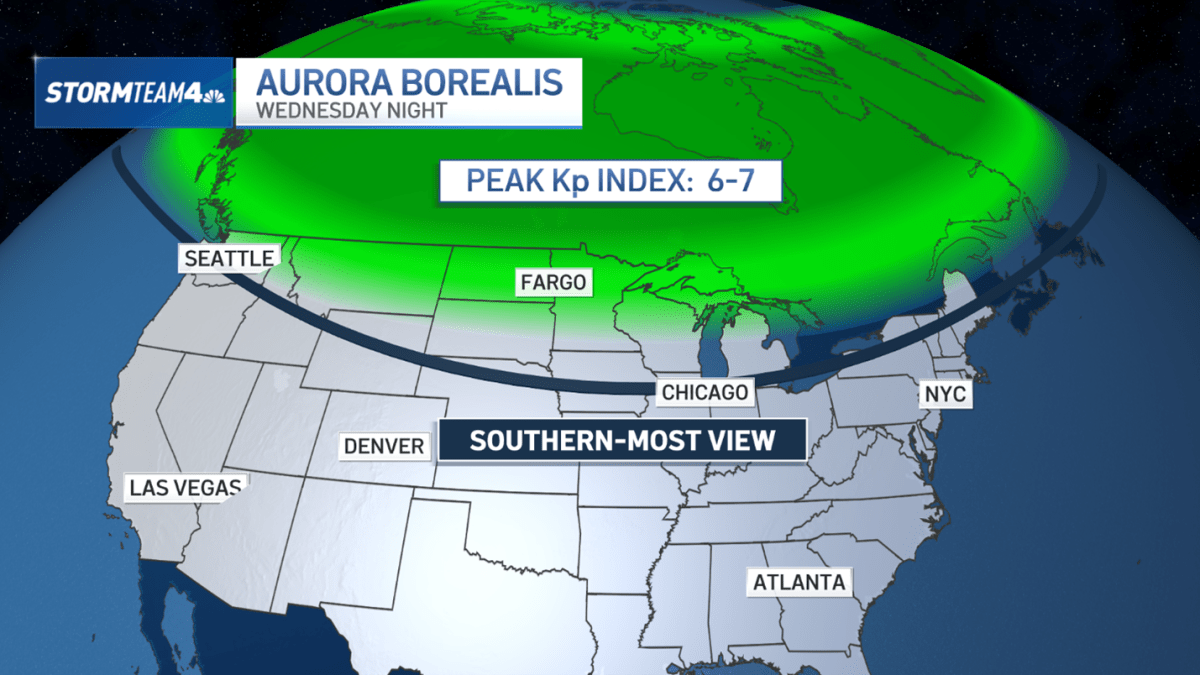
Wednesday night’s show will be confined to areas well north of New York City – think northern New England, the Adirondacks, and the Lake Ontario shoreline. The best viewing in the United States will be in the northern plains along the Canadian border.
The Aurora Borealis appears when a geomagnetic storm originating from the sun enters the earth’s atmosphere near the poles and energizes the gas molecules in the atmosphere. When energized, the atmospheric gases light up in spectacular colors. The stronger the geomagnetic activity, the more intense the color and the farther south the aurora can be seen.
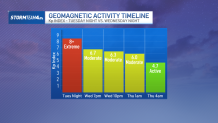
The Kp Index is a measure of geomagnetic activity. It runs from zero to nine, zero being no activity and nine being extreme. Tuesday night’s Kp Index was between 8 and 9, which made the Aurora Borealis visible all the way to New York City.
Wednesday night’s Kp Index will be lower, peaking between 6 and 7 before midnight and weakening to under 5 overnight.
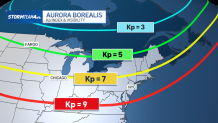
A Kp Index under 7 indicates New York City will be out of luck. The southernmost viewability will be far to the north in Upstate New York.
In addition to the less active atmosphere, cloud cover will be an issue. Skies will stay mainly cloudy Wednesday evening, when the aurora will be strongest. It won’t be until well past midnight, when the aurora is weakening further, that skies will be clearer.