
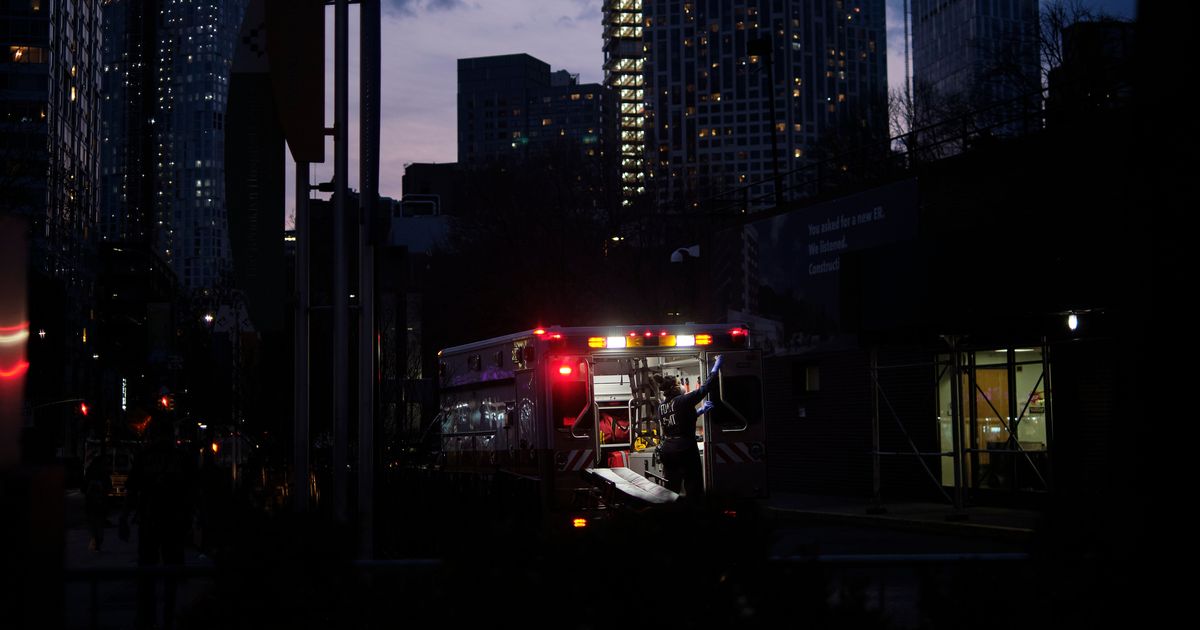
Photo: John Taggart/Redux
Sooner or later, the slow-motion collapse of New York’s response system for medical emergencies will force city leaders to get off their asses and address problems that should have been fixed long ago. Innocent people are already paying the price of City Hall perennially starving ambulance first responders of the salaries, benefits, and work conditions they deserve.
Over the last decade, response time on life-threatening medical emergencies has jumped by nearly four minutes, an increase of more than 41 percent, according to a recent report by City Comptroller Mark Levine. Non-life-threatening response time has more than doubled, by almost 15 minutes. That extra time can be the difference between life and death.
“Most critical, which would be cardiac arrest, was somewhere around 14 minutes. That’s serious,” Vincent Variale, president of the Uniformed EMS Officers Union, told me. “We know brain death begins at four to six minutes. So if I’m arriving at 14 minutes, I still need time to get into your house or your building and find you, that’s probably another three to four minutes. So it’s almost 20 minutes before we actually get down and work on the patient. Brain death has already started. The survivability of that patient has plummeted.”
Mayor Zohran Mamdani’s administration is aware of the problem. “We know this is unacceptable, and we are working tirelessly to reverse this trend,” said FDNY’s chief of department, John Esposito. (Emergency Medical Services is a division of the Fire Department).
The root of the problem, as union leaders warned in March, is the absurdly low pay that New York’s frontline “street doctors” get. First-year emergency medical technicians (EMTs) make only $43,932, far lower than the entry-level salaries of firefighters ($54,122) and cops ($55,942), and less than what we pay first-year sanitation workers ($47,752). And while other uniformed personnel hit $100,000 within five and a half years, EMTs have smaller increases and top out at $68,700, with paramedics capped at $86,348.
“You have EMTs starting out at minimum wage, a little over $18 an hour,” says Variale. “To live in New York City at that kind of salary, it’s very hard to do it. And that’s why people are leaving.”
The low wages have led workers to look for part-time work; take the exam to snag a better-paying job as a firefighter; sleep in their cars a few nights a week; or simply quit. Some even end up in homeless shelters, according to union leaders, and 14 have committed suicide since 2020.
“More and more EMTs and paramedics are leaving the job. We estimate by the time this is over, 1,500 will be gone,” says Variale, noting that 500 EMS workers have left so far this year. “It’s terrible. The main cause of response times going up is people leaving the job.”
A shrinking workforce prevents the city from having a sufficient number of ambulances ready for action. The average number of ambulances in service over the last five years was only 332, a number that recently rose to 416, but remains far below the department’s official target number of 488, according to Levine, even as volume has hit a record high of more than 1.1 million calls per year.
Reports of long waits for help during medical emergencies are starting to multiply. Last year, 14-year-old Kevin Daly had a stroke while at school; after an hour of waiting that included three calls from the school nurse, Daly’s mother came to the school and drove him to the hospital herself. In another case, the closest responder to a call on Staten Island was an ambulance in Manhattan that took 64 minutes to arrive, says Variale, who estimates that the slowing response times means 4,000 excess deaths a year.
Fixing the problem won’t be cheap. Prior to getting elected, Mayor Eric Adams promised EMS workers parity with other uniformed workers, winning the union’s endorsement, but he reneged after his inauguration; the workers have been without a contract since 2022. Levine estimates that bringing EMS workers into full parity with firefighters would cost about $1.23 billion if applied to the current contract period (2022 to 2027) and then cost an additional $289 million a year. A less expensive alternative, pegging EMS salaries to what private ambulance companies pay, would cost $352 million for the current contract and then an additional $98 million a year.
The missing ingredient here is leadership. A recent City Council hearing raised important workplace issues like the fact ambulances tend to be stationed at key intersections to speed response time, leaving EMS workers unable to take meal and bathroom breaks. The hearing also touched on the idea of increasing the number of FDNY personnel trained as paramedics ready to handle complex medical emergencies, a “fire-medic” model used in the other cities. But operational changes don’t address the core problem of low pay.
I recently asked Mayor Mamdani why New York doesn’t follow the lead of cities like Philadelphia, Portland, and Denver, which have established a minimum wage for municipal workers. “We’ve been having productive conversations with our partners in organized labor, especially when it comes to EMS workers. And we’re talking about people who it’s truly not hyperbolic to describe their work as having the consequences of life or death for New Yorkers,” Mamdani told me. “And yet, we’ve seen that they haven’t been recognized as such. I’m hopeful that those conversations not only continue but they continue to be productive.”
But hope, as they say, is not a strategy. City Hall should not wait for a tragedy to occur to make EMS first responders a job that pays a living wage and enables these public servants to build fulfilling careers saving lives.
“This mayor and this administration did not cause this problem. This problem started before they got here. And I’m happy to hear when they talk about affordability and pay equity and stuff like that. This should be right in the mayor’s wheelhouse,” says Variale. “I just think it needs to be moving a little quicker to get there. Because every day that goes by, more people are dying. Literally.”
Sign Up for the Intelligencer Newsletter
Daily news about the politics, business, and technology shaping our world.
Vox Media, LLC Terms and Privacy Notice