
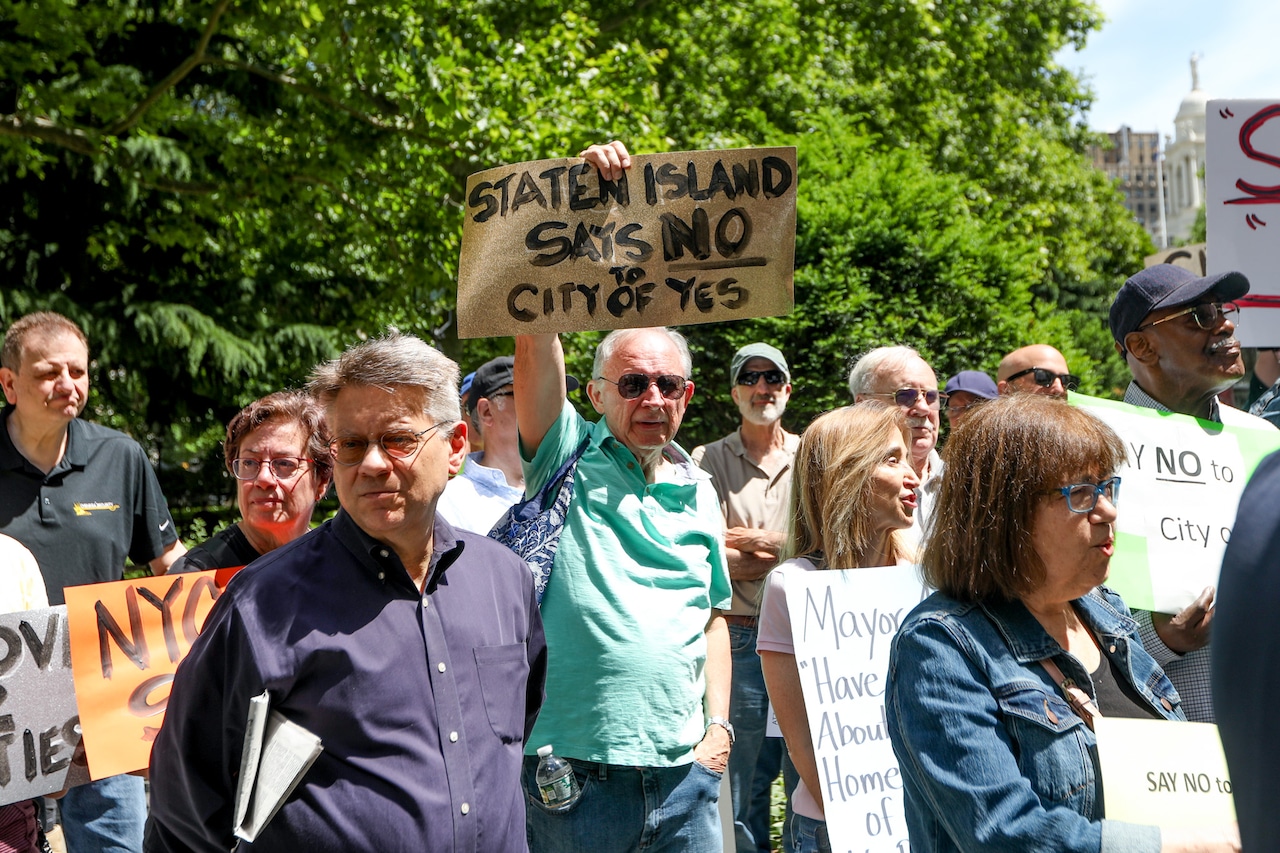
STATEN ISLAND, N.Y. — A lawsuit challenging the controversial City of Yes zoning plan has been dismissed by a Staten Island judge who claimed the city had done its due diligence during the environmental review process.
The lawsuit, brought by attorney Jack Lester, argued that Mayor Eric Adams’ administration failed to meet state-mandated environmental review requirements for the three-pronged rezoning plan.
Lester brought the case in March on behalf of a host of local civic groups and conservative elected officials, most of whom are from Staten Island.
He had argued that the Department of City Planning circumvented mitigation requirements under New York’s environmental review laws, and split the “City of Yes” plan into three parts — carbon neutrality, economic opportunity and housing opportunity — to avoid some of those requirements.
But Supreme Court Judge Lizette Colon disagreed, writing in her decision that the city’s land-use approval process “functioned as intended and created a voluminous and diverse record.”
“It is not the place of the court to second-guess policy decisions, nor interject policy opinions into this review of [state environmental law] compliance,” she wrote. “Rather, the court is merely here to confirm that respondents fulfilled their environmental review obligations under state and city law. To that extent, the court finds that the actions of respondent in creating the Final Environmental Impact Statement are not affected by an error of law and are not arbitrary, capricious or an abuse of discretion.”
In a statement to the Advance/SILive.com, Lester maintained that the city failed to provide appropriate mitigation for the changes that will come as a result of the rezoning plan.
“The heart of the State Environmental Quality Review Act is the provision of mitigation for adverse environmental impacts of governmental action. The court acknowledged that City of Yes provides no mitigation to lessen the negative impacts of density. The court excuses this failure by saying the citywide nature of the rezoning prevents mitigation,” Lester wrote.
“This is contrary to SEQRA which mandates a reasoned elaboration as to why no mitigation is provided. Merely saying it’s citywide is not a fulsome reasoning of the failure to alleviate the impacts of congestion, noise, traffic, loss of community facilities and stress on natural resources and loss of open space,” he continued.
All three “City of Yes” plans marked some of the most significant changes to the city’s zoning in decades, and have drawn particular ire on Staten Island for the housing and carbon neutrality portions.
The housing portion aims to bring about a city-estimated 80,000 units of new housing to the five boroughs through a series of regulation changes to things like accessory dwelling units, parking mandates and transit-oriented development.
The 80,000-unit estimate marked a decrease of about 30,000 from what the Adams administration originally intended and followed a compromise with the Council, which passed the plan on a 31-20 margin.
The housing portion has been fervently opposed by borough residents, many of whom fear it will drastically change the character of their low-density neighborhoods by making significant changes to what can be developed where, including allowing ancillary dwelling units (ADUs) on one- and two-family properties and small apartment buildings in areas where they were not previously permitted.
Meanwhile, the “City of Yes” carbon neutrality has helped ease development of the controversial battery energy storage sites around the Island, but their influx to the borough predated that rezoning’s passage.
A host of Staten Island’s elected officials had signed onto the lawsuit, including Borough President Vito Fossella, a Republican representing the full borough; Rep. Nicole Malliotakis, a Republican representing Staten Island and South Brooklyn; State Sen. Andrew Lanza, a Republican representing the South Shore; Assemblymember Michael Reilly, a Republican representing the South Shore; Assemblymember Michael Tannousis, a Republican representing the East Shore and South Brooklyn; Assemblymember Sam Pirozzolo, a Republican representing the Mid-Island; and Councilmember David Carr, a Republican representing the Mid-Island and part of South Brooklyn.
Three local civic groups — the Old Town Civic Association, the South Beach Civic Association and the Westerleigh Improvement Society — were also party to the lawsuit.
A representative from City Hall issued the following statement regarding the judge’s decision.
“Today’s ruling is another critical victory in the fight for affordable housing in New York City. Our transformative ‘City of Yes for Housing Opportunity’ plan is the most pro-housing zoning proposal in New York City history, creating 80,000 new homes over the next 15 years, and investing $5 billion toward critical improvements. This decision upholding ‘City of Yes’ in the face of a bogus challenge clears the way for New Yorkers to benefit from these long-overdue changes in the years ahead. In total, the Adams administration has planned, preserved, or created over 433,250 homes, because making housing more affordable for working New Yorkers has been our top priority. Efforts by NIMBY opponents to stop City of Yes in the courts have died,” a City Hall spokesperson wrote.
If you purchase a product or register for an account through a link on our site, we may receive compensation. By using this site, you consent to our User Agreement and agree that your clicks, interactions, and personal information may be collected, recorded, and/or stored by us and social media and other third-party partners in accordance with our Privacy Policy.