
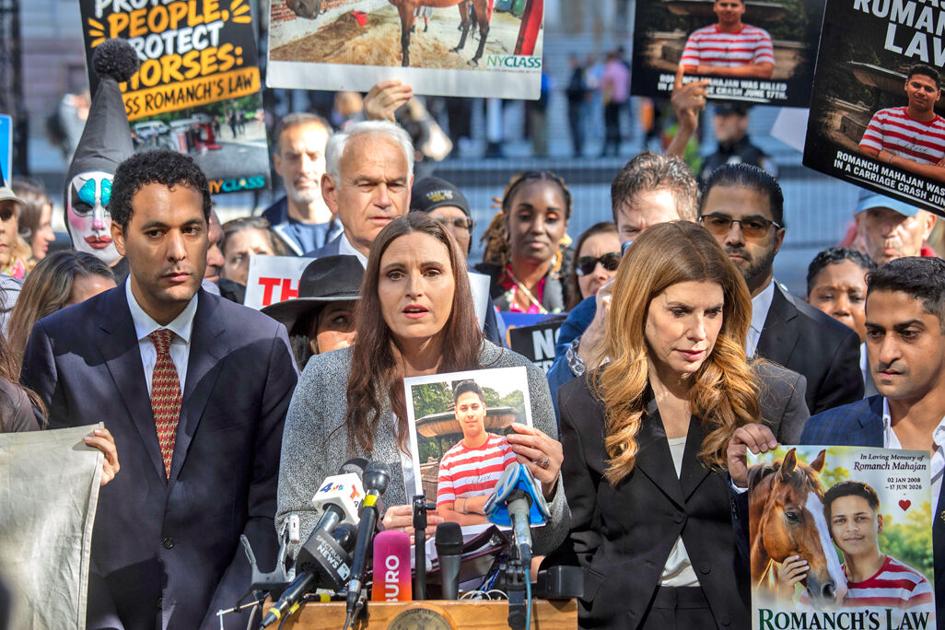
Horse-drawn carriages will soon be no more in New York City, after an overwhelming City Council vote on Oct. 22.
Lawmakers voted 40-7 in favor of Romanch’s Law, a measure that looks to phase out the industry by June 2028. It requires the city to establish a career transition program for industry workers, and help drivers find “humane disposition opportunities” for horses, per a Council press release.
The bill, introduced by Councilmember Christopher Marte (D-Manhattan), was named for Romanch Mahajan, an 18-year-old tourist who was killed in a carriage accident in June. Mayor Mamdani has said he would sign it.
Its passage marks the culmination of a yearslong fight — the Council first introduced a ban in 2007, and lawmakers in later years, including former Queens Councilmember Bob Holden, have led efforts to get one passed.
“After 19 years of relentless advocacy, the passage of Romanch’s Law marks a historic victory for horses, workers, and everyone who deserves safe streets,” said Edita Birnkrant, the executive director of New Yorkers for Clean, Livable and Safe Streets, who hails from Fresh Meadows.
To NYCLASS and other advocates, the passage is a hard-fought win. Many have long decried the carriage rides as cruel to animals, a claim denied by industry workers. Proponents also say the cab rides have become more dangerous as streets have gotten busier.
“Horse-drawn carriages have been part of New York City’s history since before cars, but our city has changed drastically,” Councilmember and Health Committee Chair Lynn Schulman (D-Forest Hills) said. “Our streets and parks have become increasingly overcrowded and chaotic. This creates a massive safety risk for all.”
Council Speaker Julie Menin (D-Manhattan) said the vote was a demonstration of lawmakers’ commitment to animal welfare, public safety and worker protection, saying the status quo has become “unsustainable and unsafe for horses and people alike.”
“The resulting plan establishes a deadline to phase out the industry while ensuring the development of a comprehensive workforce transition that will protect the livelihoods of the hardworking New Yorkers who depend on it,” Menin said in a statement.
For carriage drivers, however, the ban is a devastating loss. The Transport Workers Union, which represents them, on Oct. 21 vowed to file a federal lawsuit if the law is enacted. The union’s attorneys wrote a letter to NYC Corporation Counsel Steve Banks saying they would seek a temporary restraining order “the minute the ink dries.”
“This bill is a train wreck of constitutional and due process violations,” TWU International President John Samuelsen said in a news release, adding that it offers “nothing concrete” for workers who will be “financially crushed.”
The release continues in part that the bill as written takes property without compensation, including costly city-issued medallions, and does not guarantee employment.
TWU Local 100 Administrative Vice President Alexander Kemp called the law “blatantly unconstitutional,” saying it provides “nothing but a plan to draft a plan.”
Union leaders also have noted that more people are killed in e-bike and scooter crashes than carriage accidents.
Romanch’s Law requires the Mamdani administration to establish a transition plan by April 1 that includes career assistance for industry workers.
Menin also is set to form a joint working group to ease the transition, and the administration and union have been invited to have one representative join each.
Per a Council press release, the administration will “consider” compensating drivers, including for the value of their businesses, licenses and equipment. The city also is to help drivers find “humane disposition opportunities” for horses, and they may not be sold for slaughter or another cab business. Owners could opt to keep their horses.
Among the bill’s dissenters were Queens Councilmembers Joann Ariola (R-Howard Beach), Jim Gennaro (D-Fresh Meadows) and Vickie Paladino (R-Whitestone). Gennaro had introduced a measure calling for more industry regulations, including more driver training and hitching posts in Central Park.
Gennaro at last week’s meeting said in part that no driver in the 168-year-old industry has ever been convicted of animal cruelty.
In a lengthy statement on Facebook, he said the latest version of the bill “sidesteps” and delegates to the mayor key issues, such as the fate of retiring horses.
He also cited a lack of jobs in the hospitality industry, which some have suggested for drivers, and lingering questions about the disposition of medallions.
“If you have read this far, you hopefully have a grasp of the unfairness of Intro. No. 943-A, the callous disregard of horses’ lives, inhumane treatment of immigrant workers, the risk to the financial futures of medallion owners and their families,” Gennaro’s statement reads.
Ariola and Paladino both were co-sponsors on Holden’s ban bill, but voted against the latest measure. Both said the measure that passed lacks solid protections for impacted business owners.
“I really felt that we would come to a place where everybody had received something — the horses, the owners and the people who work there,” Ariola said. “It didn’t happen, and that’s why I just couldn’t be part of it.”
In Ariola’s view, the tragedy of Mahajan’s death thrust the bill into the public eye and propelled it to a vote prematurely.
She told the Chronicle she supported an amendment to Romanch’s Law that would have extended its timeline to 2030, but it was shot down. Ariola also would like to have seen horse carriages replaced by electric ones operated by medallion owners.
Holden’s bill originally included an electric carriage mandate, but that was dropped in a later version.
Paladino said she co-sponsored Holden’s legislation with the understanding that if it moved forward, more concrete plans for workers would be developed. Romanch’s Law did not address her concerns “except in the vaguest of terms,” she continued.
“These are generational businesses that are going to be lost forever, and the sad thing is we could’ve implemented a real solution that worked for everyone,” Paladino said.