
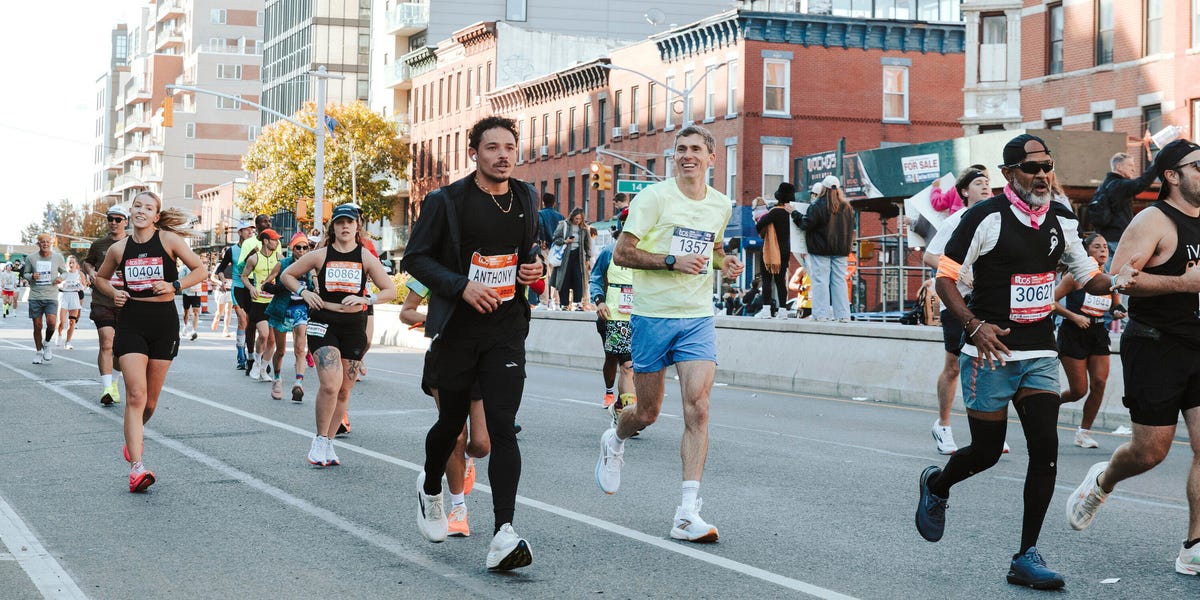
On November 1, nearly 60,000 runners will line up at the starting line of the 2026 New York City Marathon to run 26.2 miles through the five boroughs.
Although the NYC Marathon is a challenging course, it’s an unforgettable experience. There’s a reason it’s known as one of the greatest in the world, thanks to the sweeping views of the skyline, the contagious energy of the crowds, and the epic finish in Central Park.
Unlike other World Major Marathons, such as Berlin and Chicago, New York has several rolling hills, which is one reason why Runner’s World ranks it as the hardest of the Majors. That doesn’t mean a PR is out of sight, though, especially with fellow runners and roaring crowds pushing you to the finish.
To race your best, you just need to prepare for what’s ahead. Here’s what you need to know to tackle this iconic course and soak up the magic of every mile you conquer through New York City.
Save Your Steps for Race Day
Don’t try to see everything there is to see in New York City in the days before your race. This weekend, you’re a runner—not a tourist—so stay off your feet as much as you can.
When you swing through the expo, give yourself a time limit to pick up your bib, grab your race essentials, and shop around. Afterward, stick to activities that don’t require too much physical movement. Enjoy a cup of coffee or tea in Times Square, read a book in Central Park, or see a Broadway show (but don’t stay out too late!). Remember, the marathon will be your tour of all five boroughs!
Conquer the Hills
Not many people think that New York City has hills, but the marathon course throws plenty of elevation at runners. The race even starts with an incline up the Verrazzano-Narrows Bridge.
The number-one way to tackle hills in a marathon? Conserve your energy.
Many runners will try to maintain pace on hills, but when you do, it can suck the life out of you by mile 20 (which is the real start of the race). It takes a lot more energy to run hard up a hill, and many times it leaves you too tired to take advantage of the downhills.
Instead, run up the hill at a consistent effort rather than aiming for a specific pace. Shorten your stride, use your arms, and feel free to let other runners pass you (you’ll be passing them later in the race). When you reach the top, lean into it, open your stride, and let gravity pull you down. Don’t go crazy on the downhills; try to keep your effort controlled.
Remember: Don’t race too hard down the first bridge! It will make a difference later in the race when you still have the mental and physical strength to “go fishing” (more on that later).
Dress for Success
Plan to pack a few layers of throwaway clothes and gear—old blankets and sleeping bags work, too—for the prerace wait on Staten Island. You’ll be outside for a bit of time, depending on when your transportation gets you to the start and how long you have to wait for your wave. Just make sure not to leave anything valuable in your pockets, as you’ll be ditching the extra layers at the starting line.
Shivering in the early-morning cold is not only unpleasant, but it also burns up energy, which can be detrimental before your race.
Some smart ways to stay toasty? Pack a pair or two of hand warmers, wear an air-activated heat patch on your lower back (it warms up your core); bring gloves, a hat, and a garbage bag to keep you dry in the event of rain; and huddle up while seated with a group of fellow runners.
Nail Your Prerace Routine
If you have to pass some time at the start before your wave leaves, plan what you’ll do to keep those race nerves at bay. Bring a blanket to sit on and rest your body. Calm your mind by reading a newspaper or book on your smartphone, meditating, or listening to your favorite playlist. Chat with local runners to learn more about the course and the city they love so much.
Don’t forget: Plan your fueling around your wave’s start time. Set your watch alarm for two to three hours before you expect to begin running so you can consume your usual prerace meal in that time. That way, you’ll stick with the routine your body clock knows, and you’ll be fueled and ready to go when the gun goes off.
Take the Course One Stretch at a Time
What makes the NYC Marathon so famous? First, its people (the crowds of support) and next, its hills, bridges, and long straightaways. Standing at the starting line can be quite overwhelming, so it helps to have your race strategy firmly committed to memory.
Review the course map, visualize the 26.2-mile route as five pieces of the Big Apple, and then focus only on the bite you’re running.
🍎 Bite 1: Verrazzano Bridge (Miles 1 to 2)
The start of the race is one you’ll never forget. Relax, focus on your breath, and be patient, as it will take some time to get moving in the crowds. Pace yourself, breathe easily, and mindfully hold yourself back in these first two miles. You’ll hit the highest point on the course just before the first mile marker (0.8 miles), where you’ll take in the most spectacular view of New York Harbor, the Statue of Liberty, and the city skyline.
Don’t run this first section too fast. Chances are, you’ll feel jittery from the excitement of starting and a little cold from stripping away your throwaway gear—just remember that you’ll warm up quickly once you exit the bridge. It’s the most exciting two miles of a marathon in the world, with Frank Sinatra’s “New York, New York” serenading you off the starting line, and the sights will carry you into Brooklyn.
🍎 Bite 2: Brooklyn and Queens (Miles 3 to 15)
The key to finishing strong in Central Park is practicing patience: Run at an easier effort through 15 miles as you make your way through Brooklyn.
Don’t burn yourself out in the first half of the race by allowing yourself to get caught up in the excitement of the crowds and push too hard. Instead, tune the crowd out and tune in to your body. Tap into a conversational effort that lets you conserve your energy until you reach the base of the Queensboro Bridge, which is just past mile 15.
🍎 Bite 3: Up First Avenue to the Bronx (Miles 16 to 20)
As you make your way over the Queensboro Bridge and into Manhattan, dial things up to a moderate effort—not too hard, not too easy. This is one of the best spots on the course because the crowds are huge, and it feels like you’re in Macy’s Thanksgiving Day Parade.
As you run down the long, straight stretch on First Avenue from mile 16 to 19.5, think about transitioning into your second gear, while still keeping in mind this isn’t the time to push. That comes next.
🍎 Bite 4: Bronx to Central Park (The Final 10K)
As you make your way through the Bronx and over the Madison Avenue Bridge—the final bridge in the race—this is the time to tap into your mental game. Pull out your marathon mantras, focus on your breathing and effort, and remind yourself why you’re here.
The new 2026 Bronx routing takes you through a short series of turns before you head back into Manhattan, but the bigger challenge remains ahead: a long, gradual climb up Fifth Avenue.
Your conservative pacing earlier in the race will pay off here. If you slow down on the incline, that’s okay; just focus on maintaining a controlled effort rather than forcing your pace. Dedicate these miles to the people who have supported you in your marathon training, keep your thoughts positive, and stay present.
The final three miles are hard but worth it—you’ll be celebrated by the roar of the crowds while you traverse the rolling hills through Central Park. On each uphill, remember to run with good form, with your head up and shoulders back.
If you’ve got it in you, “Go fishing!” Cast out that invisible hook and gradually reel in the closest runner ahead of you. Then focus on your next fish, and the next. Every time you pass a runner, you gain a little more energy to push forward. It keeps your mind focused and engaged while you roll through beautiful Central Park.
When you reach mile 25, set yourself up for the final two right turns and sprint to the finish. Take it all in because there’s nothing quite like finishing a marathon in New York City.
🍎 Bite 5 (The Walk After the Finish Line)
After you finish, you’ll get your medal, take your photo, and go on what may feel like a walk of torture (it’s long). But it’s actually a blessing in disguise: Walking postrace can help keep you from getting stiff as your body gradually returns to a resting state.
Refuel with the postrace snacks offered along the way, congratulate your fellow runners, and celebrate your New York City Marathon finish!
More Tips for Running Strong—and Happy
Here at Runner’s World, we’ve learned a few things about running through the Big Apple. Use these additional tips to run your best NYC Marathon.
It’s great to have a race goal, but be sure to take in the experience.
The cheering crowds, the atmosphere, the thousands of runners, the bridges and boroughs, the helicopters overhead, the glorious sight of Central Park … the greatest city in the world is pulling for YOU.
Wear your name in big letters on your shirt.
You’ll feel like a rock star for all 26.2 miles as strangers cheer your name.
Just don’t get too caught up in the excitement on First Avenue.
It’s unreal, going from near silence on the Queensboro Bridge to hair-raising cheers and crowds lining the street and a bobbing sea of runners as far as you can see. But you have a long way to go, and you must hold back. The elites have a saying: You can’t win the NYC Marathon on First Avenue, but you sure can lose it there. The same principle applies to us mortals.
Don’t worry about what your watch says.
Your GPS watch is going to get a little weird in New York. Bridges, skyscrapers, and crowds can disrupt even the best Garmin’s satellite signal and throw off your pace and distance readings as a result. Keep your eyes off your watch screen, and use the official mile markers, your planned effort, and how you feel to guide you.
Use the quiet time on the bridges to refocus.
There are so many screaming spectators on the main thoroughfares that the quiet on the bridges may come as a shock. Prepare for these silent stretches and take advantage of them as an opportunity to check in with how you’re feeling and recommit to your race goals.
The last miles in Central Park are the most difficult ones.
Try not to run alone in those final miles. Find a runner who’s moving at about the same pace as you, and support each other through the finish line.
Tell your family and friends who are spectating which side of the course you’ll be running on.
Also, have them tell you precisely where they’ll be standing so you can look for them. Better yet, ask them to hold a balloon above the crowds so you can find them more easily.
Have a plan for where you’ll celebrate after the race.
The bars near the finish line fill up in a hurry. You might want to hop on the subway and go a couple of stops away before toasting your finish.
Thank the ones who got you there.
You undoubtedly received tons of support in your training and in the race. Make sure you reach out to those friends, family members, coaches, and fellow runners who pushed you to the finish line in Central Park.