
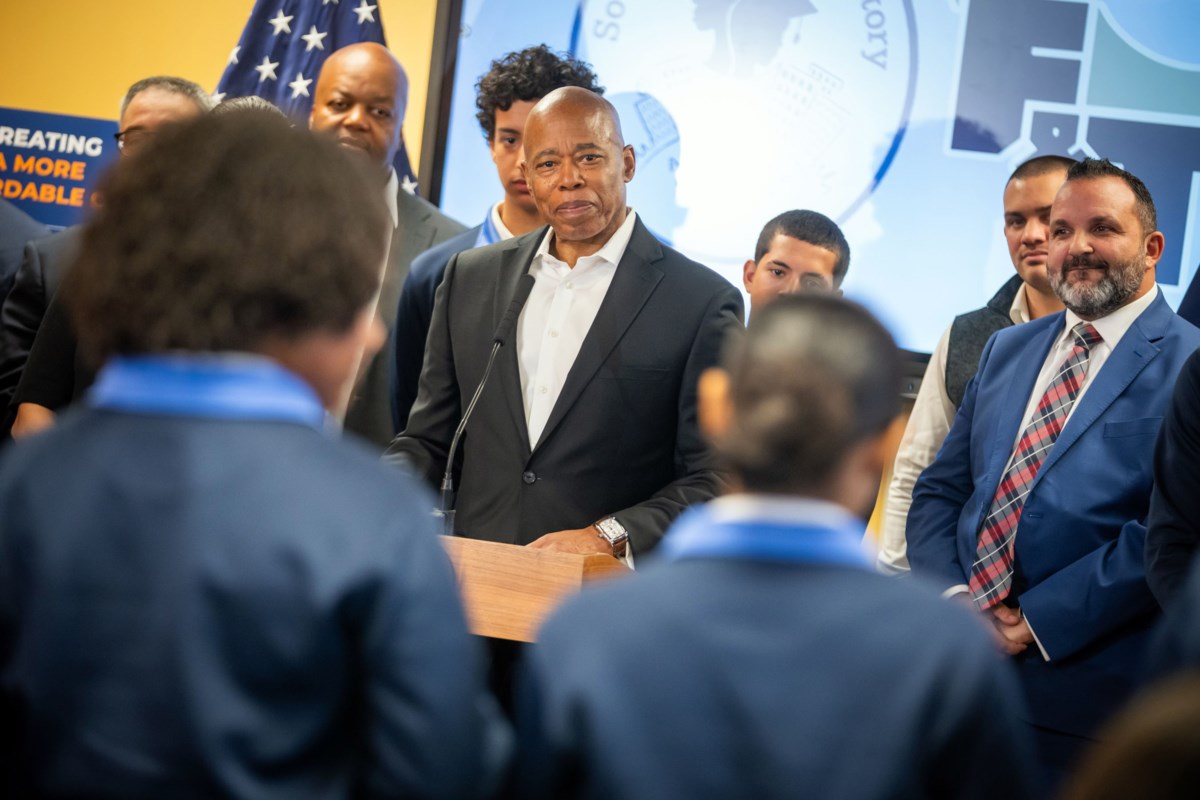
Four Brooklyn high schools will take part in a financial literacy pilot program where students and their families can open up bank accounts through the school.
Four Brooklyn high schools will join a financial literacy pilot program that allows students and their families to open bank accounts through the school.
The pilot program announced on Wednesday by Mayor Eric Adams will introduce in-school banking services to students and their families, provide workshops on best banking practices, and, when possible, connect students to career development opportunities in the financial sector.
Starting the 2026-2027 school year, students from 15 schools, including High School for Enterprise, Business and Technology, World Academy for Total Community Health High School, John Dewey High School and Brooklyn Collegiate: A College Board School will take part of the pilot program, officials said.
“If you don’t teach people how to use their money, they will lose their money,” Adams said in a statement. “With this groundbreaking program, we’ll bring banking services directly to students and give them hands-on experience opening up a safe, affordable bank account, learning about financial products, and starting careers in banking and finance. In-school banking has been called ‘the most promising frontier’ in financial education, and here, in New York City, we are on that frontier.”
Students will work with financial educators that will provide families with one-on-one free financial counseling, lead workshops, and help develop classroom resources for teachers to build responsible financial habits among students.
Financial institutions participating in the pilot program include Bank of America, Brooklyn Cooperative Federal Credit Union, Citizens Bank, M&T Bank, Neighborhood Trust Federal Credit Union, PNC Bank, Ridgewood Savings Bank, TD Bank, Santander, Spring Bank, Urban Upbound Federal Credit Union and Wells Fargo.
After approximately six months, financial educators will expand their reach to serve additional schools across the district, the mayor said.
The mayor predicted that more than 350,000 public school students and their family members will be served in the first five years of the program.
Over 238,000 households in New York City, or roughly 7% of the city’s population, do not have a bank account, according to data from the city Department of Consumer and Worker Protection.
Families without a bank account are forced to rely on costly alternatives like check cashers, which can perpetuate cycles of poverty, city officials said. The in-school banking pilot aims to address this disparity by bringing accessible financial services and education into school communities.
“Financial literacy is a lifelong skill that empowers students to make confident, informed choices about their futures,” said New York City Public Schools Chancellor Avilés-Ramos. “By bringing safe, affordable banking directly into our schools, we’re giving young people hands-on opportunities to learn how to manage money, build healthy financial habits, and open doors to new career pathways. This initiative reflects our deep commitment to preparing every student not just for college and career, but for life.”