
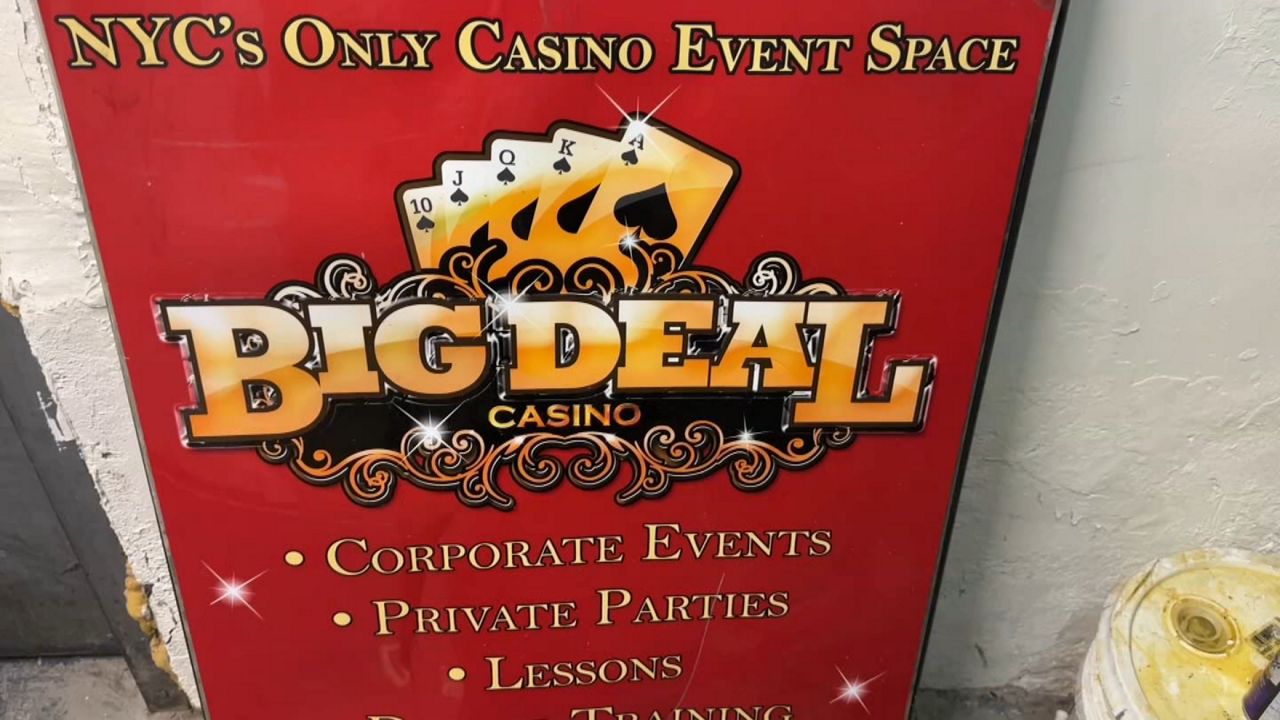
After boarding an inconspicuous freight elevator, excited crowds and licensed dealers greet you to a secret world where blackjack, roulette wheels and craps tables have been going strong in NoMad on East 28th Street for 10 years.
However, instead of playing for money, the prohibition-themed Big Deal Speakeasy Casino operates legally by taking cash winnings out of the equation.
What You Need To Know
The prohibition-themed Big Deal Speakeasy Casino operates legally on East 28th Street in Manhattan by taking cash winnings out of the equation
Big Deal Casino Academy has been training licensed casino dealers since 2014
The academy seeks to provide a training ground for dealers who hope to work in the proposed New York City casinos
The State Gaming Commission is expected to ratify a decision by the end of the year on which proposed casinos have been approved
“Every time I told any of my co-workers, any of my friends, yeah, I’m going to a casino in New York, they were like, ‘But gambling’s illegal in New York,’” Julianna Caddell, an executive assistant for a hedge fund, said. “And I’m like, ‘No, no, no, it’s fake money. It’s fake money!’”
Caddel discovered the speakeasy while searching for a fun venue for a corporate bonding event.
She’s aware that full-scale casinos where people can bet real money could soon be licensed in the city, but considers this version the ideal alternative.
“If you look at like zero-proof alcohol, you get the same fun without the risk,” Caddel said. “I know gambling can be very devastating for a lot of people, as fun as it is. But here, I can have as much fun as I want, and I still go home with the same amount in my checking account. It’s amazing!”
Owner Wendy Rubin says that while this speakeasy is mostly used for private events, she also runs Big Deal Casino Academy in the same space.
Rubin launched the school in 2014 after the New York State Constitution was amended to authorize up to four casinos upstate and three downstate.
“We are thrilled, so thrilled, to finally be relevant with the dealing school,” Rubin said.
The casino academy is the state’s first and only licensed gaming school in which students can get certified to deal in any casino across the country.
“You don’t even need a high school diploma,” Rubin said, “and you can be making $25-$50 an hour. So, that’s insane. And so people come here, and they want to change their life and we help them. We’ve got a 100% placement rate.”
That track record appeals to students like Christina Santaella of Pelham Bay and Cathy Figueroa of East New York, who work together in hospitality.
Santaella resides close to the proposed site for a Bally’s casino in the Bronx, while Figueroa lives about 15 minutes from Resorts World Casino in Jamaica, which is seeking approval to add live-dealer table games.
If both materialize, the two friends hope to play their hand at a new career.
“I’m a receptionist, and I would like to be able to progress in life,” Santaella said.
“I definitely look forward to that, as well as all the jobs that it will bring also to our community,” Figueroa said.
Looking ahead, the decision now rests with the state Gaming Facility Location Board, which is a group of five experts who will make the final recommendations for licensure.
The state Gaming Commission will then ratify their decision by the end of the year.