

The City Council on Thursday endorsed Mayor-elect Zohran Mamdani’s call for the state to pony up more money for childcare programs in the Big Apple — and laid out a series of suggestions for how he could make the system as a whole more effective.
The Council, under the leadership of outgoing Speaker Adrienne Adams, unveiled its reasoning in a 14-page report that could also serve as a roadmap for Mamdani next year as he seeks to make good on his campaign promise to usher in free childcare for all city kids between the ages of six weeks and 5.
Currently, only families of 3 and 4-year-olds qualify for universal childcare programs in the city, and Mamdani’s campaign says the expansion he envisions would cost an additional $6 billion every year.
Mamdani has said the state should provide that funding, specifically by increasing taxes on millionaires and corporations in the city — a proposal that’s already running into headwinds in Albany.
In its new report, a copy of which was obtained by the Daily News ahead of its release, the Council sided with Mamdani’s demand for more state childcare cash, but stopped short of saying the money should be raised through tax hikes.
“To provide the city’s families with expanded access to affordable early childhood education, the state budget must commit far greater funding support, whether through budget and/or tax policy changes enacted by the governor and state legislature,” says the report.
The document doesn’t specify a figure for how much more money the state should provide, but a Council official told The News the speaker agrees with Mamdani that it should be in the “billions.”
The speaker, who ran against Mamdani in June’s Democratic mayoral primary, is leaving office at the end of the year due to term limits.
But the leading candidates running to succeed her as speaker, Brooklyn Councilwoman Crystal Hudson and Manhattan Councilwoman Julie Menin, are also largely supportive of Mamdani’s push for universal childcare and could be key in helping him convince Albany to act next year.
Besides echoing Mamdani’s demand for more state funding, the new Council report says his administration must immediately get to work on reforming the ways in which the city contracts with private providers who administer the childcare programs.
The main contract for the Department of Education’s childcare programs is set to expire in July 2026. The Council report says that “presents a pivotal opportunity” for the incoming Mamdani administration to have the new contract remove kinks in the existing system.
Opportunities and obstacles
For instance, the report says the new contract should standardize a way to provide free “extended day” childcare seats for low-income families. Such seats provide childcare for up to 10 hours per day, year-around — above the traditional 6 hours and 20 minutes per day, 10 months per year currently subsidized by the universal 3K and pre-K programs.
Low-income families, in particular, are often in need of keeping their children at daycares for longer hours. The Council report says that can be accomplished by creating “a sliding scale” under which families earning more would pay “modest” fees for extended day seats in order to make sure those on the lower end of the income ladder can get theirs fully subsidized, a system that wouldn’t be totally free for everyone.
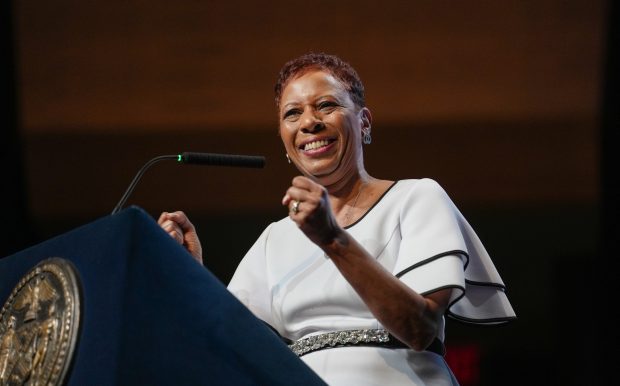
Barry Williams / New York Daily News
New York City Council Speaker Adrienne Adams. (Barry Williams / New York Daily News)
The Council report also says the new contract should increase the number of seats for children with disabilities, ensure parents can apply for seats on site at a daycare as opposed to only doing it via an online portal and standardize wages for all city-contracted childcare workers. The wage proposal would likely result in higher overall costs.
Additionally, the document says the new contract should “streamline overlapping or contradictory procedures” that currently exist because of the childcare enrollment process involving a number of different agencies beyond the Department of Education, including the Administration for Children’s Services. The report doesn’t specify exactly how such streamlining would be done.
A Mamdani spokeswoman didn’t immediately return a request for comment on the Council report.
Once he’s sworn in Jan. 1, Mamdani, 34, will face serious obstacles in how to secure the childcare funding he’s seeking.
Gov. Hochul, whose support will all but certainly be required to unlock more state funding, has said she’s against raising taxes on the rich next year, while President Trump has threatened to cut various federal funding for the city once Mamdani’s mayor.
The Democratic leaders of both legislative chambers in Albany, though, are on board with Mamdani’s tax-the-rich proposal, putting pressure on Hochul, especially with the Council also lining up with the mayor-elect.
Hochul has said she supports Mamdani’s overall push to make free childcare more accessible, potentially by tapping a different funding stream.
It remains unclear what that funding stream might be, but Hochul has not directly shot down Mamdani’s proposal to increase corporate taxes. The governor also met with Mamdani on Thursday afternoon and discussed their “shared desire to make significant additional investments that put New York on a path to universal child care,” according to a readout provided by the mayor-elect’s team.
“They committed to ongoing conversations at the senior staff level in the coming weeks to further develop a policy for FY 2027 and beyond,” the readout added.
Earlier in the day, while touring a childcare center in Brooklyn’s Crown Heights neighborhood, Mamdani told reporters the most important thing for him is to provide more childcare, not the method by which an expansion is funded.
He also shied away from giving himself a firm deadline by which he needs to make meaningful progress on providing more childcare.
“I view the time that I will be the mayor as the time that we have to implement the policies that we ran on,” said Mamdani, whose first term as mayor ends 2030. If he’s reelected to a second term, he can serve until 2035.
With Cayla Bamberger