
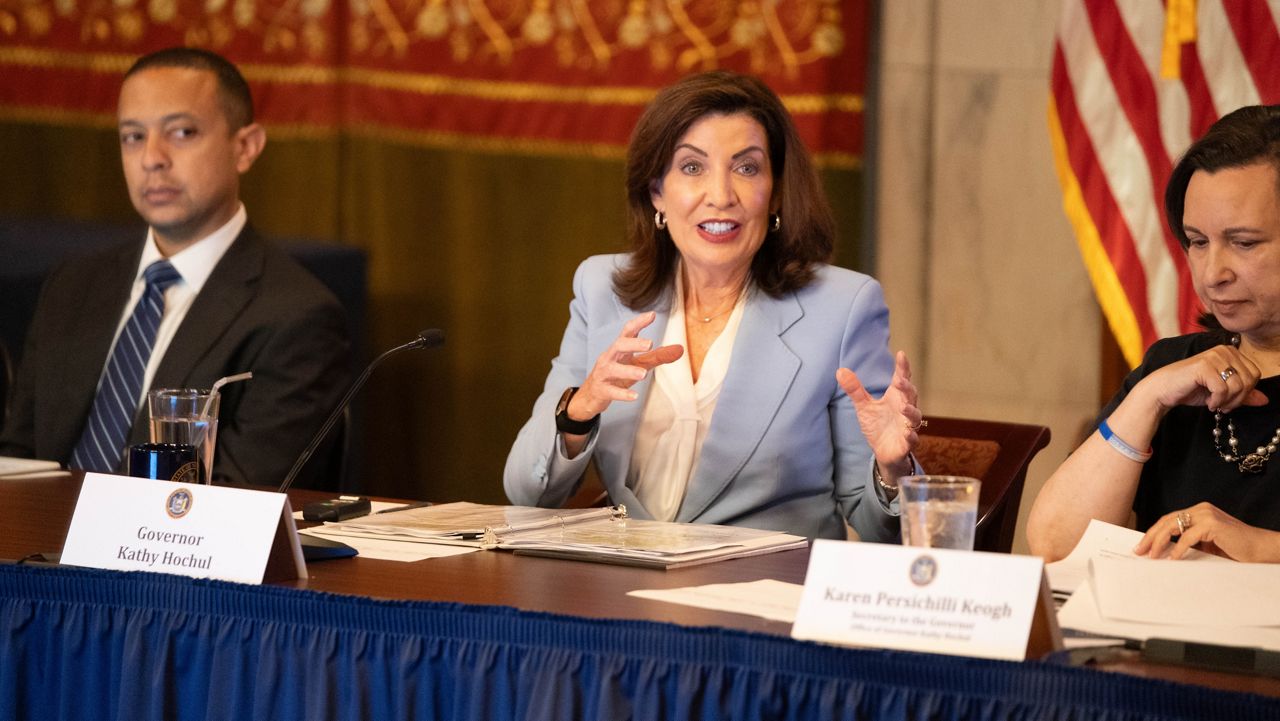
Progressive lawmakers and environmental advocates were fuming Thursday, one day after it was revealed that New York state will pause its all-electric building law pending a court decision in a lawsuit brought by gas and construction trade groups.
It comes just days after the Hochul administration infuriated those same groups by approving a Trump-backed gas pipeline, and then cut a deal with cryptocurrency mining company Greenidge to renew an air permit associated with their Central New York facility.
As Gov. Hochul is squeezed from both sides heading into 2026, lawmakers, including Emily Gallagher, a cosponsor of the original bill, accused the Hochul administration of succumbing to pressure from those industries to score political points ahead of her reelection bid. Republicans, who have for years pushed the governor to reconsider the law offered muted satisfaction and skepticism, but not praise.
“Years of grant money and time and expertises all to be thrown in the garbage because of fear mongering,” Gallagher said. “It’s time that we overcome this propaganda and the buyouts of my colleagues to carry lies.”
Advocates, including Liz Moran, New York policy advocate for Earth Justice, questioned the state’s decision to agree to a delay, considering the current appeal is only happening because the law was already upheld in July.
“I need to emphasize just how stark this is because it comes as we’ve been winning in the courts,” she said. “In July, the United States District Court for the Northern District of New York ruled that New York has the power to enact the all-electric buildings act, and that wasn’t the only win.”
Multiple Democratic lawmakers claim the motive is pretty clear. Assemblyman Al Stirpe, among others, accused Hochul of working to blunt the potential political impact of the state’s climate legislation as it relates to affordability ahead of the 2026 election, and said he doesn’t understand the governor’s approach even in that context.
“She believes that by doing things like this that really play to the base of the opposition, for some reason, they are going to feel comfortable with her and vote for her which is ridiculous because they will never do that,” he said.
Republican Rep. Elise Stefanik who is running against Hochul certainly thinks that’s the case; accusing Hochul of flip-flopping and insisting the governor would reverse course if reelected.
“Kathy Hochul is lying to New Yorkers. She wants them to believe there will not be a gas stove ban and all-electric mandate policies that will absolutely crush New York’s economy and cause a skyrocketing of prices further worsening the affordability crisis. This is a cynical political ‘pause’ so she can screw New Yorkers with higher prices after the election,” she said, calling for a full repeal of the law.
The Hochul administration tells a different story, and while Hochul has acknowledged a need to embrace an ‘all of the above’ approach to energy in pursuit of affordability and reliability, Ken Lovett, senior communications advisor on energy and environment for the governor, said she isn’t turning her back on the law.
“The Governor remains committed to the all-electric-buildings law and believes this action will help the State defend it, as well as reduce regulatory uncertainty for developers during this period of litigation,” he said in a statement. “Governor Hochul remains resolved to providing more affordable, reliable, and sustainable energy for New Yorkers.”
Hochul has for months signaled that New York’s climate goals associated with the 2019 climate law are a product of a pre-COVID world, and various aspects of it are potentially in need of a second pass. Last month, a group of moderate Democrats in the Assembly wrote to Hochul asking for the law to be delayed. At the time, she seemed at least amenable to revisiting the law and it’s not clear what, if any, action may be taken beyond the state agreeing to this pause.
“We just received correspondence from some upstate members of the Legislature, so we’re looking at that seriously. You know, I’ve made affordable housing one of my top priorities,” she said in Rochester on Oct. 24. “On the electric building issue, I’m looking for an all the above approach. I really want to make sure that we’re being thoughtful about this. I know the laws that are in place. We have made some accommodations in the past, like the electric buses. We had to delay that sometime because there’s not enough electric buses being built. So, I’m going to look at this with a very realistic approach and do what I can because my number one focus is affordability right now because New Yorkers are suffering too much.”
Hochul’s Democratic primary opponent, her lieutenant governor, Antonio Delgado, also chimed in to bash her over the pipeline and the crypto facility.
Grant Reeher, professor of political science at Syracuse University, says that even if affordability is a genuine concern, there likely is political strategy to the governor’s recent climate messaging as she attempts to navigate being tugged in one direction by Delgado and New York City Mayor Zohran Mamdani, and Stefanik.
“You’re already seeing this weighing, and an effort to thread the middle ground that is probably going to play out,” he said in reference to the pipeline decision. “This is something the Trump administration wanted, and so that is something that environmentalists and those on the left are not going to like.”
Republican lawmakers Thursday offered a mix of relief and skepticism, applauding the pause itself but questioning the governor’s motives and daring her to go further. State Senate Minority Leader Rob Ortt called for a special session to roll back the law.
“The only logical next step is to repeal this out-of-touch legislation and allow consumers to choose their own energy sources,” he said.
Assembly Minority Leader Will Barclay gave Hochul at least some benefit of the doubt, assuming that it’s a combination of political calculus and some genuine acknowledgment of the Republican position that the state’s climate goals are unattainable in their current form.
“I think there is obviously a political aspect, but reality plays a role in this and implementing these sort of mandates I don’t think is realistic on the timeline,” he said. “I think we should all be happy about that, but as policy makers we have to take a very serious look at this, put politics aside and say, ‘is this really good public policy for New Yorkers?’”
For those in favor of the law, it remained unclear Thursday exactly what avenues exist considering the delay came out of a court decision.