
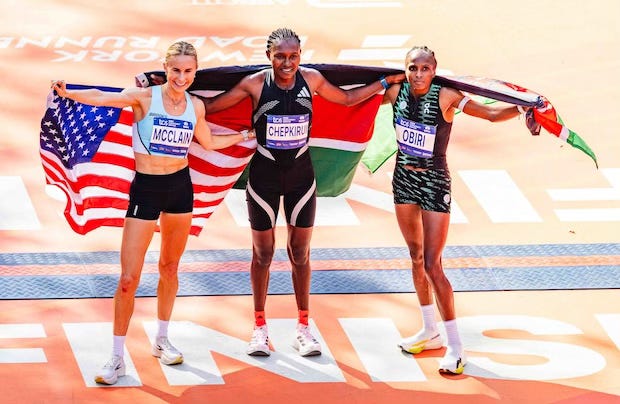
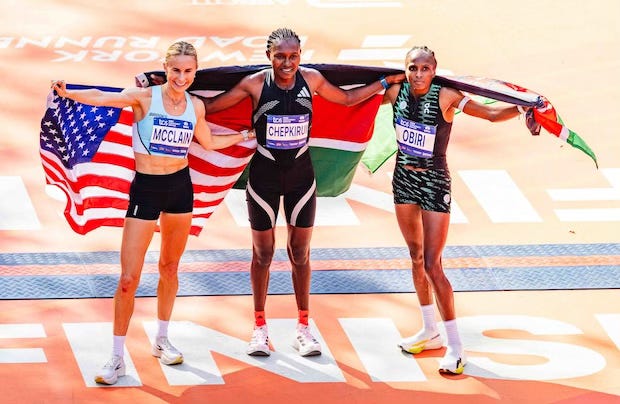
 L-R: Jess McClain, Sheila Chepkirui, and Hellen Obiri (Photo by Katrina Gaisford)
Sunday’s New York City Marathon came down to the expected battle between two of the race’s past champions—Kenya’s Sheila Chepkirui, who won in 2024, and Hellen Obiri, who won in 2023 and 2025. But few would have predicted how much of a factor Jess McClain would be in the closing stages of the race.
In the 23rd and 24th miles, Chepkirui and Obiri began to pull away from the rest of the field, and with two miles to go, they had opened up a seven-second gap over McClain and Kenya’s Mercy Chelangat. But in the 25th mile, something happened that we don’t usually see: McClain began to reel the leaders back in. That was partly because she was running well and partly because she was doing a good job running the tangents in Central Park.
By mile 25, McClain had cut Chepkirui and Obiri’s lead to two seconds. The duo began to pull away again over the next mile, but McClain kept fighting. Chepkirui, who had done much of the leading late in the race, finally shook Obiri for good with about 200m to go. She cruised to the win in 2:24:36.
When McClain hit 200m to go, she was on her own. It looked like she would finish third and become the first U.S. woman to make it onto a podium at a World Marathon Major since Emily Sisson’s runner-up finish at the 2022 Chicago Marathon. That would have been a great day. But Obiri, spent from sprinting for the win, was slowing. And McClain was closing fast.
Fewer than 10 strides from the finish line, McClain caught and passed Obiri, edging her out by 0.41 seconds to earn a surprise runner-up finish, 2:24:42 to 2:24:43. McClain’s final push took her performance from excellent to epic. There are days that unite and inspire U.S. running fans, and this will go down as one of them. (I appreciated this reel that Allie Ostrander posted right after the race.)
Chepkirui, 35, earned $100,000 for the win, McClain, 34, earned $60,000 for her runner-up finish, plus another $25,000 for being the top U.S. finisher. And Obiri, 36, earned $40,000 for third.
After hitting halfway in a relatively conservative 1:13:53, Chepkirui covered the second half of the race in 1:10:43, running splits similar to those she posted during her 2024 win in New York. By 35K (21.7 miles), the lead pack was down to six runners—Obiri, Chepkirui, McClain, Weini Kelati, and Kenya’s Mercy Chelangat and Edna Kiplagat. But just before the 22-mile mark, Kelati started throwing up and she dropped back. In the next mile, Chepkirui and Obiri surged away from the field.
Kiplagat, who will turn 47 in two weeks, was the next to drop back, but she kept her composure and finished strong, passing Chelangat to take fourth in 2:25:42. No one older has ever run faster on this course. Kiplagat is the 2010 New York City Marathon champion, and her longevity in the sport is unmatched. She earned $25,000 for finishing fourth and another $3,000 for winning the masters division.
Chelangat, who was a two-time NCAA champion for the University of Alabama, has been running marathons for only about a year and a half, but she has taken well to the distance. Following a fourth-place, 2:20:30 finish in Boston earlier this year, the 29-year-old took fifth here in 2:25:46. And Carrie Ellwood, who also had a breakout day in Boston, posted another strong performance here, taking sixth in 2:26:28. Ellwood—who I think was a bit overlooked in most of the prerace conversations—ran in the lead pack for most of the race before dropping back during the 22nd mile.
Considering how she was likely feeling with four miles to go, Kelati did an excellent job of hanging on to finish seventh in her debut at the distance, running 2:26:51. (Which is right around the 2:26:58 Deena Kastor ran in her marathon debut in New York 25 years ago. She, too, finished seventh.)
Paige Wood, Chelangat’s HOKA NAZ Elite teammate, ran what was probably her best marathon yet, finishing eighth in 2:27:29. Kenya’s Viola Cheptoo was ninth in 2:28:34, and Germany’s Fabienne Königstein rounded out the top 10 in 2:28:49.
My lasting memory of this day will be of McClain’s run here. She’s had her ups and downs in the second act of her pro career, but through it all, she just keeps coming back stronger with each race. This was her most impressive marathon yet, in my opinion, and over the past two years, she has learned a lot about how to race marathons, as opposed to just running them.
Between her 2:20:49 fifth-place finish in Boston and her runner-up finish in New York, she has to be considered the best U.S. marathoner of 2026. (Yes, even though Emma Grace Hurley ran two seconds faster than McClain’s PR in Chicago.)
There’s a tendency to look ahead and consider what this might mean for the 2028 U.S. Olympic Marathon Trials, but I’d rather appreciate McClain’s run on its own merits, regardless of what the future holds. And for the first time in four years, it’s wonderful to see an American woman back on the podium at a World Marathon Major. (New York City Marathon live results | Complete/searchable results)
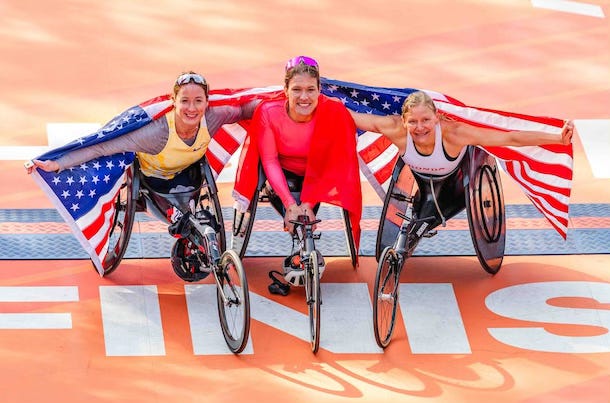 L-R: Tatyana McFadden, Catherine Debrunner, and Susannah Scaroni (Photo by Katrina Gaisford)
Less than a month after breaking her own world record at the Chicago Marathon, Switzerland’s Catherine Debrunner also dominated the wheelchair race in New York, winning in 1:40:02. Her time was the second-fastest ever in NYC, behind only her own course record of 1:39:32. Tatyana McFadden, who has been making podiums at this race since 2010, finished second in 1:48:28, and 12 weeks after having her first child, Susannah Scaroni finished third in 1:48:32.
The pro race produced four new qualifiers for the 2028 U.S. Olympic Marathon Trials: Weini Kelati, Lauren Hagans (13th in 2:29:42), Roberta Groner (20th in 2:35:55), and Cailie Hughes (22nd in 2:36:09). Dot McMahan, 49, is the oldest qualifier for the Trials so far, but Groner has to be the second oldest. And it looks like there were two qualifiers out of the mass start: Lily Murphy, who ran 2:30:06, and Grace Clements, who ran 2:33:50. Taylor Somers came awfully close to hitting the 2:37:00 standard, running 2:37:08.
Annie Frisbie, who has consistently been one top U.S. finishers at major marathons in recent years, finished 15th in 2:30:04. She said in an Instagram post that she had only been back to running for 12 weeks after recovering from a tibial stress fracture. And though it was one of her slower marathons, she’s incredibly proud of her race. (I love when people who are serious about sport can see the positives in their performances, even when they might not look quite as flashy on paper as their past results.)
The following athletes won their age groups: Kajal Parmar (18-19, 3:12:20), Lily Murphy (20-24, 2:30:06), Lauren Hagans (40-44, 2:29:42), Edna Kiplagat (45-49, 2:25:42), Erica Belandi (50-54, 2:58:33), Katsue Heginbotham (55-59, 3:10:11), Patty Monge (60-64, 3:13:39), Gwen Jacobson (65-69, 3:18:31), Monika Donges, (70-74, 3:35:38), Wilaiwan Khrisanapant (75-79, 5:23:52), and E. Laverne Johnson (80-89, 6:29:23).
The start of the pro women’s race did not go to plan. The cannon went off as a voice was saying, “Athletes on your mark.” There was some confusion, but fortunately it did not affect the race.
Ten days before the race, all of the women in the pro field learned that they would have to take an SRY gene test to participate in the race. The directive came down from World Athletics, and the timing left some of the pros scrambling to figure out how and where to get the test done. Because of the tight timing, New York Road Runners got permission to let the athletes do their testing after the race if need be. But the whole thing just feels like such an unnecessary inconvenience that is unlikely to eliminate anyone from the field. And I certainly hope that the athletes aren’t having to pay for testing themselves. If World Athletics is going to put up barriers, I think it should be up to them to cover the cost and make the process as easy as possible for everyone involved. For more on the history of sex testing in sports, I highly recommend Reo Eveleth’s Tested podcast.
Thanks to her top five finish, Jess McClain became the first American to earn an auto qualifier for the 2028 Olympic marathon. She would still need to finish in the top three at the U.S. Olympic Trials to make the team, but now she doesn’t need to worry about chasing the time standard, which hasn’t been announced yet.
As of late Sunday night, it looks like 61,147 people—a record number—have finished the race. This year’s race didn’t have quite as many sub-3:00 performances on the women’s side. In both 2024 and 2025, there were 203. This year, there were 173.
McClain and Rachael Rudel, the subject of the next news item, are both coached by David Roche.
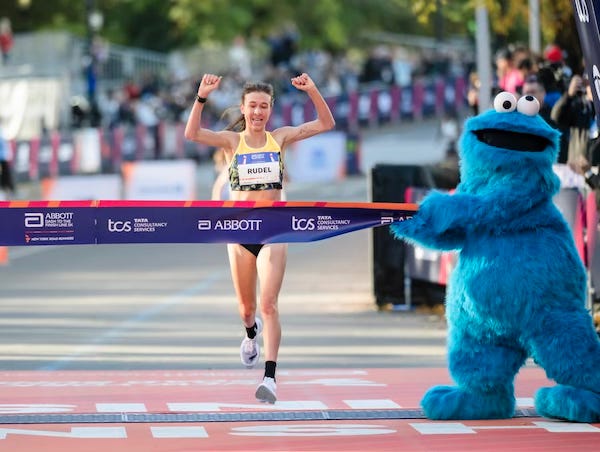 On Halloween, with Cookie Monster holding the finish tape, Rachael Rudel wins the Dash to the Finish Line 5K. (Photo courtesy of NYRR)
It’s been the spring, summer, and fall of Rachael Rudel. She took the show to New York City on Saturday and won the Dash to the Finish Line 5K in 15:35. Josette Andrews finished second in 15:41 and Ednah Kurgat was third in 15:42.
Rudel sat back slightly early in the race and let others set the pace. But with about 800m to go, she put in a surge that no one could match. Rudel’s time was a 40-second personal best, because she hadn’t raced the distance recently and because it was her first-ever 5K at sea level.
Because of the strong media presence at the race, it seemed like a number of people were hearing the name Rachael Rudel for the first time. (It’s tempting to put the emphasis at the end of her last name, but Rudel rhymes with noodle…or poodle.) But her breakout race came five months ago at the Bolder Boulder 10K. And for more on her indirect path to professional running, I featured her in July.
Sometimes I feel like my job is to shout “notice this person and the incredible things they are doing!” until people do take notice. And once a lot of people have done so, I tend to back off, because we have crossed a line where the athlete doesn’t necessarily want more attention anymore. I’m still in the shouting stage for Rudel, but I don’t think I will be for long.
She wore a variety of brands during the race and joked afterward, “For Halloween, I’m dressed up as [someone who is] sponsored by every single brand.” She confirmed that she is still unsponsored, but she and her agent are in negotiations with brands. She said that she expects to make a decision by the end of the year, or early in 2027.
Andrews has had a tough year. She missed the entire track season due to injury, but she made a strong return in September when she finished second at the Fifth Avenue Mile in 4:16.2. She’s in the midst of her fall base training, which will hopefully set the foundation for a healthy 2027 track season, and she managed another runner-up finish in NYC.
And Kurgat, 35, is a veteran of the sport, but she was making her debut for HOKA NAZ Elite. The team announced last week that they signed her and former Florida and Alabama runner Hilda Olemomoi Navarro of Kenya, who finished fifth here in 15:47.
Bailey Hertenstein said after winning the Long Beach Half Marathon three weeks ago that she cut her racing season short in the spring because she was falling out of love with running. She said that the half was “a great first stepping stone back into my love and reminding me why I do it.” And hopefully Saturday’s race was another solid step in that direction. She finished fourth in 15:46. (Results | Broadcast replay | And I appreciated the extended post-race interviews, which were more informative than most)
On Sunday, it was gutting to wake up to the news that Irish Olympian and 2024 European 1500m champion Ciara Mageean had died of bowel cancer at age 34. She was an amazing runner, but it was also clear that she was an incredible person. I appreciated her willingness to speak her mind and stand up for what she believed in. If you need a good cry, scroll through her Instagram. She had just just married her longtime partner, Tommy Moran. I appreciated the comments on this post, as well as what Izzy Fry, Phily Bowden, and Anna Silvander had to say about Mageean. But the news is truly devastating.
Sam Borden wrote a powerful piece for ESPN about gender-based violence toward female runners in Kenya. It accompanies an E60 documentary called Still They Run that premiered late last night and should now be available on the ESPN app. I had the chance to watch it last week and it’s really well done. It’s shocking how easy it has been for men to literally get away with murder in Kenya. Joan Chelimo and Mary Ngugi-Cooper are true heroes for everything they’re doing to help, including Chelimo’s mentoring of Agnes Ngetich. And I just hope that this content helps put the pressure on Kenyan authorities to do better. Shortly after watching the documentary, I came across this article about 2012 Boston Marathon champion Sharon Cherop who is in a legal battle with her ex-husband over her assets. According to the article, she has accused him of domestic cruelty and violence.
For Front Office Sports, Cindy Kuzma wrote about the financial ramifications of injuries for professional runners.
Molly Seidel weighed in on Peres Jepchirchir’s provisional suspension for doping here. “[Doping is] part of the reason why I’ve taken a step back from the marathon in the past few years,” she said. “A clean athlete’s body cannot hold up to the strain of the sport when people who are doping can keep putting out insane performances year after year. When you’re clean, you break down after a while.” Others shared their thoughts in this Front Office Sports article.
According to CBC News, 70-year-old Jennifer MacDonell set a marathon world record for the 70-74 age group at the Toronto Waterfront Marathon, running 3:23:59.
Suzanne La Burt was named last week’s USATF Athlete of the Week after she had the best age-graded performance at the USATF Masters 5K Championships. She ran 20:41 on a hilly course and won the 60-64 age group.
Vanessa Fraser won a Jorts Mile in New York City on Friday night, running 5:02. I appreciated her post-race interview.
The last time BYU’s Jane Hedengren raced, she finished third at the Cowboy Jamboree after going out hard and getting passed by two runners with about 400m to go. Due in part to illness, Hedengren hadn’t raced since, but she returned to Stillwater, Oklahoma, on Saturday to take on Oklahoma State’s challenging course and the best runners in the Big 12. This time, Hedengren went out about 10 seconds slower over the first 2K and finished 13 seconds faster over the final 2K. That enabled her to win the race, 19:28.0 to 19:38.0, over Cowboy Jamboree winner Billah Jepkirui, who was racing on her home course. West Virginia University’s athletes ran a smart race, steadily moving up through the field throughout, but they weren’t able to catch BYU, who narrowly won, 56 to 63. The close race sets up a great battle among No. 1 BYU, No. 2 NC State, and No. 3 West Virginia at the NCAA Championships on November 21 in Terre Haute, Indiana. (Big 12 results | Full race replay | All conference meet results)
I got sucked into following the Javelina Jundred on Saturday, which was fun and all, but I really needed to be spending more time writing this newsletter and less time reloading to see if various people had gotten back to “Jackass Junction” or “Rattlesnake Ranch” yet. In her 100 mile debut, Des Linden led for nearly four hours in the middle of the race before running into some trouble shortly after the 60.3-mile checkpoint. When I went to sleep on Saturday night, Great Britain’s Carla Molinaro, 42, had a seven-minute lead and 10 miles to go, but Heather Jackson, also 42, won the race by 55 seconds, in 13:48:29. Both earned golden tickets to the 2027 Western States 100. I went back to watch what happened, but the livestream unfortunately missed the pass and the commentators didn’t realize until the last 0.3 miles that Jackson had taken over the lead. (The camera operator actually apologized for this on the livestream.) It sounds like Jackson took the lead with less than a mile to go. Linden struggled significantly after 60 miles, but she gutted her way to the finish line and finished ninth in 16:58:00. (Here’s what she’s had to say about it so far.) Canada’s Cassandra DeWinter won the 100K outright in a course record of 7:44:45. I’m sure there were all sorts of celebrity pacers at this event, but I appreciated seeing that Emily Venters was one of them. (Results | Livestream part one and part two)
Recent University of North Dakota graduate Jadyn Keeler won the Hamilton Road2Hope 5K in a Canadian record of 15:10. Her pro career is off to a great start; she also broke the national half marathon record six weeks earlier. (Results)
Weini Kelati’s pre-NYC podcast with Carrie Tollefson was much more informative than any of the interviews she did at the pre-race press conference. She said her mileage leading up topped out around 95 miles per week, and she seemed relieved to hear that Jess McClain also runs lower mileage compared to many of their competitors.
On I’ll Have Another, it was interesting to hear Australia’s Izzi Batt-Doyle talk about pacing Kenya’s Peres Jepchirchir at the Sydney Marathon, before anyone knew about Jepchirchir’s positive doping test. Jepchirchir went faster than planned and Batt-Doyle could not keep up, so she dropped back and ran with a different pack.
On The Shakeout Podcast, Canada’s Dayna Pidhoresky, 39, discussed running a big personal best of 2:26:01 at the Toronto Waterfront Marathon. And she said she also plans to race the Philadelphia Marathon in three weeks.
Additional Episodes: Jess McClain pre-NYC on Citius Mag | Former University of Toledo runner Ari Fisher discussed her interesting path to a 2:34 marathon on Road to the Trials | Juliet Hershey-Beatty talked about her recent string of sub-3:00 marathons and 50-54 age-group wins at World Marathon Majors on Run Farther & Faster | Emma Grace Hurley on Hurdle | Nell Rojas on Earthmovers | Merry Lepper, the first-known woman to finish a road marathon, on Starting Line 1928
Keeping this newsletter going depends on support from readers and sponsors. If you enjoy Fast Women and you’d like to help, there are a few ways to do so:
A one-time contribution via Venmo.
Monthly contributions via Patreon.
If you use this link to shop at Running Warehouse, a percentage of your purchase will help support Fast Women. (And newsletter readers can use the code FASTWOMEN to save 20% on clothing and socks, and 10% on clearance shoes, nutrition, and hats. The code helps you, and using the above link helps the newsletter.)
A huge thanks to Katrina Gaisford for traveling to NYC and spending much of her Sunday up on the photo bridge at the New York City Marathon, taking photos for Fast Women. To see more of her work, you can follow her here.
It’s been a bit of a rough week at the Fast Women headquarters (my house). I accidentally splashed a little liquid on my laptop’s keyboard and managed to ruin the machine in the process. It was a very expensive mishap. My computer is now on its way to Austin, Texas, to see if its data can be salvaged. Learn from my mistakes and back up your computer, if you haven’t recently. I’ve still been able to do most of my work this week, but there are a few key documents here and there that I am really missing.
I hope you all have the best week possible.
Alison