
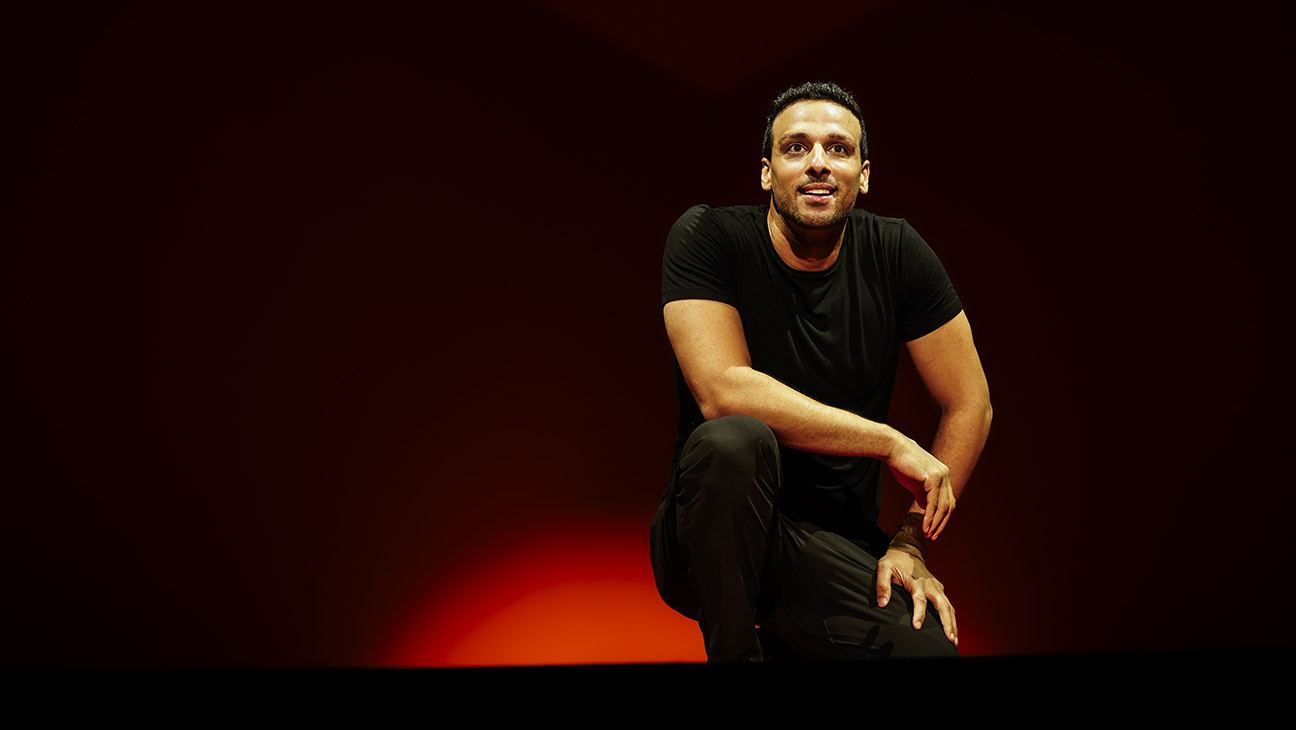
Tony-winning actor Ari’el Stachel felt the dread of social discomfort early on. As a boy, he was an outlier at his Jewish day school, where his skin was darker than his classmates’ and his surname, Yeshayahu, felt like “too much.”
Despite his upbringing in progressive Berkeley, California, his schoolmates taunted him, particularly after 9/11.
“Check Air’el’s bag for bombs,” Stachel recounts in his searing one-man play, Other, running through Dec. 6 at Greenwich House Theatre in New York.
Inhabiting a staggering 48 characters in this autobiographical revelation, he lays bare the kinds of personal frailties and comical crack-ups most rising actors would be advised by their agents to ignore.
It was a long road getting here.
While Stachel, 34, has discussed in recent years some of the lengths he went to as a teen to conceal his Arab Jewish Middle Eastern roots, he had not been as forthcoming about a debilitating anxiety disorder that had overtaken his life “since the womb.”
His original plan as a 10-year-old trying to find even some partial relief in his life was to pass as white — aided by a new school, new name and hairstyle (“like Ross Geller from Friends,” he says).
It worked for a time.
By 12, his complexion had darkened. When a new friend assumes he is Black, Stachel leans in and stays there, passing as Black through several more school transfers and on through to young adulthood.
Writing this show, he told THR in an interview this week, was “my active way of almost beating the shame out of myself.”
Throughout his youthful charade, he was also concealing his bearded Yemenite Israeli father, Aaron Yeshayahu, the parent with whom he spent most of his time after his folks divorced.
Stachel even skips all of his school graduations through the years so as not to be seen publicly with him. The stress of it all drives him to a frazzled thread.
(His mother, Laura Stachel, a white American Ashkenazi Jew originally from New York, did not pose the same kind of dilemma for him).

Ari’el Stachel portrays 48 characters in ‘Other,’ which opened Oct. 8.
Ogata
The tall, athletic Stachel started writing this introspection on race, identity, mental health and “what it means to be American” seven years ago amid his lauded Broadway run in The Band’s Visit.
Among the catalysts, he said, was that he came to understand that “if I didn’t write this story, I would never see my culture reflected onstage.”
Since opening last month, Other has been attracting the kinds of audiences that theater hierarchies say they want: younger, truly diverse and engaged.
In another rarity, audience members tend to gather organically after each show, not at a stage door but in small groups, where they share their own “othered” experiences with one another — and often with the star himself.
“They will literally wait,” says the show’s lead producer, the Broadway quadruple-threat LaChanze. “They will stand outside and wait for him because they feel seen. Ari so courageously puts himself out there, you feel like you’re ready to talk.”
(On Wednesday, Stachel was the keynote speaker at The Broadway League’s annual “Belonging on Broadway” summit, where he said there is no substitute for live storytelling. “It’s how we make each other feel less alone,” he said. “And what [theatergoers] are ultimately sharing is that through watching a story it makes them feel like they belong.”)
Among Other’s highlights is its hilarious and jarring opening scene, depicting the night of Stachel’s 2018 Tony victory. As he makes his way through a swarm of afterparty well-wishers, his anxiety produces rivers of sweat that pour from his temples (a feat he is somehow able to magically reproduce onstage).
After sprinting to the men’s room every few minutes for a frantic mop down, he eventually collapses on the bathroom floor.
Ari’el Stachel won his Tony for his turn as a smooth-talking trumpet player in the musical ‘The Band’s Visit,’ based on the 2007 film.
Jemal Countess/Getty Images for Tony Awards Productions
But if you had actually seen him onstage as the seductive Egyptian musician Haled in The Band’s Visit, or on Law & Order: SVU as the suave, compassionate Sgt. Khaldun, it’s near impossible to reconcile the inner torment he describes here. These performances weren’t just smooth, they seemed effortless.
Stachel explains that it wasn’t necessarily the shock of a Tony win that sent him to his knees that night, “so much as the experience of having been so fractured for my entire life. Your body is so used to being in fight or flight, that accepting love is challenging.
“It led to this dissonance between how other people were seeing me and how I felt inside.”
Those feelings resurfaced two years later on the set of SVU. The recurring role of Khaldun had been created expressly for him by Tony-winning playwright (and veteran Dick Wolf showrunner) Warren Leight.
“I was so honored that he wrote that for me,” says Stachel, whose credits also include Don’t Worry Darling, The Night Agent and Blue Bloods. “But I was also terrified because now I’m supposed to be a peer of these people — this cast that I admired from afar? I hadn’t caught up to the way that the world sees me.”
His first seconds before the camera, opposite “thee Olivia Benson” (Mariska Hargitay) as he describes onstage, quickly went south.
As sweat poured from his every pore, a make-up team rushed in with useless towelettes. An entire cast and crew were now “waiting for one thing: for me to stop sweating.” Causing “the most expensive delay in Law & Order history” was not a record he sought.
Khaldun eventually cracks his first case after calming a reluctant witness (Dave Shalansky) with fluent, soft-spoken Hebrew in the season 21 episode “I Deserve Some Loving Too.” An English translation was not provided onscreen by design.
“What we see is that these two Jewish men, one who is brown and one who is Ashkenazi, are communicating,” he says. “Warren wanted to make it clear that Jews could look like me too.”
“It really was a gift,” he adds — another piece of a public reconciliation.
Other is one of the most physically demanding stage plays to come along in a while. Stachel says he’s managing his eight shows a week (several of them part of two-show days), by “living in monk mode and athlete mode” — and doing everything he can to keep his anxiety in check.
“This is such a holy mission for me, to help de-stigmatize mental health issues in a way that’s not slapping people over the head, but that’s funny, that’s human,” he says.
Generally he says his life has vastly improved. New medication has helped.
“Being honest about it and not fighting yourself is 90 percent of the battle,” he says. “If I wake up and judge myself for being anxious and beat myself up, that is where a lot of the tension lives. Yeah, I have a condition. I sweat sometimes. I get a little nervous. That’s OK. I have my handkerchief. It’s right here. Awesome. Yeah, move on.”
LaChanze, who’s been on a hot streak with four consecutive producing Tonys in just the past three years for her work on Kimberly Akimbo, Topdog/Underdog (revival), The Outsiders and Purpose, is gearing Other for a Broadway transfer.
“If we’re going to continue to grow in live theater, we’ve got to make the stories interesting for those people who we want to come in,” she says. “It’s important to me that we create a space in commercial theater that is inviting for young adults.”
Both she and Stachel acknowledge their partnership — a Black woman producing a play about an Arab Jewish man — is unique. “It shouldn’t be so radical, but somehow it is,” Stachel said.
“LaChanze seeing herself in my story made me understand that this didn’t just belong to Yemeni Israeli or Ashkenazi Jews. It belongs to everyone. And it felt like an alignment artistically in the world that I want to live in. Why is it so abnormal for someone who’s not white to produce outside of their race?”
Ari’el Stachel with ‘Other’ producer LaChanze and director Tony Taccone.
Ogata