
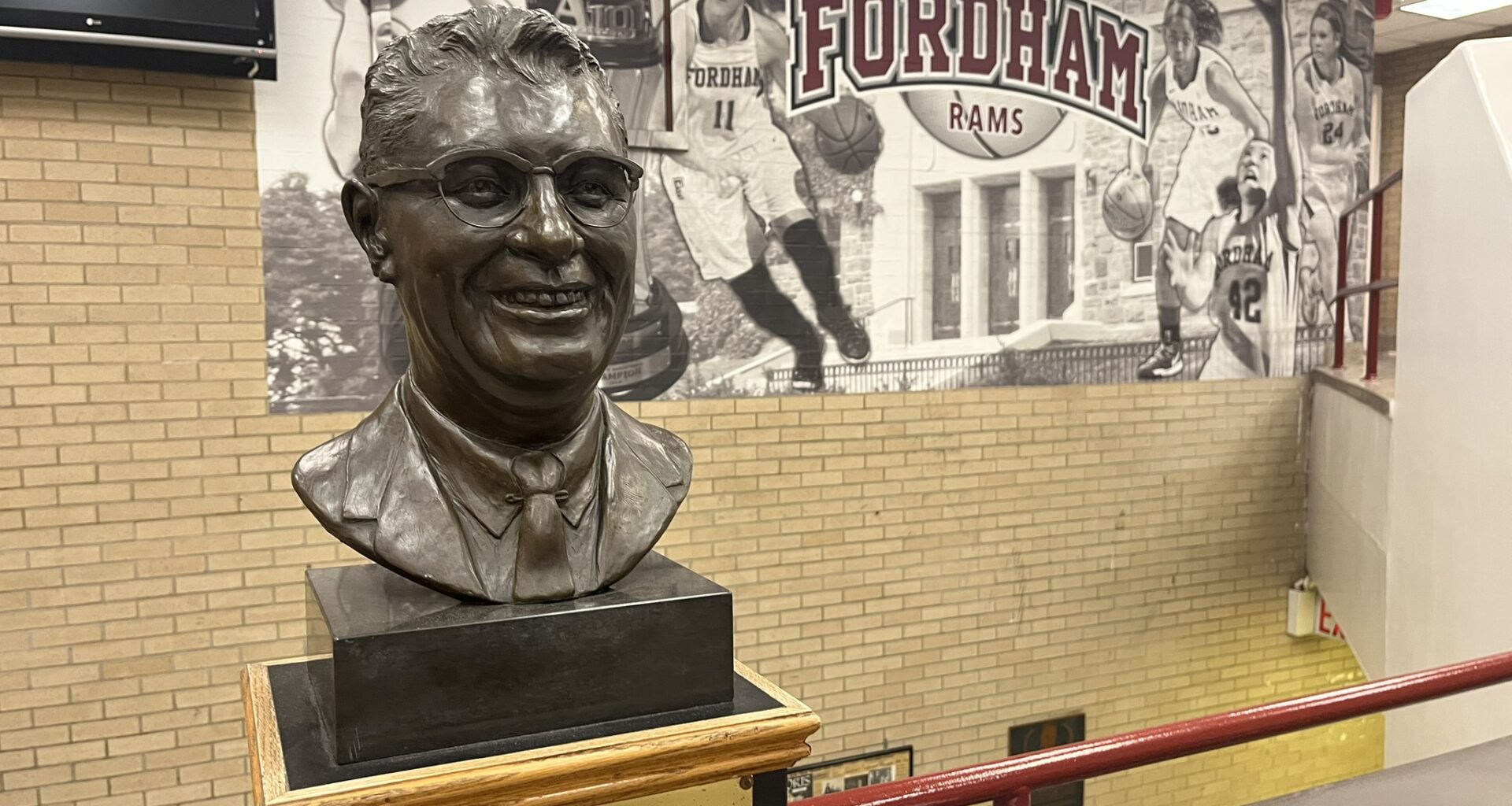
Vince Lombardi, the football head coach who won the first two Super Bowls and had the Super Bowl trophy named after him, is best remembered for his achievements in Wisconsin. However, Lombardi, a devout Catholic, got his start in New York.
Sacraments, seminary, and Sheepshead Bay
Stone markers erected on a triangle of grass near East 17th Street and Jerome Avenue in Sheepshead Bay, Brooklyn, are easy to overlook. One marker installed in 1974 reads, “In memory of Vince Lombardi, 1913-1970.”
That neighborhood was where the legendary football coach grew up. This 1950s-era New York Giants offensive coordinator directed the 1960s Green Bay Packers to five NFL championships and an unsurpassed three consecutive league titles, first learned the most important aspect of the triangle that he preached.
“God, family, and the Green Bay Packers. He had those priorities in order,” former Giant and 1967 Packers fullback Chuck Mercein said in a telephone interview. “His faith meant a lot to him.”
His birthplace at 2542 East 14th Street in Brooklyn stands in a neighborhood that attracted thousands of immigrants like Vincenzo Lombardi, Vince’s grandfather from Naples, Italy, and the Izzo clan on Vince’s maternal side from Vietri di Potenza east of Naples.
“This has always been a welcoming place to immigrants. Just looking at a lot of the names associated with the parish, there’s certainly a heavy Italian influence,” said Father Robert Mucci, the pastor at Saint Mark’s Catholic Church, in an interview at the church.
Just south of his boyhood home was the previous home to Saint Mark’s, whose tall steeple rose high as a neighborhood reminder of the top of Lombardi’s life triumvirate.
“Our Catholic faith and practice of it was primary to family life. Prayer was part of our daily existence,” said Sister Bernadette M. Izzo, O.P., a relative of Lombardi’s, in a telephone interview. “Praying as a family was what kept us unified and able to meet the challenges of life.”
The church where Lombardi worshipped no longer stands, but its altar remains in use at the current Saint Mark’s Church a few blocks away on East 19th Street.
Lombardi stood beside it as an altar server. He likely received sacraments of initiation in front of that altar and made daily Mass his practice.
“He was very strict in his observance of being a daily communicant,” said Bill Curry, a center with the 1965 and 1966 championship Packers, in a phone interview. “He was very serious about it.”
Seriousness about his faith led Lombardi to discern the priesthood at 15 years old, attending Cathedral Prep. His devotion to Christ never seemed to waver there, but what pulled the teenager outside the bounds of seminary life was football, which Cathedral Prep didn’t offer.
Lombardi instead graduated from Brooklyn’s Saint Francis Preparatory School, which at that time was six blocks from the shipyards along the East River he crossed to chase his football dream.
Fordham, Saint Cecilia, and the search for “Magis”
The Latin word “magis” means “more.” Within the Spiritual Exercises of Saint Ignatius of Loyola, it reflects the search to become “what is more conducive to the end for which we are created.”
Lombardi’s young adulthood became an inward discovery of “magis” and an outward, often-frustrating exploration to find where football coaching could fulfill that faith call.
From 1933 to 1937, Lombardi attended Fordham University’s Rose Hill campus in the Bronx.
He sat inside Keating Hall his senior year for Fordham’s capstone philosophy classes, integrating his entire college coursework.
“This is what’s called the Ratio Studiorum. The Jesuits created the world’s first liberal arts curriculum, which is used to this day,” said Robert Reilly, the retired assistant dean of the Feerick Center at Fordham Law, in an interview on campus.
“If one is going to see God in all things, one has to look at a whole bunch of things to see Him, so one can start seeing the connections.”
Reilly said Lombardi dived into those connections’ relationship to Christ’s greatest commandments, “to love the Lord your God with your whole heart, mind, and soul, and love your neighbor as yourself.”
Part one came through daily Mass at Fordham University Church.
Reilly said that the second part of Christ’s commandment, one that paralleled his discipline, moral integrity, and trust in objective truth, involved “social justice, or corporal works of mercy.”
“He saw that we’re not separated from anybody,” said Reilly. “Collectively if a rock falls down and falls on him, we’ve all got to work together to get this rock off the guy. There was a collective, ‘I can’t turn my back and say you got the responsibility, not me.’”
The third part of Lombardi’s rock-hard triumvirate of faith, family, and football reflected that lesson, through shared responsibility on Fordham’s offensive and defensive lines.
Lombardi and six fellow linemen formed the rock-hard Seven Blocks of Granite, leading Fordham to win more than three-quarters of its games in Lombardi’s three years on varsity.
Struggle and Perseverance on the Path to Greatness
Lombardi graduated in 1937. The next 22 years became a struggle to make “magis” reality.
In 1939, the football coaching bug led him to teach at Saint Cecilia’s High School in Englewood, New Jersey. He force-fed his students with how academic and athletic lessons reflected “magis,” God’s integration into all things, including football, for which he became the school’s head coach in 1942. His players’ routine involved pregame Mass, followed by demolishing opponents, 25 wins as part of a 32-game unbeaten streak with three consecutive sectional championships.
But Lombardi knew “magis” called, to go further than a high school in a Jersey suburb.
He returned as a Fordham assistant in 1947 and 1948, spent five years coaching offense under College Football Hall of Fame coach Earl “Red” Blaik at Army, then spent five more years with the Giants, where he paired with defensive coach Tom Landry, who later led the Dallas Cowboys to Super Bowl glory, to help the Giants to an NFL title in 1956.
Lombardi knew he was head coaching material, but opportunities for “magis” slid past him those 12 years, at least partially due to social injustices against Italian-Americans.
“He was informed by a selection committee at a Southern college that he would never get a head job anywhere because he was Italian, and he never forgot that,” said Curry.
But he found God in his suffering within a visceral call to make his eventual opportunity something that would transcend wins and losses.
That “more” came in 1959 in Green Bay, where he won the hearts of players and fans into believing a dual demand: The disciplined sublimation of the will to a greater calling, and the call of love and responsibility to one’s fellow God-created human being, the same call to “magis” that he learned in New York.
Lombardi’s final resting place is in Mount Olivet Cemetery in Middletown, New Jersey, not far from where he and his wife made their final residence, in Fair Haven. Fans and admirers regularly visit and decorate the grave with mini-footballs and team memorabilia.