
In an editorial, Hoboken resident Donna Antonucci makes the case that the local school district is one of many that needs to be consolidated in New Jersey to help solve the state’s affordability crisis.
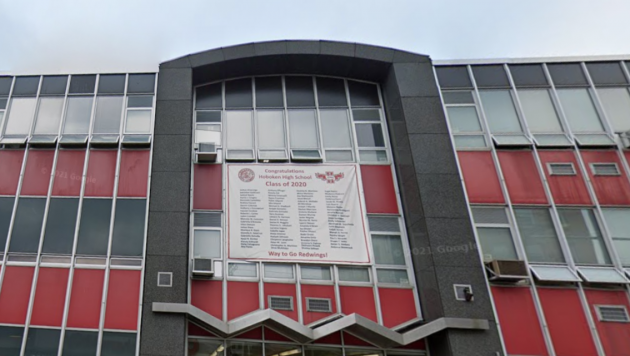
 Photo via Google Maps.
The affordability crisis in New Jersey demands that we rethink how our towns operate.
The Hoboken school district will need more space as enrollment grows.
We need to stop thinking in silos and work across governing bodies, starting with a long-overdue merger: the consolidation of Hoboken High School with a neighboring district — most likely Weehawken.
State Sen. Vin Gopal, of Monmouth County, has shown that referendums on school regionalization are possible. District consolidation could help address capacity issues while taking Hoboken’s overall affordability into account.
As residents grapple with skyrocketing costs, our local government, Board of Education, library boards and county government continue to act in isolation, ignoring the fact that they all draw from the same strained tax base.
To survive a shifting economic landscape, our towns must break down these artificial silos and look toward regionalization before the choice is taken out of our hands.
New Jersey is losing jobs, weakening the income tax base that helps fund aid to municipalities and further exacerbating the problem.
Start with the schools
Across the state, student enrollment is dropping, yet we continue to fund separate administrative structures for towns that sit practically on top of each other.
While Hudson County’s population has bucked some of the broader statewide decline, the economic problem remains. We are spending millions of tax dollars on duplicate superintendents, business administrators and separate bureaucratic infrastructures.
Hoboken has a high per-pupil cost of about $21,900 per student. Meanwhile, declining enrollment and rising health care costs are putting additional pressure on school budgets. Consolidation could help districts respond to those financial pressures.
By consolidating Hoboken High School with Weehawken, which I think is the most logical choice, we could spread fixed administrative expenses over a larger student body. This is not about cutting corners — it is about redirecting funds to where they matter.
Money saved on redundant administration could be funneled directly into classrooms, including:
Specialized Advanced Placement classesMore robust elective programsModern classroom suppliesCompetitive extracurricular programs
Consolidation could also leave room for further growth in the lower grades. The current Hoboken High School building, for example, could be repurposed for younger students.
If Gopal’s school consolidation legislation is successful, we may have fewer choices about which districts Hoboken could easily partner with in the future. That makes it important to study our options now.
The economic tailwinds of the past few decades are shifting. As artificial intelligence disrupts traditional job markets and corporations relocate out of state, we cannot assume the tax base will endlessly grow to absorb the inefficiencies of local government.
New Jersey has talked about consolidation before
When Jon Corzine was governor, his administration created a five-year commission to study consolidation. But a five-year timeline meant the study would not be completed until a potential second term, which Corzine never had.
From conversations I had with him at the gym, I came away believing Corzine understood one of the forces driving New Jersey’s high property taxes: too many municipalities and too many school districts.
Other East Coast states have restructured government. Connecticut and Rhode Island, for example, eliminated much of their traditional county government structures, with responsibilities handled by the state and municipalities. The point is that consolidation and restructuring are possible.
Chris Christie also recognized the problem, although his administration did not pursue consolidation on the scale New Jersey needed.
I attended several of Gov. Phil Murphy’s telephone town halls during the pandemic. He surveyed callers about their top concerns, and property taxes consistently ranked No. 1. His administration, too, has had to confront the costs associated with New Jersey’s fragmented system of local government.
Consolidating school districts is a place to start. The Hoboken Board of Education is putting together its long-range plan, and consolidation should be one of the options it studies seriously rather than dismissing it outright.
Look beyond the school district
Hoboken’s broader fiscal decisions also deserve scrutiny.
The administration of former Mayor Ravi Bhalla made spending and development decisions that, in my view, contributed to the city’s tax burden.
That includes the use of payments in lieu of taxes, commonly known as PILOT agreements.
The school district has raised concerns that the municipality has underestimated the number of students who would live in developments covered by PILOT agreements.
Because PILOT revenue is distributed differently from conventional property tax revenue, such agreements can affect how the tax burden is shared.
The municipality should examine whether some of its previous commitments can be reworked and whether additional funding can be directed to the school district.
At the same time, the Board of Education has a responsibility to identify more economical ways to operate. Consolidation should be among them.
We should also consider whether Hoboken needs to maintain its library in its current form.
The free public library system dates to an era long before cars, smartphones and the internet transformed how people access information.
I am not suggesting that communities need no libraries. But given how dramatically the world has changed, it is fair to ask whether every municipality needs to maintain the same level of library infrastructure independently.
One option worth examining is whether Hoboken voters could approve repurposing the library building for the Board of Education and establishing an arrangement that would allow residents to use Weehawken’s library at a lower overall cost.
The state should also revisit the formula governing municipal library funding to determine whether it still reflects the needs of communities today.
If our elected leaders do not act proactively, a shrinking economy and changes in state funding could eventually force difficult mergers with fewer choices and less time to plan.
The municipality, school board and other autonomous local boards must stop acting as if they operate in a vacuum.
It is time for a unified approach to fiscal responsibility, and studying a Hoboken-Weehawken high school merger would be a logical place to start.
Call to action
The Hoboken Board of Education should:
Invite state Sen. Vin Gopal to a Board of Education meeting to discuss school regionalization and consolidation.Include consolidation as an option in its long-range plan and investigate how a Hoboken-Weehawken partnership could work.Consider putting a consolidation question before voters.
Donna Antonucci is a 30-year resident of Hoboken.