
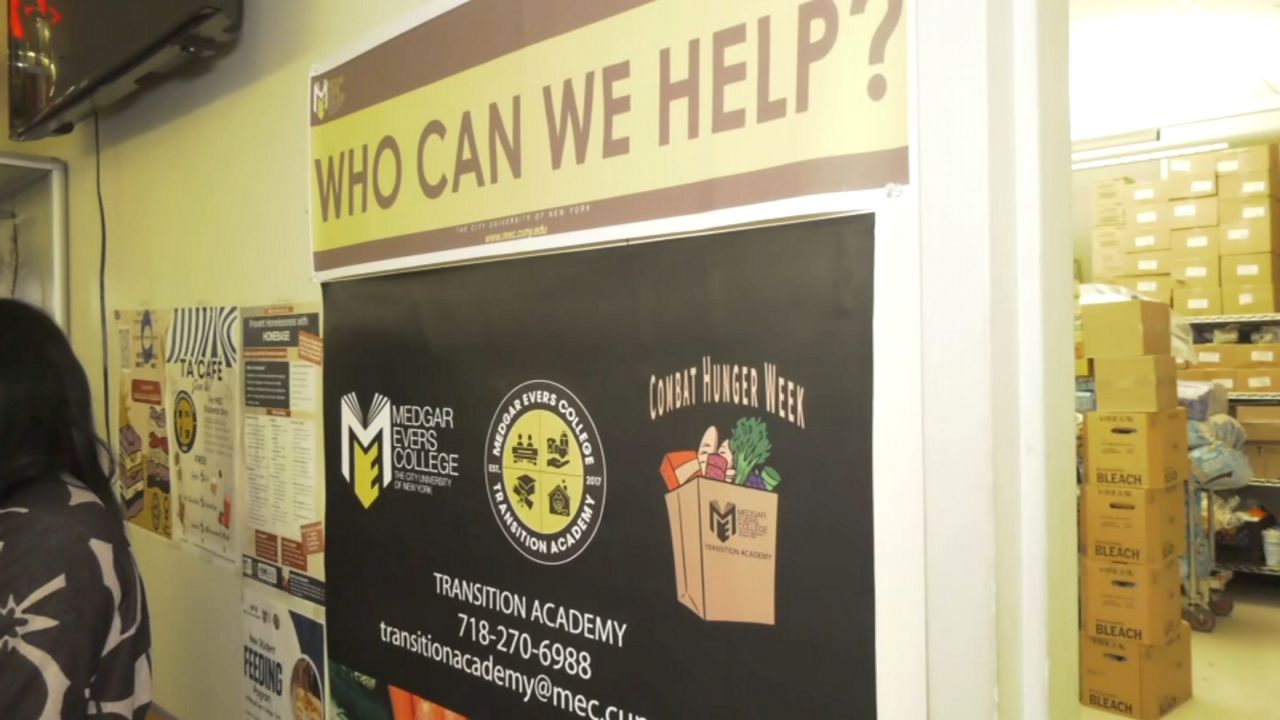
Some students walk into class wondering about their grades. Jahmarley Irving walks in wondering what he’ll eat.
“I rely on the pantry 1000 percent,” Irving said.
What You Need To Know
Half of all CUNY students rely on SNAP or Medicaid, which is more than 100,000 people
A 2022 study found 40% of CUNY students say they have low or very low food security
During the shutdown, food pantry lines stretched longer citywide, including at CUNY’s 25 pantries, many of which are supported by the Food Bank of New York City
Medgar Evers College created the Transitional Academy after discovering some students weren’t just hungry — they were homeless
When SNAP stalled during the shutdown, the stress at home showed up fast.
“The shutdown took a lot from me and my family,” he said.
Medgar Evers College created the Transitional Academy after discovering some students weren’t just hungry — they were homeless.
It’s a one-stop support center meant to help students without forcing them to repeat their trauma across multiple offices.
“The Transitional Academy was created to try to minimize them having to tell their story,” Director Waleek Boone said.
From that came Cougar Country Pantry, one of 25 CUNY pantries. Students shop once a week for free. The Food Bank of New York City supports many of them.
“College hunger has soared in the last 10 or 15 years,” Zac Hall, with the Food Bank for NYC, said.
And the scale is staggering. Half of all CUNY students rely on SNAP or Medicaid, which is more than 100,000 people. During the shutdown, pantry lines stretched longer citywide, including at the school’s pantries.
“College hunger was there before the shutdown and it’s going to be there tomorrow,” Hall said.
To keep up, Medgar Evers expanded hours, opened on weekends and gave students with active SNAP an extra $250 to buy groceries.
“A lot of times that we think about homelessness or food insecurity, that it looks a way. What we try to do is really destigmatize reaching out and needing help,” Jesse Kane, senior vice president of Student Success, said.
“I’d probably have to get a full-time job, on top of full-time school, if this was to really escalate,” Irving said.
A 2022 study found that 40% of CUNY students say they have low or very low food security — that’s about 110,000 students.