
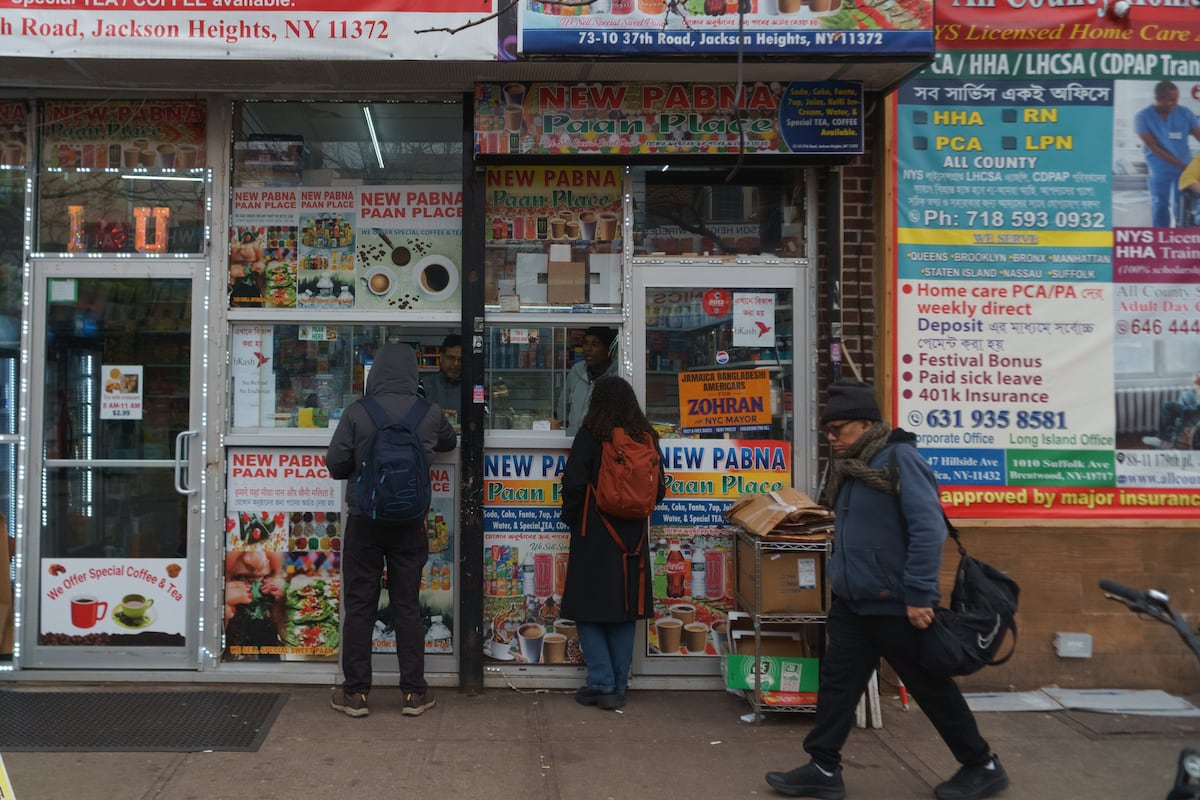
A section of Roosevelt Avenue in Queens is known as the “100 Languages” stretch. On this avenue, which runs through two of the most diverse neighborhoods — Jackson Heights and Elmhurst — in the most diverse borough in the United States, the accents and customs of more than 100 countries converge. Here, you might eat Colombian arepas for breakfast and Indian curry for dinner, business signs begin in one language and end in another, and on a cold November morning, the rhythm of Mexican cumbia blaring from a food truck parked near the 74th Street subway station blends with the conversation of a Nepalese couple strolling along the sidewalk.
Two weeks have passed since Democrat Zohran Mamdani’s historic victory in the New York City mayoral race. Posters bearing the mayor-elect’s face still hang in the restaurants and shops surrounding Diversity Plaza, where Roosevelt Avenue intersects Broadway in the so-called “World District.” From the window of one of these shops, next to a poster reading “Bangladeshi Americans for Mamdani,” a salesman, speaking a few words in Bengali and some English, recalls that Mamdani was here just a few days before the November 4 election.
It was the night of October 30. The 34-year-old Democratic socialist arrived at Diversity Plaza around midnight, after chatting with taxi drivers at LaGuardia Airport and visiting night-shift medical staff at an Elmhurst hospital. He had dinner at one of his favorite kebab shops on the corner of the square before holding a press conference surrounded by his supporters.
Mamdani made areas like this one in Queens a central focus of his mayoral campaign. Not only because he lives in the borough, but also because he understands that many of the issues that have dominated his career — diversity and immigrant communities, the working class, and “affordability” in a city with a skyrocketing cost of living — converge in neighborhoods like Jackson Heights, Elmhurst, and Corona.
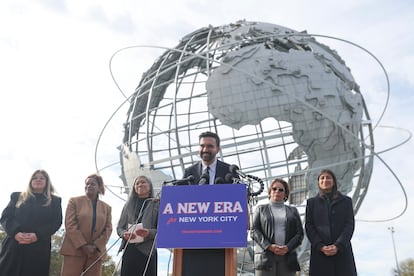 Zohran Mamdani at his first press conference as mayor-elect, at the Unisphere in Queens, on November 5.Heather Khalifa (AP)
Just hours after his election victory, which he celebrated in Brooklyn, the politician was back in Queens. He met with members of his transition team under the Unisphere, a 32-meter-tall stainless-steel globe built for the 1964 World’s Fair, which was held in the Corona neighborhood. Today, the structure is one of Queens’ most recognizable symbols. Mamdani said he chose the location for his first press conference as mayor-elect because it symbolized his pride in the borough. Afterward, he returned to Jackson Heights for lunch at a Nepali restaurant with New York Congresswoman Alexandria Ocasio-Cortez.
When he takes office on January 1, Mamdani — who was born in Uganda to Indian parents and has been a U.S. citizen since 2018 — will break more than one precedent. He will be the first mayor of New York City to live in Queens, the first to have previously represented the borough in public office (he was a member of the State Assembly in Albany), and the first Muslim mayor in the city’s history. He will also be the first immigrant to hold the position in nearly half a century.
For Shekar Krishnan, a member of the New York City Council, whose district includes three of the neighborhoods crossed by Roosevelt Avenue, it’s impossible to understand Mamdani’s victory without first understanding the cultural richness of Queens. “And you can’t tell the story of Queens without telling the story of Jackson Heights,” he points out by phone from City Hall.
In New York City, about 35% of its 8.5 million residents are immigrants. However, in Queens that percentage rises to almost 50% of a total of 2.3 million. And in neighborhoods like Jackson Heights, the immigrant population exceeds 60%. Mamdani won here, as well as in parts of Elmhurst and Corona, two other neighborhoods where more than half the population is immigrant.
 Premises on Broadway in Jackson Heights.Nicolas Lupo
More than 300 languages are spoken in the borough, and a third of them coexist on Roosevelt Avenue, according to the Alliance for Endangered Languages. In a stretch of about 20 blocks between Jackson Heights, Elmhurst, and Corona, you can travel the world without leaving New York City: you’ll hear Bengali, Nepali, Spanish, Punjabi, Tibetan, Urdu, Greek…
Krishnan, who has known Mamdani for years, says of his victory, “[It was] a statement of our values as a city, an affirmation of the importance of immigrant communities.” “His election illustrates how New Yorkers are united both in their desire for a more affordable city and in their desire for us to embrace and celebrate our diversity,” he says.
Krishnan was the first Indian-American elected to the New York City Council in history. He and Mamdani were both present at a taxi drivers’ strike in 2021, during which the now mayor-elect participated in a 15-day hunger strike alongside hundreds of other drivers protesting the debt they had accumulated after being subjected to predatory lending practices to pay for their licenses. Both were arrested during the protests, which culminated when the city agreed to a program that forgave millions of dollars in debt.
“I was drawn to that fight with Zohran precisely because we were fighting for our community,” Krishnan recalls. Many of those taxi drivers were immigrants and residents of Queens, and they joined Mamdani’s campaign four years later.
Trump’s birthplace
Now, as mayor of New York City, Mamdani will lead the Democratic resistance against Donald Trump. The Republican president has threatened to cut federal funding to the city in response to the socialist’s victory and has considered sending National Guard troops, as he has already done in other Democratic cities like Los Angeles, to enforce his immigration agenda. Mamdani, for his part, has made it clear that he will not be intimidated. In his victory speech on election night, he addressed the president directly, asking him to turn up the volume on his television to make sure he could hear him, and declared: “New York City will remain a city of immigrants, built by immigrants, and powered by immigrants. And, starting tonight, led by an immigrant.”
Theirs will be the battle of the two Queens, because the Queens of Mamdani or Krishnan — the migrant heart of the city — is also Trump’s birthplace. In fact, the president’s ties to the district go back to the beginning of the 20th century. His paternal grandparents, German immigrants, settled in Woodhaven, Queens, in the early 1900s. The president was born in the Jamaica neighborhood and grew up in the adjacent, affluent area of Jamaica Estates, just over six miles away but worlds apart from places like Jackson Heights or Elmhurst, which by then were already known for their growing diversity.
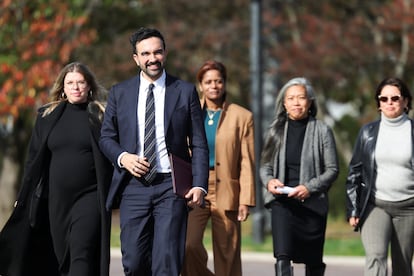 Mamdani with his transition team in Queens.Kylie Cooper (REUTERS)
In the 2024 presidential election, the Republican candidate garnered significant support in both neighborhoods, as well as in other areas of Queens with large immigrant populations. Although the Democratic candidate, Kamala Harris, won New York State, she did so by a considerably smaller margin than Joe Biden had in 2020. In Elmhurst and Corona, support for the Democrats then declined by 40%.
A year later, the vast majority of those same areas voted overwhelmingly for Mamdani. Although independent candidate and former New York Governor Andrew Cuomo — whom the president endorsed just days before the election — generally performed better among Trump voters, Mamdani managed to win back many predominantly immigrant areas in Queens.
For Jason Antos, the borough’s historian, it’s not a difficult paradox to understand. “It’s very Queens,” he says. The director of the Corona-based Queens Historical Society also argues that “many of the reasons people voted for Trump are the same reasons they voted for Mamdani,” starting with the high cost of living.
Antos explains that the borough has always been a destination for migrants, even since colonial times, when Europeans of various nationalities arrived attracted by the cheap land, which was also ideal for agriculture. Today, the borough’s diversity, in which “every country, even the smallest, is represented to some degree,” is due in part to the fact that it remained for years a more affordable place to live than Manhattan or Brooklyn. Many migrant communities displaced by the city’s gentrification have ended up in neighborhoods like Jackson Heights.
This reality, however, has been changing “over the last 20 years,” according to the historian. Rents and the cost of living have steadily increased in Queens, as they have in the rest of New York City. This issue was a central focus of both Trump’s 2024 campaign and Mamdani’s 2025 campaign. It was also a key factor in both of their victories.
State Assemblywoman Jessica González-Rojas, whose district includes Jackson Heights, says Mamdani won in these predominantly immigrant areas that supported Trump because he understood voters’ concerns. “Zohran really listened to the community, especially after the 2024 election. What he heard from them was that they were fed up with the politics of the past and were looking for something different. And the issue of affordability was something that really resonated,” she says by phone from Albany.
González-Rojas arrived at the State Assembly in 2021 alongside Mamdani, becoming the first Latina, of Puerto Rican and Paraguayan descent, elected to represent her district. She has known the mayor-elect for years and supported his candidacy for the City Council. She is confident that Mamdani’s administration will reflect the contradictions of neighborhoods like Jackson Heights, which can ultimately be seen as a mirror of the United States: an increasingly immigrant-based country struggling to make ends meet and seeking an alternative to “business as usual.”
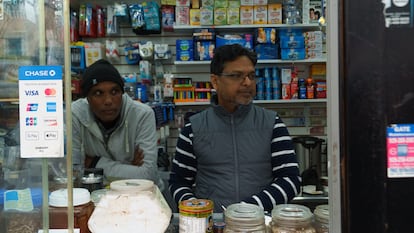 Vendors at a business in Diversity Plaza, New YorkNicolas Lupo
Back in Diversity Plaza, from his shop counter, the Bengali vendor smiles and recounts how he and his son voted for Mamdani. The reason? “Because change is needed,” he manages to reply.
Sign up for our weekly newsletter to get more English-language news coverage from EL PAÍS USA Edition