
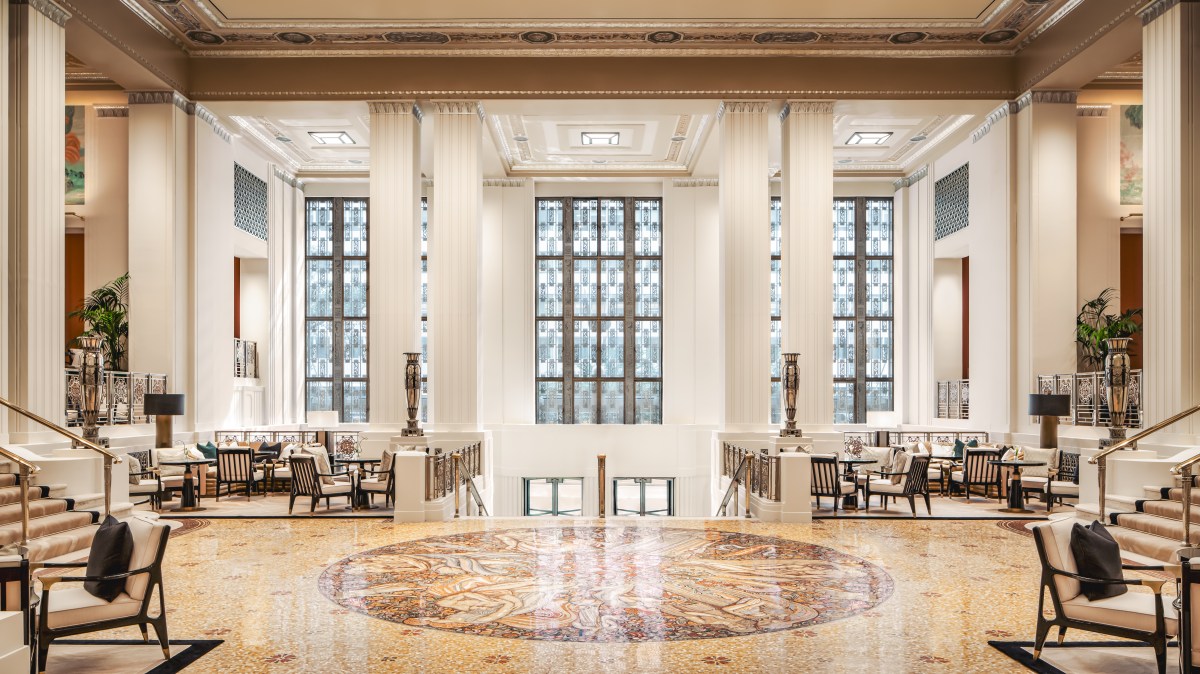
Some things just take longer than expected. When the Waldorf Astoria, that big beast of New York hotels, closed for renovation in 2017 the plan was for the work to take a couple of years, three max. Eight years later, after various boardroom shenanigans you probably didn’t notice, a pandemic you probably did, and a reported outlay of $1.5 billion (yeah, billion), those shiny brass doors on Park Avenue are revolving once again.
The art deco masterpiece is used to the drama. Every president from Hoover to Obama has stayed here. JFK supposedly first met Marilyn Monroe in its ballroom (the same ballroom in which Prince Rainier III of Monaco and Grace Kelly threw their engagement party). Frank Sinatra made one of the suites his New York base in the 1980s. And Conrad Hilton kept a magazine picture of it on his desk, vowing that he would one day own the hotel he deemed “the greatest of them all” — which he eventually did. In fact his great-granddaughters, those shrinking violets Paris and Nicky, spent much of their teenage years living here. Put simply, the Waldorf Astoria is a big deal.
At least, it was. Time marches on and the 20th-century thoroughbred had turned into a 21st-century also-ran. If not quite ready for the knacker’s yard, the 1,400-room behemoth seemed to have lost its lustre and its way. It had become something more utilitarian. Something, shudder, ordinary.
“We wanted to become a true luxury hotel again,” the hotel’s managing director, Luigi Romaniello, told me when I visited in October. “Because, let’s face it, it had become just another very big hotel.”
What you need to knowWhere is it? Midtown Manhattan, a seven-minute walk from Grand Central TerminalWho will love it? People who love art deco, hotels with stories and good old-fashioned luxuryInsider tip Be sure to try all the dishes invented (or at least popularised) at the hotel, including eggs Benedict, Waldorf salad and red velvet cake The revamp includes a huge new spa
To be fair, it is still a very big hotel. The 47-floor limestone and brick building, with its crowning pair of copper-topped towers, takes up a whole city block between Park and Lexington in Midtown Manhattan. And while the Guerlain Wellness Spa hadn’t quite opened when I visited, at 22,000 sq ft and with 16 treatment rooms it is the French brand’s biggest spa (60-minute treatments from £145; waldorfastorianewyorkspa.com). Boutique this place ain’t.
However, that feeling of true luxury, of classic New York glam, really does seem to be back. Uniformed doormen greet me by name as I arrive in the porte-cochère, a private covered driveway usually only found in the most expensive apartment buildings here. And later, in the Peacock Alley bar, my Manhattan cocktail slips down to the accompaniment of an excellent jazz trio, the pianist using a Steinway baby grand once owned by Cole Porter, another long-time resident (cocktails from £22).

Inside the Peacock Alley bar
Porter lived in one of the suites here for 30 years until his death in 1964 and is thought to have composed many of his hits on the Steinway, which he named High Society. You know the songs: Anything Goes, I Get a Kick Out of You and, of course, You’re the Top, which includes the superlative line “You’re the top, you’re a Waldorf salad”.
Trying the brasserie’s new version of the Waldorf salad
Whether the object of Mr Porter’s affection took kindly to being compared to the fruit and nut dish invented here is unclear, but the salad is still served in the hotel’s brasserie, Lex Yard. I can’t say I get a kick out of the new version by the big-hitting chef Michael Anthony, where the celery, apple, grapes and candied nuts are tossed in a lemon dressing, rather than the trad mayonnaise — like several of the dishes here, it feels overly fussy, with too many competing flavours (I’m at the Waldorf, keep it classy). But I’m assured the composition of the dish will vary with the seasons, so maybe I just need to come back when it’s snowing.
• Discover the best hotels, city breaks, road trips and things to do in the US
I am, however, impressed by Lex Yard itself. Not so much the upper of the two floors, which is a bit Dubai airport lounge in its opulent blandness and is where you will have an excellent breakfast (order the eggs Benedict, obviously, £29). More the main room downstairs, which is dark and cosy and a little bit sexy. Every hotel will fib and say its bar and restaurant attract as many locals as guests, but I could very well imagine trying to perk up a moribund marriage by digging out the Aramis and coming here for oysters and rib-eye (mains from £25; lexyardnyc.com).
Much better, at least as far as the food is concerned, is the other restaurant, Yoshoku, with its magnificent six-course “kaiseki-inspired” Japanese feast. The chef Ry Nitzkowski’s halibut meunière served with a ponzu beurre blanc, and wagyu with charred maitake mushrooms are absolute table-slappers. And the service here is outstanding. It’s just a pity that the tiny restaurant is shoved up some stairs by the Park Avenue entrance, in what feels like a fancy cloakroom (set menu from £143; yoshokunyc.com).

Inside the hotel’s Park Avenue One Bedroom Suite
JOE THOMAS
But I guess if you’re going to be closed for eight years you have to take a few gambles, make some bold decisions. Otherwise what’s the point? And the Waldorf Astoria has certainly been bold.
The whole place was gutted, with walls torn down and all 5,600 or so windows ripped out. Anything that wasn’t considered part of the core building or hadn’t been awarded official landmark status by the city (ie listed) was tossed. At one point during the renovation you could stand with your back to any exterior wall and see 60m straight through to the far end.
Those 1,400 rooms were trimmed down to 375 hotel rooms and 372 private residences. The hotel rooms are much larger than they used to be, with interiors designed by Pierre-Yves Rochon. They feel fresh, modern and modest, with subtle art deco detailing in the furniture and fittings, and luxurious bathrooms stocked with full-size bottles of Aesop products. Are the rooms a little bland? Perhaps. But they are also extremely comfortable. And despite, or maybe because of, the extravagance elsewhere, they feel wonderfully calm.
• Explore our full guide to New York
You know what, I told you a lie earlier: not all the windows were ripped out. The architects Skidmore, Owings & Merrill (SOM) found one on the 16th floor whose original painted steel frame had not been ruined by previous bodge-job refurbs, and it became the template to craft replacements for the others. That’s the level of detail that has gone into the project. The objective was to return the Waldorf Astoria to the grandeur of old, not build a new hotel. Restoration as much as renovation.
To make sure they got things right, SOM hit the archives at the Wolfsonian research centre in Florida, studying the drawings and plans of the first architects, Schultze and Weaver, whose building opened in 1931. Murals were cleaned and ugly panels were removed. Inside the busy Park Avenue entrance, the fabulous Wheel of Life floor mosaic by Louis Rigal was expertly restored. And for the Basildon Room, a remarkable third-floor function space, a single postcard helped to establish the original colour scheme and let the restorers know when to stop peeling off the layers of garish paint.
• 38 of the best hotels in New York City for 2025
A dramatic, feud-fuelled history
Not that the 1931 iteration of the hotel was really the original. That was about a mile away on Fifth Avenue. And it didn’t start as one hotel, but two, born out of a feud between members of one of America’s most fêted families.
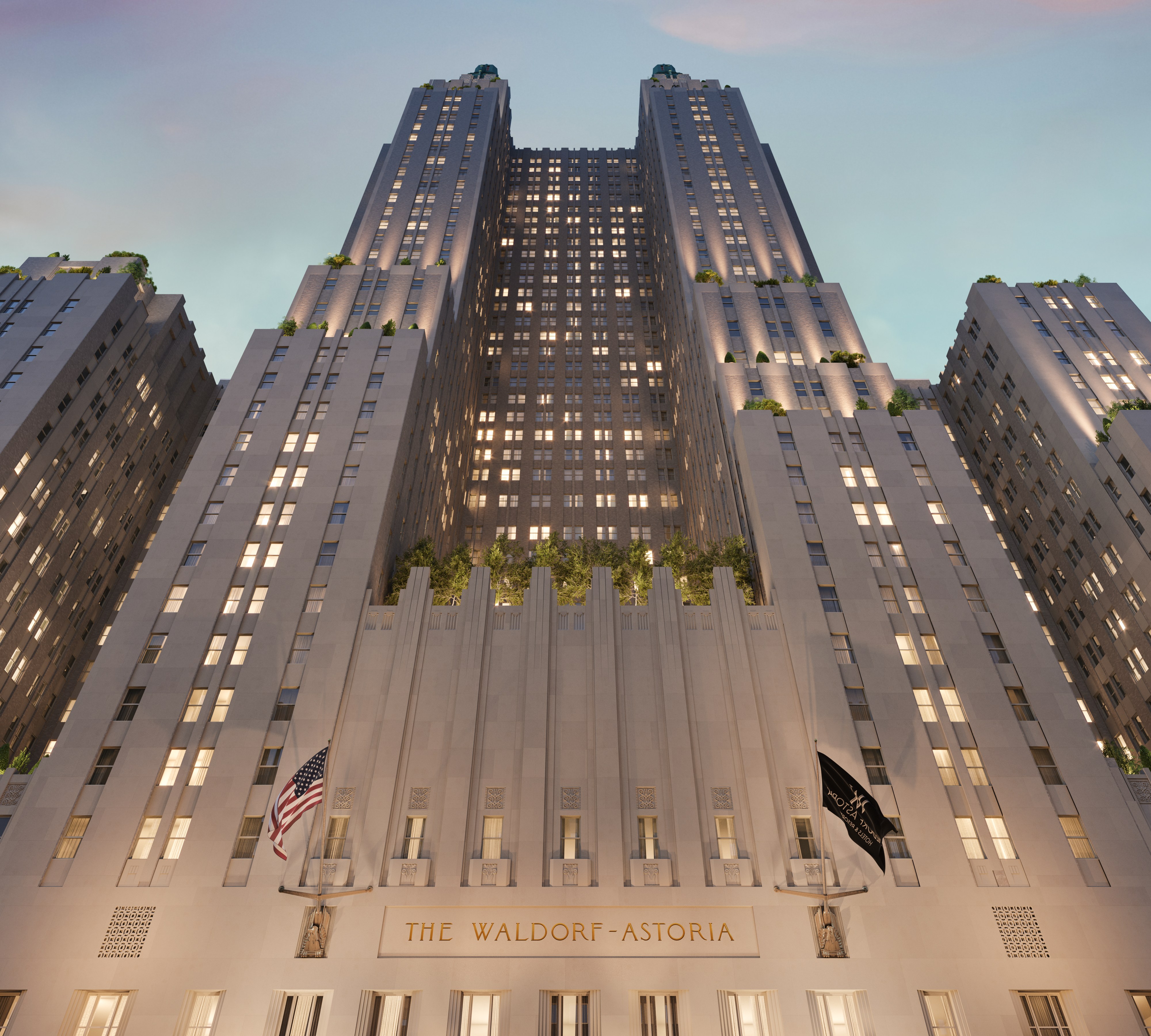
The Waldorf Astoria was completed in 1931 at its current location
When William Waldorf Astor decided to build his German renaissance-style Waldorf hotel, he chose the location primarily to annoy his aunt, who lived next door. It worked. The aunt had angered William by demanding to be known as “the” Mrs Astor (a name William thought his own wife should assume). She duly grew weary of the construction work and, once the hotel opened in 1893, the crowds. So she moved uptown. A few years later, her son, John Jacob Astor IV, hit back, building his own hotel, the Astoria, three storeys higher than the Waldorf, on the site of the mansion his mother had deserted.
Happily, the cousins soon made up and joined forces, building a corridor between the Waldorf and the Astoria and creating what was then the world’s biggest hotel, and the first to offer private baths in each room. It was also the first hotel to have a telephone in every room, inadvertently inventing room service. The great and the good of New York’s high society would flit between restaurants and parties at the two elegant spots, parading their finery as they walked through the corridor. Peacocking, in other words.
• This is where to find some of New York’s most spacious hotel rooms
In 1929 the hotel was sold and then demolished to make way for the Empire State Building, before reopening in a new building at its present location, a seven-minute walk from Grand Central Terminal and the Rockefeller Center.
Today, Peacock Alley, named after that corridor, has a cocktail list devised by the star mixologist Jeff Bell from Please Don’t Tell, a reservation-only speakeasy in the East Village that’s so cool you enter via a telephone booth in a grotty hot dog joint (cocktails from £12; pdtnyc.com). It serves not only as a bar, but also as a kind of roundabout, funnelling people towards the lifts, the lobby, the two restaurants and the outside world. And no matter where they are heading, and whether in sequins or Skechers, everyone stops to gawp at the 8ft clock in the middle of the roundabout.
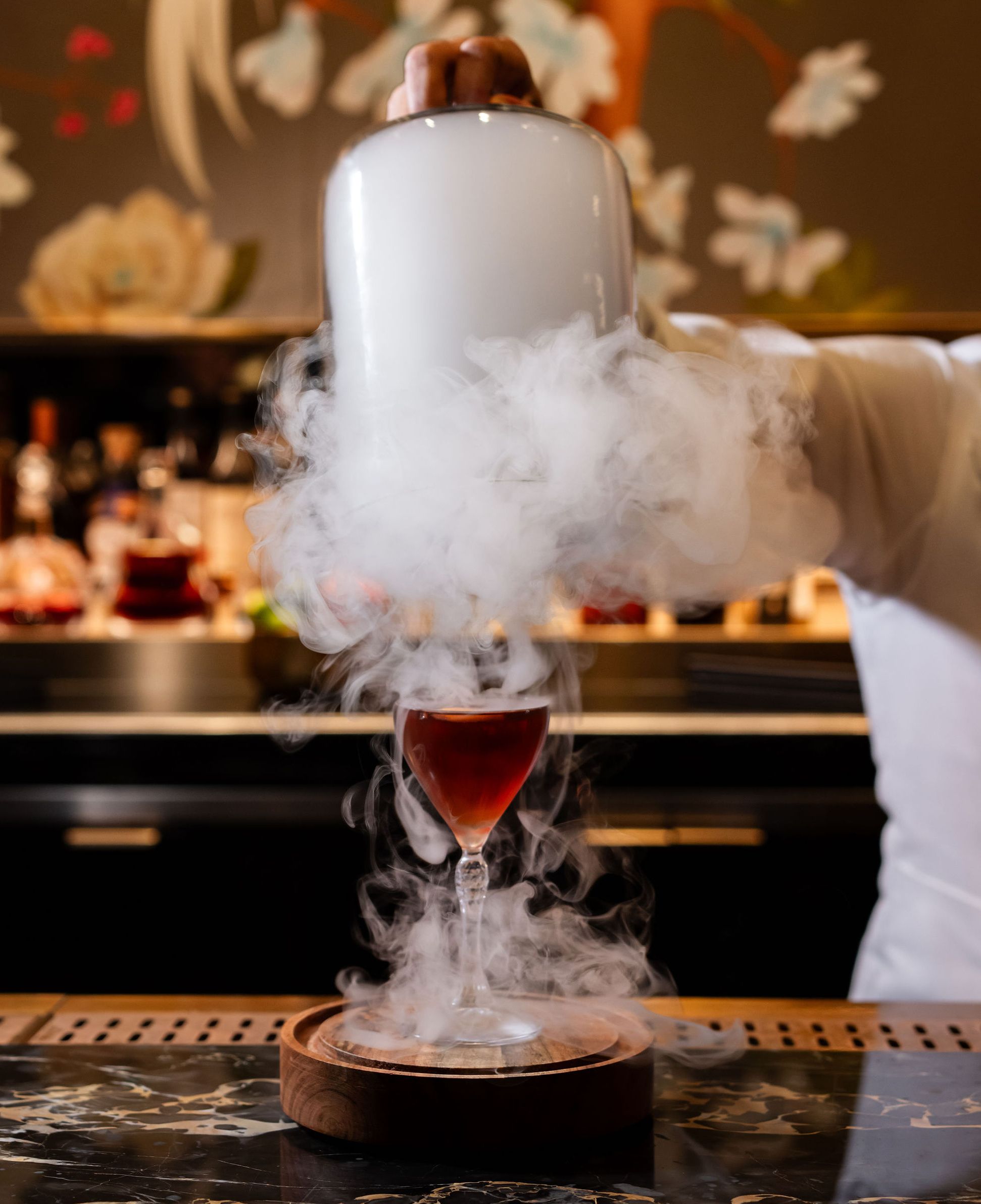
A cocktail being served at the Peacock Alley bar
JOE THOMAS
Commissioned by Queen Victoria for the 1893 Chicago World’s Fair, the four-faced clock features images of US presidents and is topped by a mini Statue of Liberty. After the fair, John Jacob Astor IV bought it and placed it in the lobby of his hotel, giving rise to the revellers’ refrain, “Meet me at the clock.”
With the clock fully restored and three of its four faces ticking nicely (the fourth, facing the bar, is always set to 5 o’clock), it is once more the place to meet. And this grand old hotel once again feels like the place to stay in New York. So cheers, Waldorf Astoria. Good to have you back. I’ll take a Manhattan.
Mike Atkins was a guest of the Waldorf Astoria New York, which has room-only doubles from £1,140 (waldorfastorianewyork.com). Fly to New York City