
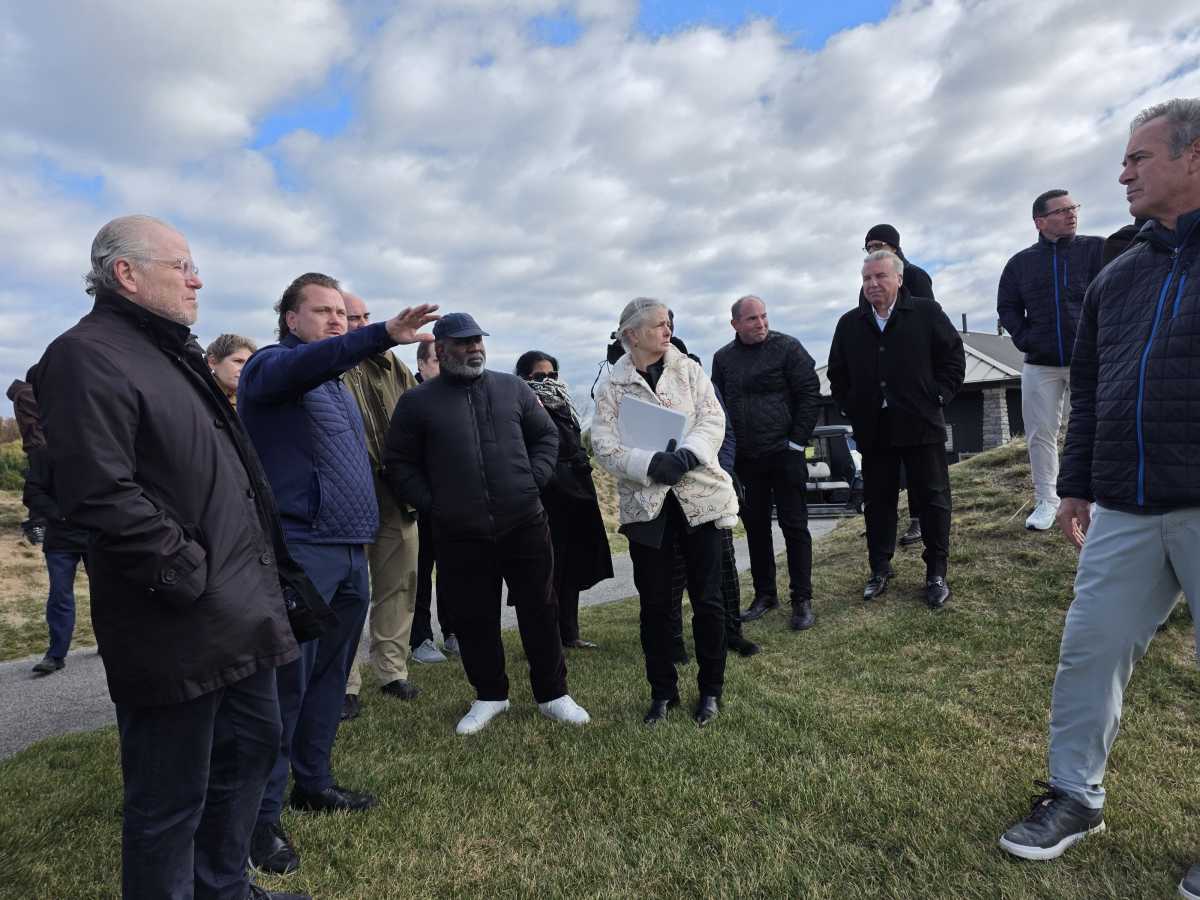
Members of the state Gaming Facility Location Board, who will soon decide on the fate of Bally’s and two other casino bidders, visit Ferry Point Park on Nov. 17 with Christopher Jewett, senior VP of corporate development (left, pointing), and Brian Crowell (right), PGA general manager.
Photo by Emily Swanson
Members of the state Gaming Facility Location Board, which holds the power to award up to three New York City area casino licenses, visited the sites of all remaining bids on Nov. 17 for a firsthand glimpse into each project’s potential impact on the neighborhood.
The 10-member group started their day at Bally’s Links in Ferry Point Park before proceeding to the proposed sites for Metropolitan Park in Flushing and Resorts World in Ozone Park, Queens.
In just weeks, the board is expected to announce a decision about which of these projects —if any— will receive a highly sought-after casino license.
Bally’s proposal to develop a casino and 500-room hotel in Ferry Point Park is one of just three New York City-area bids approved by their respective Community Advisory Councils (CACs)— a key final step that allowed them to proceed under state consideration.
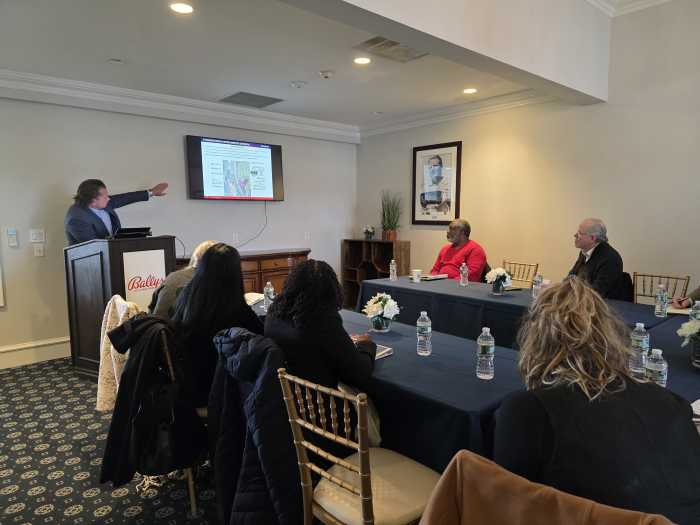 The Gaming Facility Location board toured all three potential casino sites on Nov. 17, starting at Bally’s at Ferry Point Park. Photo by Emily Swanson
Inside Bally’s River House at 450 Hutchinson River Parkway, board members heard a brief presentation from the development team, then hopped aboard golf carts to see the course and where the planned hotel-casino-entertainment complex would be located. They also boarded their charter bus for a loop around the site to get a sense of affected roadways and planned mitigation measures.
In the presentation, Christopher Jewett, Bally’s senior vice president of corporate development, noted that the meeting would likely provide many board members’ first opportunity to see the site in depth and visualize the planned development.
Jewett said the location was “ideal for multiple reasons,” including its proximity to major highways, bridges and LaGuardia airport and distance from neighboring homes.
“You intentionally have to come to this site, in terms of getting here from the local neighborhoods or from the highway, and we’re not in anyone’s backyard,” Jewett said.
He and others on the development team outlined planned improvements to Ferry Point Park, including a new pathway under the Whitestone Bridge to connect pedestrians and cyclists to the east and west sides of the park.
The parkland improvements — which focused solely on Ferry Point Park, at the request of the Bronx CAC — were finalized last week, Jewett said. The company plans to invest $100 million in such improvements, according to Bally’s application.
Developers also briefed the board on plans for a bridge over Hutchinson River Parkway designed to mitigate traffic volume. They showed several diagrams to orient board members as to where the parking garage, casino, hotel entrance and other parts of the $4 billion complex would be located and where guests would enter off the highway via car or public transit.
Two new MTA stops are in the works, but exact locations have not yet been finalized and Bally’s plans to offer shuttles for employees and guests using public transit, Jewett said.
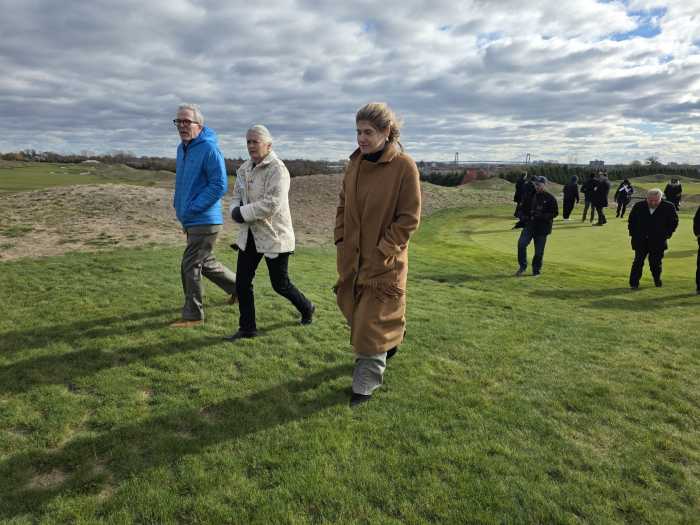 Members of the Gaming Facility Location Board toured the golf course to envision how the potential Bally’s casino complex would be situated on the parkland. Photo by Emily Swanson
Brian Crowell, PGA general manager, led the golf cart tour amid blustering winds, stopping at high points that show off the course’s expansive views of the East River, Manhattan skyline and Whitestone and Throggs Neck Bridges.
Crowell said Bally’s Links already attracts the biggest names in golf and that a casino complex would further improve its visibility and boost the economy.
Having onsite accommodations and parking would open up Bally’s to hosting major golf tours, Crowell told the group. “Where we could accommodate players for a major tour was always a factor in the past. So to have that ability to have rooms on the property would set us apart.”
The company projects that the Bally’s resort-casino, if approved, would attract 9.3 million visitors per year, with the vast majority coming from outside the Bronx.
The economic impact of gaming, sales and hotel taxes, employment and other aspects of the development’s creation and operation would likely be significant. Bally’s projects an annual economic impact of $1.5 billion for the Bronx and $1.9 billion for New York State, plus committed to a $765 million benefits package for the East Bronx community that would provide long-term investment in schools, sports teams, organizations, infrastructure and more.
However, the surrounding community appears divided on whether Bally’s is a good bet. The project’s land use application was rejected by Community Board 10 last spring, and Council Member Kristy Marmorato has remained staunchly opposed throughout the long approvals process but she was recently voted out of office.
Local opposition in the Bronx has not reached the level of the Metropolitan Park project, in which Mets owner Steve Cohen has proposed to a casino and retail complex on a 50-acre Citi Field parking lot. On Nov. 16, nearly 1,000 residents protested the bid outside the Queens Public Library in Flushing, marking a larger anti-casino presence than has been seen thus far in the Bronx.
Despite some local opposition, Bally’s has received strong support from many key elected officials, from the East Bronx Assembly and Senate to Borough President Vanessa Gibson to Mayor Eric Adams. But since the licensing power lies solely with the state, all eyes are on the Gaming Facility Location Board, and a decision is expected before the end of 2025.
Reach Emily Swanson at eswanson@schnepsmedia.com or (646) 717-0015. For more coverage, subscribe to our newsletter and follow us on Twitter, Facebook and Instagram!